







The global IT staffing market is expected to hit over $82 billion by 2027. This shows a big move towards using outside talent for IT needs. With technology changing fast, companies must choose between boosting their IT skills or outsourcing to meet their tech needs.
It’s key to know the differences between these two strategies. Both can help fill gaps in internal skills, but they have different ways of doing things. They also have different good points and not-so-good points.
Table of Contents
Key Takeaways
- Understanding the growing demand for external IT talent.
- Differences between IT resource augmentation and outsourcing.
- Benefits and drawbacks of each strategy.
- Factors to consider when choosing between augmentation and outsourcing.
- Impact on business operations and IT capabilities.
1. The Strategic Dilemma in IT Staffing Solutions
As cloud adoption grows, companies face a big challenge in figuring out their IT staffing needs. Over 70% of organizations plan to use cloud services by 2025. This means they need flexible IT talent.
This change has led to a strategic dilemma in IT staffing. Businesses must choose the right staffing model to meet their tech needs.

The strategic dilemma comes from balancing control over IT projects and using outside expertise. Experts say, “The key to successful IT staffing is knowing the differences between staffing models and their impact on business.” For companies, IT staff augmentation could be a good choice.
Choosing the right staffing model is crucial for IT success. It means looking at the pros and cons of each approach. Then, pick the one that fits your business goals.
The IT staffing choice greatly affects a company’s ability to keep up with tech changes. It also impacts their competitiveness in the market.
2. What is IT Resource Augmentation?
IT resource augmentation is a smart way to manage IT staffing. It brings in outside experts to join a company’s team. This way, businesses can tackle specific projects or cover temporary IT gaps without the long-term commitment of hiring full-time staff.

2.1 Defining Staff Augmentation in Modern IT
Staff augmentation in modern IT means adding external IT pros to a company’s team. It lets businesses get specialized skills and expertise for specific projects. This boosts their ability to handle complex IT tasks.
2.2 How Resource Augmentation Models Operate
Resource augmentation models connect businesses with a pool of vetted IT pros. Companies pick the talent they need for projects. The provider handles recruitment, onboarding, and compliance, so the business can focus on the project.
2.3 Types of IT Staff Augmentation
There are several types of IT staff augmentation, each for different needs:
2.3.1 Short-Term Augmentation
This is great for short projects or immediate skill needs. It offers flexibility and quick talent access.
2.3.2 Long-Term Augmentation
For ongoing projects or constant skill gaps, long-term augmentation is a stable choice. It helps companies keep a steady IT capability.
2.3.3 Highly-Skilled Expert Augmentation
This brings in specialized pros for complex or unique tasks. It’s perfect for innovation projects or when rare skills are needed.
IT resource augmentation is flexible and scalable. It’s a great choice for businesses that need to quickly adapt to IT demands.
3. What is IT Outsourcing?
IT outsourcing is when companies choose to outsource their IT tasks to outside vendors. This choice helps businesses use the skills of experts and save money. It can also make operations more efficient.
3.1 Understanding IT Outsourcing Fundamentals
IT outsourcing means giving a specific task or function to a vendor. They are fully responsible for the outcome. Services can range from software development to cybersecurity.
3.2 Primary Outsourcing Delivery Models
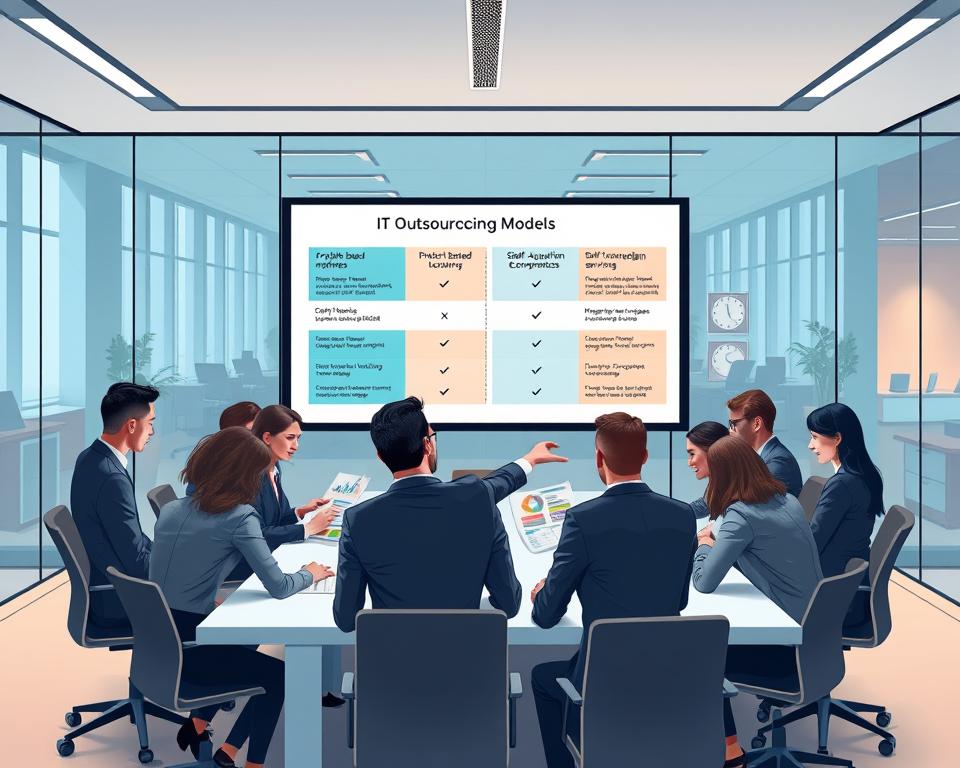
There are several ways to outsource IT, each suited for different needs. The main models are:
- Project-Based Outsourcing: A vendor is hired for a specific project with a set budget and timeline.
- Dedicated Team Outsourcing: A vendor gives a team to work on a project for a long time.
- Managed Services Outsourcing: A vendor manages a company’s IT needs on an ongoing basis.
3.2.1 Project-Based Outsourcing
Project-based outsourcing is great for one-off tasks. It’s flexible and can save money.
3.2.2 Dedicated Team Outsourcing
Dedicated team outsourcing gives a team of experts for a project. It’s good for long-term needs.
3.2.3 Managed Services Outsourcing
Managed services outsourcing means constant IT management. It keeps IT performance and security high.
4. Key Structural Differences Between the Two Models
It’s key to know the differences between IT resource augmentation and outsourcing. These differences affect how you manage your IT projects. The main difference is who has control and who is responsible for the project.
4.1 Management and Oversight Authority
In IT resource augmentation, the client has full control over the staff they hire. They decide what tasks to assign, how to direct the project, and how to evaluate performance. Outsourcing, on the other hand, means giving control to the service provider. They are then in charge of completing the project.

4.2 Team Integration Approaches
How teams work together is different in each model. In IT resource augmentation, the new staff members join the client’s team. This helps everyone work together better. Outsourcing, however, means working with a separate team. They have their own manager and communicate through set channels.
4.3 Responsibility and Accountability Distribution
Who is responsible for the project’s success is also different. In IT resource augmentation, the client is in charge. They are accountable for the project’s success. Outsourcing means the service provider is responsible. They are accountable for the project’s outcome.
As Michael H. Correll, CIO of a leading tech firm, once said,
“The choice between IT resource augmentation and outsourcing is not just about cost; it’s about control, expertise, and strategic alignment.”
This shows why it’s important to understand these differences. It helps make choices that fit your company’s goals.
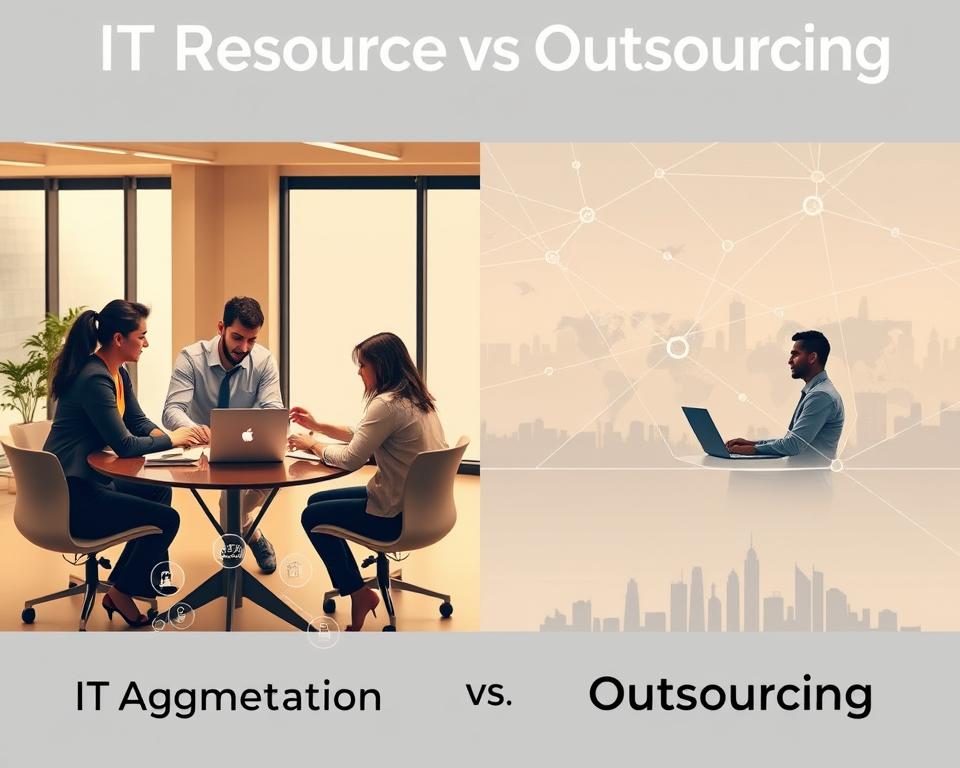
5. IT Resource Augmentation vs Outsourcing – Full Comparison
IT resource augmentation and outsourcing have big differences. They vary in control, flexibility, and access to special skills. Knowing these differences helps businesses choose the best IT solution for them.
5.1 Direct Control Over Resources and Processes
IT resource augmentation lets businesses have direct control over resources and processes. They can manage the augmented staff like their own employees. This means they can oversee project details and how it’s done.
Outsourcing, however, means giving up direct control. The service provider manages the project or process based on what’s agreed upon.
5.2 Engagement Duration and Commitment Flexibility
The engagement duration and commitment flexibility are different in each model. Staff augmentation lets businesses adjust their team size as needed. This flexibility is great for changing project demands.
Outsourcing, while flexible, often requires longer commitments. It also comes with more strict contract terms.
5.3 Access to Specialized Skills and Talent Networks
Both models offer access to specialized skills, but in different ways. IT resource augmentation connects businesses with skilled professionals for specific projects.
Outsourcing, however, gives access to a wide range of services and expertise. This can offer a more complete solution through one vendor.
5.4 Communication Channels and Reporting Lines
Communication channels and reporting lines are clearer in staff augmentation. Augmented staff usually report directly to the client’s management.
In outsourcing, communication goes through the vendor’s project management. This can make reporting more complex.
In conclusion, choosing between IT resource augmentation and outsourcing depends on what a company needs. It’s about control, flexibility, and access to special skills. By understanding these differences, businesses can make choices that fit their goals.
6. Advantages of IT Resource Augmentation
IT resource augmentation helps businesses blend external resources with their teams smoothly. This method brings many benefits that boost a company’s IT skills and project success.
6.1 Maintaining Direct Control and Agility
One big plus of IT resource augmentation is keeping direct control over IT projects and resources. This control lets companies quickly adapt to project changes. It keeps them agile in a fast-paced market.
6.2 Facilitating Knowledge Transfer to Internal Teams
IT resource augmentation makes it easy to share knowledge from outside experts with internal teams. This sharing boosts the skills of the internal team. It also helps the company keep valuable knowledge even when the extra resources are gone.
6.3 Seamless Cultural and Operational Integration
When done right, IT resource augmentation makes it easy for external resources to fit in with the team. This integration is key for making sure the extra staff works well with the team. It helps improve project results.
6.4 Flexibility in Scaling Team Size
Another big plus is the flexibility to change the IT team’s size as needed. This flexibility lets companies adjust to project changes without being stuck in long-term deals.
| Advantages | Description | Benefits |
|---|---|---|
| Direct Control | Maintain control over IT projects and resources | Enhanced agility and responsiveness |
| Knowledge Transfer | Transfer expertise from external to internal teams | Retained expertise and enhanced internal capabilities |
| Operational Integration | Seamless integration of external resources | Improved project outcomes and team cohesion |
| Scalability | Flexibility to scale team size as needed | Adaptability to changing project demands |

7. Disadvantages of IT Resource Augmentation
IT resource augmentation has its downsides. It brings flexibility and specialized skills but also new challenges. Organizations must tackle these issues.
7.1 Increased Management and Supervision Requirements
One big problem is the increased management and supervision requirements. Adding external staff to teams is complex. It needs extra work from managers to keep everyone working well together.
7.2 Administrative and HR Overhead
There’s also administrative and HR overhead with IT resource augmentation. Dealing with contracts, paying augmented staff, and following company rules adds to the work. It can take away from the main business tasks.

7.3 Onboarding Time and Productivity Ramp-Up
Another big issue is the onboarding time and productivity ramp-up for new staff. Getting new team members up to speed takes time. This can slow down projects and affect schedules.
To see how IT resource augmentation compares to other options like managed services, check out Next Big Technology.
In summary, IT resource augmentation has many benefits. But, it’s important for companies to know the downsides. These include more management work, extra administrative tasks, and challenges in getting new staff up to speed. This helps make better choices.
8. Advantages of IT Outsourcing
IT outsourcing brings many benefits to a company’s operations and finances. It lets businesses focus on what they do best. This can make them more productive and competitive.

8.1 Minimized Internal Management Burden
One big plus of IT outsourcing is less internal management work. By handing over IT tasks to a third party, companies can free up their teams. They can then focus on important business goals.
8.2 Leveraging Established Methodologies and Frameworks
IT outsourcing lets businesses use established methodologies and frameworks they might not have the resources for. Outsourcing providers bring their know-how to the table. This ensures projects are done well and efficiently.
Experts say, “Outsourcing IT services lets companies use the latest tech and best practices without big upfront costs.” This shows how outsourcing can keep businesses ahead.
8.8 Rapid Scalability and Infrastructure Access
Outsourcing IT services helps companies grow quickly when needed. This is great for times of expansion or unexpected issues. For more on boosting productivity through outsourcing, check out Next Big Technology.
8.4 End-to-End Project Accountability
Outsourcing IT projects means companies get end-to-end project accountability. The provider is in charge of delivering the project on time and to the right standards. This reduces risks and gives businesses confidence in their projects.
9. Disadvantages of IT Outsourcing
IT outsourcing has many benefits, but it also has big downsides. Knowing these downsides is key to smart IT planning.
Reduced Operational Visibility and Control
One big worry with IT outsourcing is losing control and visibility. When outside vendors handle IT, it’s hard to keep an eye on things. This can lead to problems with quality and following rules.
Key challenges include:
- Limited insight into vendor operations
- Difficulty in enforcing internal standards and policies
- Potential for misaligned priorities between the organization and the vendor
Communication Barriers and Time Zone Complexities
Good communication is vital in any partnership, especially in IT outsourcing. But, time zone, language, and cultural differences can cause big problems. These can lead to misunderstandings and delays.
“The biggest risk in outsourcing is not the outsourcing itself, but the loss of control over the outsourced activity.” –
Potential Knowledge Loss and Vendor Dependency
Outsourcing IT can mean losing valuable knowledge and skills. This makes companies rely too much on their vendors. This reliance is risky, especially if the vendor faces money troubles or if the company needs to change vendors.
| Disadvantage | Description | Potential Impact |
|---|---|---|
| Reduced Operational Visibility | Limited oversight of outsourced IT functions | Quality and compliance issues |
| Communication Barriers | Differences in time zones, languages, and cultures | Misunderstandings and project delays |
| Knowledge Loss and Vendor Dependency | Loss of internal IT expertise and reliance on vendors | Increased risk and reduced flexibility |

In summary, IT outsourcing has its benefits, but we must also think about its downsides. By understanding these risks, companies can make better choices and find ways to overcome these challenges.
10. Cost Analysis and Budget Considerations
When it comes to IT, the cost of hiring and outsourcing is key. Knowing the costs helps decide the best choice for a company. A detailed cost analysis is needed to see how each option affects the budget.
10.1 Resource Augmentation Pricing Structure
Resource augmentation means hiring IT pros for a set time or rate. This model lets companies adjust their IT team as needed. It’s flexible and fits project demands.
10.1.1 Hourly and Monthly Rate Models
The hourly rate is good for projects with changing needs. The monthly rate works better for longer projects. Both need careful planning based on project length.
10.1.2 Associated Administrative Costs
There are more costs than just hiring IT pros. Companies must also think about recruitment, onboarding, and HR costs. These add up and affect the overall cost.
10.2 Outsourcing Cost Framework
Outsourcing has its own pricing, like fixed price and time and materials. Knowing these is key for budgeting.
10.2.1 Fixed Price vs. Time and Materials
Fixed price contracts are predictable, with a set cost upfront. Time and materials billing is flexible but can change costs. Companies must consider the pros and cons of each.
10.2.2 Setup and Transition Expenses
Outsourcing also has setup and transition costs. These include transferring knowledge and adjusting infrastructure. These should be included in the cost analysis.
10.3 Total Cost of Ownership Comparison
When looking at resource augmentation and outsourcing, total cost is important. This includes direct costs, administrative expenses, and extra fees. It’s crucial for making a fair comparison.
| Cost Component | Resource Augmentation | Outsourcing |
|---|---|---|
| Direct Costs | Hourly/Monthly Rates | Fixed Price/Time and Materials |
| Administrative Costs | Recruitment, Onboarding, HR Overhead | Setup, Transition Expenses |
| Total Cost of Ownership | Variable, Depending on Project Scope | Can be Predictable (Fixed Price) or Variable (Time and Materials) |
For more on staff augmentation and outsourcing, check out NeonTri’s blog.
11. Optimal Use Cases for IT Resource Augmentation
In the fast-changing world of IT, resource augmentation is a flexible staffing solution. It helps organizations quickly adapt to new project needs or skill demands.
11.1 Addressing Temporary Skill Shortages
One key use of IT resource augmentation is to solve temporary skill shortages. Companies can add experts with the needed skills for a project. For example, they might need data scientists or cloud computing specialists for a short project. This way, they can fill gaps without hiring long-term.
11.2 Adding Specialized Expertise to Existing Projects
IT resource augmentation brings specialized expertise to ongoing projects. It boosts capabilities and improves results. For instance, a company might add experts in app development to meet new standards and user needs.
11.3 Expanding Development Capacity During Peak Periods
During peak periods, businesses can grow their development team. This helps handle more work without losing quality or meeting deadlines. It’s great for managing busy times or sudden demand increases.
11.4 Testing New Technologies Before Full Commitment
Another good use of IT resource augmentation is testing new tech. Companies can try out new approaches with experts. This helps them decide if it’s worth investing in the future.
Understanding these use cases helps organizations use IT resource augmentation well. It boosts their IT skills, project success, and keeps them competitive.
12. Optimal Use Cases for IT Outsourcing
Outsourcing IT services lets companies focus on what they do best. It’s great when you need special skills or to grow fast.
Full-Cycle Software Development Projects
For full-cycle software projects, outsourcing is a top choice. It means getting a complete solution from start to finish. This way, companies get top-notch software without the hassle.
Non-Strategic IT Operations and Maintenance
Outsourcing routine IT tasks is smart. It frees up your team to work on big projects. Meanwhile, experts handle the day-to-day stuff.
Accelerated Market Entry Initiatives
Want to get to market fast? Outsourcing IT can give you the tech you need quickly. It’s perfect for launching new products or services.
24/7 Support and Operations Requirements
Need support all day, every day? Outsourcing to 24/7 vendors keeps your services running smoothly. It’s great for businesses that can’t stop.
| Use Case | Benefits |
|---|---|
| Full-Cycle Software Development | End-to-end solutions, high-quality delivery |
| Non-Strategic IT Operations | Focus on strategic initiatives, reduced operational burden |
| Accelerated Market Entry | Rapid deployment, reduced time-to-market |
| 24/7 Support and Operations | Continuous service delivery, around-the-clock support |
13. Decision Framework: Choosing the Right Model
Choosing between IT resource augmentation and outsourcing is a big decision for businesses. They must think about several important things. These include how well they can manage, the project’s size, their goals, and how much risk they can handle.
13.1 Evaluating Internal Management Capacity
It’s important to check if a company can handle more resources. They should look at their leadership team’s workload and the current team’s tasks. Good management is crucial for adding staff or handling outsourced work.
13.2 Analyzing Project Scope and Complexity
The project’s size and complexity matter a lot. Simple projects with clear needs might be better for outsourcing. But, projects that need to change a lot might do better with IT resource augmentation. Knowing the project well helps pick the right model.
13.3 Aligning with Strategic Business Goals
It’s key to match the chosen model with the company’s goals. Companies should think if the project is very important or just a little part of what they do. Outsourcing might be good for things that aren’t core. But, IT resource augmentation could be better for projects that need to work closely with the team.
13.4 Assessing Risk Tolerance and Control Needs
Looking at how much risk a company can take and how much control they need is important. Companies that don’t like taking risks might choose outsourcing. But, those who want more control might prefer IT resource augmentation. Knowing how much risk you can handle helps make a good choice.
13.5 Practical Decision Matrix
Using a decision matrix can make choosing easier. It helps by looking at things like project size, control needs, and risk tolerance. A good matrix can help businesses decide between IT resource augmentation and outsourcing.
By looking at these factors and using a framework, businesses can make a choice that fits their goals and needs.
14. Industry-Specific Applications and Considerations
When it comes to IT, different industries have their own needs. This affects whether to use IT resource augmentation or outsourcing. Each field has its own set of challenges and requirements.
Healthcare and Life Sciences Technology
In healthcare and life sciences, data security and compliance are top priorities. IT resource augmentation offers specialized skills for handling complex IT projects. It also helps keep sensitive data safe.
Financial Services and Banking Systems
The financial world needs highly secure and scalable IT solutions. Outsourcing is good for banks and financial firms. It helps manage IT and meet strict rules.
E-commerce and Retail Platforms
E-commerce sites face ups and downs in demand. Scalability is key. IT resource augmentation lets e-commerce companies grow their teams fast when needed.
Manufacturing and Supply Chain Software
In manufacturing, efficient supply chain management is vital. Outsourcing offers complete IT solutions for complex supply chains. It boosts overall efficiency.
15. Conclusion
Choosing between IT resource augmentation and outsourcing depends on several factors. These include control needs, project scope, and strategic business goals. It’s crucial to understand the differences between these models to make an informed decision.
IT resource augmentation is great for projects needing specialized skills and temporary support. It offers flexibility and direct control. Outsourcing, on the other hand, is a comprehensive solution for managing entire projects or non-strategic IT operations. It uses established methodologies and frameworks.
Organizations should evaluate their internal management capacity, project complexity, and business objectives. This helps determine the best model. The right choice between IT resource augmentation and outsourcing helps businesses optimize their IT strategies. It enhances operational efficiency and drives growth.