






Moving digital assets to a new team marks a major milestone for any growing business. During a software project transfer, keeping operational control remains your top priority. You want to protect your vision while gaining a global partner’s efficiency.
A skilled Indian development company can help you scale operations. Success requires more than moving code between servers. Manage contracts, infrastructure, and communication carefully to keep your team aligned.
Effective planning supports a smooth transition. Focus on documentation, security protocols, and thorough testing to keep your product launch-ready. This guide covers key steps that protect your investment and support long-term growth.
Table of Contents
Key Takeaways
- Prioritize clear communication channels to maintain operational control.
- Develop comprehensive documentation before initiating the migration.
- Establish robust security protocols to protect your intellectual property.
- Focus on thorough testing phases to ensure launch readiness.
- Align your business goals with the expertise of your new partners.
What to Clarify Before You Transfer Your Software Project
Strategic planning supports a smooth software project transfer to an offshore team. Your internal stakeholders must agree on why you are making the move. This preparation prevents confusion and gives your product a clear path forward.

Define the Business Goals for the Transition
Every successful migration starts with clear business goals. Are you reducing operating costs, or do you need to expand engineering capacity quickly? These goals help you select the right engagement model for your needs.
Decide whether you need product stability or a major feature overhaul. Clear goals help new partners focus resources on your long-term vision.
Identify the Current Project Status and Critical Risks
Before starting a software project transfer, honestly review your existing codebase. Find hidden technical debt, outdated dependencies, and missing documents that could delay onboarding.
Recognizing risks early helps you build a mitigation plan. Transparency about the current project status keeps the incoming team ready for legacy issues and complex architectural bottlenecks.
Set Success Criteria for the Indian Development Team
To measure your software project transfer, establish clear, measurable success criteria. These metrics should cover more than delivery dates and measure output quality.
Consider tracking these indicators to keep your partnership productive:
- Delivery Predictability: The ability of the team to meet sprint commitments consistently.
- Defect Density: The number of bugs found in production relative to the volume of new code.
- Knowledge Retention: How quickly the team masters your specific business rules and domain logic.
Setting these measurable expectations creates accountability. This plan builds collaboration, so your U.S. team and Indian partners can succeed together.
How to Transfer Software Project to Indian Development Company
Choosing the right partner is the most important step in outsourcing software development. Your transition depends on how well the partner matches your needs and long-term vision. Thorough technical due diligence can reduce risks and support a smooth handoff.

Choose Between Staff Augmentation, Dedicated Teams, and Full Project Handoffs
First, understand each engagement model and its level of control. Each model gives your Indian development company different duties and responsibilities.
- Staff Augmentation: You add individual developers to your existing team to fill specific skill gaps.
- Dedicated Development Team: You hire a full, autonomous team that works exclusively on your project under your guidance.
- Full Project Handoff: You outsource the entire lifecycle, including management, design, and delivery, to an external partner.
Evaluate Indian Development Companies for Technical and Domain Fit
Technical skill alone is not enough; your partner must understand your industry. Seek firms with successful solutions in fintech, healthcare, or e-commerce.
Review their internal processes to see whether they meet your quality standards. A strong partner should know your tech stack and give clear examples of solving complex architecture problems.
Verify References, Security Practices, and Delivery Experience
Do not skip verification. Ask past clients about the company’s communication style and ability to meet deadlines.
Also, confirm that the firm follows strict security protocols. It should protect data, intellectual property, and code through clear, secure management policies.
Compare Pricing Models, Time-Zone Coverage, and Contract Terms
Compare more than hourly rates when reviewing potential partners. Consider total value, working-hour overlap, and flexible contract terms.
| Model | Control Level | Best For |
|---|---|---|
| Staff Augmentation | High | Scaling existing teams |
| Dedicated Team | Medium | Long-term product growth |
| Full Handoff | Low | Turnkey project delivery |
Make sure the contract defines payment milestones and acceptance criteria clearly. A transparent agreement builds a healthy, long-term relationship with your dedicated development team.
Build a Complete Project Transfer Checklist
Organizing your technical assets into a clear project handoff checklist helps ensure a smooth transition. Breaking the ecosystem into manageable parts helps prevent missed components.
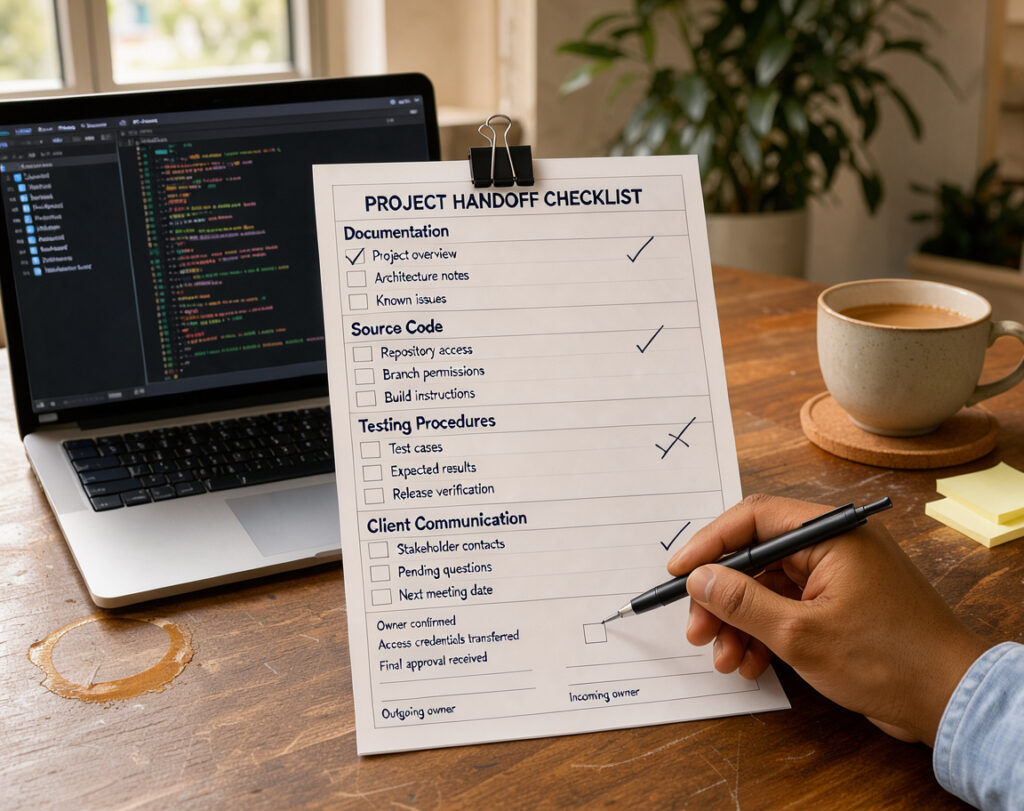
List the Codebases, Services, Environments, and Dependencies
Map every part of your infrastructure first. Identify active repositories, cloud services, and third-party integrations that keep your application running.
- Primary and secondary code repositories.
- Cloud hosting environments (staging, production, and development).
- External APIs and third-party service dependencies.
- Configuration files and environment variables.
Document Product Requirements and Business Rules
Technical code tells only half the story. The new team also needs to understand the business logic behind your product features.
Clear user stories and acceptance criteria explain the “why” behind the code. This knowledge transfer prevents confusion and helps new developers follow your long-term goals.
Record Open Bugs, Technical Debt, and Known Limitations
Be transparent during the handoff. List current issues, known bugs, and areas where the code needs refactoring.
Early acknowledgment of technical debt helps the new team plan effectively. It also sets realistic expectations for performance and potential stability challenges during the initial phase.
Assign an Owner to Every Handoff Item
Accountability supports a successful transition. Every list item needs an owner from your internal team or the incoming partner.
Clear responsibility closes information gaps. It helps teams answer questions quickly and complete tasks on schedule.
Use a Shared Transfer Tracker for Approvals and Follow-Up
A shared tracker is the single source of truth for your knowledge transfer process. Record approvals, unresolved questions, and deadlines for every item on your project handoff checklist.
Regular updates keep both teams aligned. The tracker preserves decisions and helps maintain momentum throughout the transition.
Organize the Technical Documentation for a Smooth Handoff
Strong codebase documentation supports a successful software project transfer. Well-prepared materials help the new team become productive faster. This work strengthens effective knowledge transfer and keeps critical information safe during the transition.

Explain the System Architecture and Major Data Flows
Begin with high-level diagrams of your system architecture. Show how services interact and where data moves through the ecosystem. Visual aids help developers understand the big picture before studying specific code.
Document Local Development and Environment Setup
A new developer should run the project on their machine in under an hour. Give them a clear, step-by-step guide that covers:
- Prerequisites like language versions and package managers.
- Environment variable configurations.
- Commands to seed the local database.
- Steps to run the test suite locally.
Describe APIs, Integrations, Libraries, and Third-Party Services
List every external dependency your application needs to work. Include payment gateways, cloud storage providers, and internal microservices. Documenting these connections helps the new team fix integration errors and update API keys.
Capture Database Schemas, Migrations, and Data Retention Rules
Your database is the heart of your application. Keep schema documentation current, and explain how migrations work. Also state your data retention policies clearly to support privacy compliance.
Show How Developers Can Reproduce Common Issues
Vague bug reports slow progress. Provide a library of reproducible scenarios that includes:
- Exact steps to trigger the issue.
- Expected versus actual results.
- Relevant log snippets or error codes.
- Screenshots or screen recordings of the failure.
Following these steps makes your knowledge transfer thorough and gives new partners what they need to succeed.
Secure Code, Credentials, and Intellectual Property
Prioritize IP ownership and software security when handing your codebase to an Indian development partner. Use a structured process to protect proprietary information throughout the transition.

Transfer Repository Access Without Sharing Personal Credentials
Never share personal login credentials with your new development team. Use individual service accounts or invite developers through their professional email addresses.
This practice makes every codebase action traceable to a specific user. It also simplifies access management without weakening your software security posture.
Move Secrets Into a Managed Password or Secrets Platform
Hardcoding API keys or database passwords in source code creates a major risk. Before handoff, move sensitive credentials to a dedicated platform such as HashiCorp Vault, AWS Secrets Manager, or 1Password.
Centralizing secrets keeps you in control of access to production environments. It also prevents sensitive data from entering version control during migration.
Limit Permissions With Role-Based Access and Least Privilege
Apply the principle of least privilege by giving developers access only to resources they need. Use role-based access controls to set clear limits on what each team member can view or change.
This strategy reduces the impact of accidental errors or unauthorized changes. It keeps your development environment organized and secure as the new team starts work.
Protect Customer Data During Testing and Troubleshooting
Never use live production data for testing or debugging. Always use anonymized or synthetic datasets that mimic real-world scenarios without exposing sensitive customer information.
This step helps maintain compliance and protect user privacy. It lets the new team troubleshoot effectively while keeping your data assets safe.
Revoke Former Vendor Access After the Transition
After onboarding the new team, immediately audit and revoke the previous vendor’s access. Keeping old accounts creates vulnerabilities that could threaten your IP ownership and system integrity.
Ensure all SSH keys, VPN access, and cloud console permissions linked to the former team are permanently disabled. A clean break is the final, essential step in securing your project’s future.
Finalize Contracts, Ownership, and Compliance Requirements
A well-drafted contract guides a secure, productive partnership with your Indian developers. Before code changes hands, ensure your legal agreements fit your needs and protect your long-term interests. Formalizing these details now helps prevent costly disputes later.

Define Intellectual Property Ownership and Work-Product Rights
Your contract must state that the company retains full IP ownership of all code, designs, and documentation created during the engagement. Include a “work-for-hire” clause covering every deliverable. This ensures every line of code belongs to your organization from the moment of creation.
Set Confidentiality, Data Protection, and Security Obligations
Protecting trade secrets is vital when you work with external partners. Require strict confidentiality rules and explain how the team must handle sensitive information. Also require industry-standard security practices to block unauthorized access to internal systems.
Clarify Payment Terms, Acceptance Criteria, and Warranty Support
Clear payment milestones support a healthy relationship and keep the project on track. Set specific acceptance criteria for each sprint, so both parties know when a task is “done.” Include a warranty period requiring the team to fix bugs found soon after release.
Address U.S. Privacy Requirements and Cross-Border Data Transfers
When software handles user information, you must follow strict U.S. privacy laws. Your contract should explain how the team manages cross-border data transfers and meets regulatory standards. Verify that the partner understands its role in following local and international data protection mandates.
Specify What Happens to Code and Documentation at Contract End
Plan for the engagement’s end before it begins. Your contract must require the return or destruction of all proprietary data, credentials, and documentation. This keeps you in control of your assets after the partnership ends.
| Contract Clause | Primary Objective | Risk Mitigation |
|---|---|---|
| IP Ownership | Secure asset rights | Prevents unauthorized usage |
| Data Privacy | Ensure compliance | Avoids legal penalties |
| Warranty Support | Guarantee quality | Reduces technical debt |
| Exit Strategy | Smooth transition | Protects business continuity |
Clear communication about these legal terms builds trust and supports successful collaboration. Addressing these points early creates a stable environment where your team can focus on building great software.
Plan Communication Across the United States and India
When your development team spans the globe, clear communication becomes the backbone of success. A bridge between the United States and India takes planning, so everyone stays aligned. By prioritizing time zone collaboration, you can turn distance into a business advantage.

Choose Overlapping Working Hours for Decisions and Handoffs
Strong teams find a “golden window” when both groups work online together. This overlap supports synchronous decision-making and task handoffs that need fast feedback. Use these hours for high-impact discussions, not routine status updates.
Saving this time for complex problems helps prevent delays. It lets the Indian team clarify requirements before starting deep-work cycles. This plan keeps everyone moving instead of waiting for answers across the ocean.
Set Channels for Urgent Issues, Daily Updates, and Documentation
Clear communication channels prevent information silos. Use instant messaging for urgent incidents that need an immediate response. For daily updates, use agile software development tools like Jira or Slack, keeping progress visible without live meetings.
Store long-term project documentation in a central wiki or cloud-based repository. This separation keeps urgent noise from hiding important project knowledge. With clear categories, team members spend less time searching and more time building.
Define Meeting Cadences Without Creating Excessive Meetings
Do not overload your team with unnecessary calls. Use a lean set of ceremonies that respects every developer’s time. A brief daily stand-up often maintains alignment in an agile software development environment.
Use longer meetings for sprint planning or retrospective sessions. If a topic needs only a comment or shared document, choose that instead of a video call. Efficiency is the goal, giving your team more time to focus on code.
Make Written Decisions the Single Source of Truth
Verbal agreements can fade or cause confusion across cultures and time zones. Document key decisions in a shared space so time zone collaboration stays effective. This record gives everyone a reference they can use at any time.
Writing the “why” behind a technical choice helps the team move forward with confidence. This transparency reduces constant check-ins and builds trust between U.S. stakeholders and the Indian development team. Written clarity is the ultimate tool for long-term project stability.
Run a Knowledge Transfer Program That Reduces Dependency on Individuals
You can ensure a smooth transition by building a strong knowledge transfer program for new partners. Move beyond static documents to prevent bottlenecks when only one person understands the system. Active engagement creates a strong foundation for long-term success.
Schedule Architecture Walkthroughs With Screen Sharing and Recordings
Host live sessions where lead engineers explain the system architecture. Use screen sharing to explore the codebase, and record each session for future reference. This lets the Indian development team review complex logic at their own pace during the knowledge transfer process.
Use Pairing Sessions to Demonstrate Complex Workflows
Pairing sessions let new team members watch how your current team handles daily tasks. Working side by side online gives the new team practical experience with your coding standards and business logic. This approach connects theory with real-world work.
Have the New Team Explain the System Back to the Existing Team
The teach-back method offers a clear way to check understanding. Ask the new team to explain the system architecture or a workflow to your original developers. This exercise finds knowledge gaps and confirms that the knowledge transfer is complete.
Transfer Operational Knowledge for Deployments and Incident Response
Operational stability requires knowledge of production environments and unexpected issues. Walk the new team through deployment pipelines and incident response protocols. Clear, step-by-step guides reduce downtime risks during the transition.
Measure Handoff Readiness With Practical Demonstrations
Do not rely on verbal confirmation that the team read or understood the documents. Require the incoming team to demonstrate a deployment or bug fix in a staging environment. This practical readiness measurement confirms they can take project ownership.
| Method | Primary Benefit | Knowledge Transfer Impact |
|---|---|---|
| Architecture Walkthroughs | Visual Context | High |
| Pairing Sessions | Hands-on Skill | Very High |
| Teach-back Exercises | Validation | High |
| Operational Demos | Risk Mitigation | Critical |
Validate the Indian Development Company With a Controlled First Sprint
Start with a controlled pilot project to build confidence in a new offshore partner. Starting small lets you observe the team before giving it your core business logic. This approach limits disruption and reveals the team’s professional capabilities.
Choose a Low-Risk Feature or Maintenance Task
Choose a task away from your critical path, so problems do not affect end users. Routine software maintenance tasks, such as updating dependencies or fixing minor UI bugs, suit this first phase. These assignments help the team learn your codebase without pressure from a high-stakes release.
Provide Acceptance Criteria and a Realistic Definition of Done
Clear communication supports agile software development. Give the team clear acceptance criteria, so everyone understands what success means for the task. A realistic definition of done helps the team deliver high-quality, production-ready code from day one.
Review Code Quality, Testing, Documentation, and Communication
Use this sprint to assess the team’s internal testing strategy and ability to follow your coding standards. Check their change documentation and whether they ask questions when requirements remain unclear. Teams that communicate well on small tasks will likely manage larger challenges with similar transparency.
Use Sprint Results to Adjust Scope and Responsibilities
After the sprint, review the results to decide whether the team can take on more complex work. If results meet expectations, gradually increase its responsibilities. If gaps appear, use the feedback to improve your processes before moving forward.
Do Not Transfer the Highest-Risk Components Before Trust Is Established
Do not rush the transition or move your most sensitive, complex components too early. Building trust takes time, so keep high-risk modules in-house until the team proves its reliability. This caution protects your intellectual property and supports long-term project stability.
| Evaluation Metric | Pilot Sprint Focus | Full-Scale Integration |
|---|---|---|
| Task Complexity | Low (Maintenance) | High (Core Features) |
| Risk Level | Minimal | Significant |
| Team Autonomy | Guided | Independent |
| Primary Goal | Validation | Scaling |
Protect Quality Through Testing and Delivery Controls
Moving your project to a new team is exciting, but it needs a solid testing strategy. Clear expectations help new partners maintain the high standards your users expect.
Agree on Unit, Integration, End-to-End, and Regression Testing
A complete testing approach supports every stable application. Work with your team to define a clear testing strategy for every software layer.
This includes unit tests for functions, integration tests for service communication, and end-to-end tests for user journeys. Regression testing ensures new changes do not break features customers use daily.
Require Pull Requests, Peer Reviews, and Branch Protection
Collaborative oversight helps maintain code quality. Requiring pull requests for every change creates space for peer reviews, shared knowledge, and issue discovery.
Branch protection rules are also important. They block unauthorized or untested code from entering your main production branch, improving your overall software security.
Set Up Continuous Integration and Deployment Checks
Automating your workflow reduces human error. A robust CI/CD pipeline runs automated tests every time code is pushed to the repository.
When a test fails, the system should block deployment automatically. This ensures only verified, high-quality code reaches staging or production environments.
Track Defects With Severity, Ownership, and Resolution Targets
Even strong processes cannot prevent every bug. Use a transparent system that gives each defect a severity level and specific owner.
“Quality is not an act, it is a habit.”
Firm resolution targets help teams prioritize critical fixes. They keep the project moving while preventing technical debt from building over time.
Maintain a Separate Production Approval Process
Automated CI/CD checks are vital, but they should not control live deployments alone. Maintain a separate, manual approval process for production releases.
This final gate acts as a safety net for a last stakeholder check before changes go live. It keeps your software security and business goals aligned throughout the release cycle.
Transfer Infrastructure, Operations, and Release Responsibilities
A successful cloud infrastructure transfer marks a key step in any software project handoff. It gives the new team control of the environment while keeping services stable for users. A clear plan helps prevent downtime during the move.
Document Cloud Accounts, Hosting, Domains, and Network Configuration
Before the takeover, create a complete inventory of your digital assets. This record gives the new team a strong base for managing the environment.
- List all cloud provider accounts, including AWS, Azure, or Google Cloud.
- Map out domain registrations, DNS settings, and SSL certificate expiration dates.
- Detail your network architecture, including VPCs, subnets, and firewall rules.
- Provide access to third-party hosting services and CDN configurations.
Move Deployment Ownership Without Interrupting Active Releases
Moving your production deployment process takes careful planning to prevent service interruptions. Hand over these duties in stages, not all at once.
First, give the new team read-only access to your CI/CD pipelines. After they understand your workflows, slowly add shared deployment permissions. This phased approach lowers risk and builds trust between both teams.
Set Up Monitoring, Logging, Backups, and Alert Escalation
Strong operational visibility helps keep an application healthy. Give the new team full access to your observability stack. They can then track performance and find errors early.
Check that these systems work correctly and remain accessible:
- Monitoring tools like Datadog or New Relic for real-time health checks.
- Centralized logging platforms to help the team troubleshoot issues quickly.
- Automated backup schedules that ensure data integrity and recovery options.
- Clear alert escalation paths that define who to contact during a critical system failure.
Define Support Hours and Service-Level Expectations
Clear availability rules prevent confusion during urgent situations. Create a formal agreement that states when the team works and how it handles off-hours support.
Set response-time goals based on the issue’s severity. Whether you need 24/7 coverage or standard business hours, document these service-level expectations. This keeps everyone aligned about responsibilities for routine maintenance and incident resolution.
Manage the First Production Release With a Rollback Plan
The first production deployment completes the transition to a new development team. It moves code beyond preparation and onto a live server. During this handoff, protect stable and secure business operations.
Freeze Scope and Confirm Release Readiness
Before release, enforce a strict code freeze. This blocks last-minute changes that could cause bugs or configuration drift. Confirming readiness means checking updated documentation and team approval for the final build.
Run Final Security, Performance, and User Acceptance Checks
Never skip final validation. Run automated security scans for vulnerabilities, then load-test the system for traffic spikes. User acceptance testing (UAT) should confirm that the software meets stakeholders’ specific needs in the United States.
Coordinate Stakeholders During the Deployment Window
Clear communication supports a successful production deployment. Tell all key stakeholders the deployment window, and give them direct contact with engineering. This openness manages expectations if minor adjustments become necessary.
“Success in software delivery is rarely about the code itself; it is about the discipline of the process and the readiness of the team to handle the unexpected.”
Monitor Errors, Availability, and User Behavior After Launch
Work continues after the code goes live. Monitor logs for errors and track availability to support a smooth user experience. Analyze user behavior to confirm that new features work as intended in real-world use.
Prepare a Tested Rollback Procedure Before Deployment
A recovery plan helps only after testing in a staging environment. Document and test rollback steps before the actual production deployment begins. Do not wait for an incident before learning how to reverse changes.
| Task Category | Action Item | Responsibility | Priority |
|---|---|---|---|
| Scope Control | Code Freeze Implementation | Project Manager | High |
| Quality Assurance | Security & Performance Audit | QA Lead | High |
| Deployment | Rollback Procedure Testing | DevOps Engineer | Critical |
| Monitoring | Post-Launch Error Tracking | Support Team | Medium |
Measure the Transition and Improve the Working Relationship
After launch, focus on continuous improvement and data-driven management. A strong framework for vendor management keeps your partnership productive and aligned with business goals.
Track Delivery Predictability, Defect Trends, and Response Times
Monitor key metrics to measure team performance. Delivery predictability shows whether the team meets sprint commitments consistently. High-performing teams usually keep steady velocity and low defect rates.
Response times also help maintain user trust. Measure how quickly the team fixes critical bugs to find workflow bottlenecks.
Review Technical Debt and Documentation Quality Each Month
Regular audits support high-quality software maintenance. Each month, review your codebase and technical documentation.
Fast-growing technical debt can slow future feature development. Updated documentation helps the entire team share knowledge.
Gather Feedback From U.S. Stakeholders and the Indian Team
Base improvement decisions on shared evidence, not isolated impressions. Give U.S. stakeholders and the Indian development team a safe space for honest feedback.
This approach reveals hidden challenges before they become major issues. When both sides feel heard, the working relationship grows stronger.
Adjust Team Capacity, Processes, and Governance as the Project Evolves
Project needs change as its scope grows or shifts. Be ready to adjust team capacity and governance structures to stay efficient. Flexibility marks a mature partnership.
This table lists key metrics for monthly reviews and effective software maintenance.
| Metric Category | Key Indicator | Goal |
|---|---|---|
| Delivery | Sprint Velocity | Consistent Output |
| Quality | Defect Density | Minimize Regressions |
| Support | Mean Time to Resolve | Rapid Response |
| Documentation | Coverage Ratio | Full System Clarity |
Conclusion
Moving your software project to an Indian development company changes how you manage your digital assets. The process involves more than moving code between repositories. It requires clear documentation, secure access protocols, and robust contractual agreements.
Treat this transition as a managed operating change, not a simple task handoff. Prioritize structured knowledge transfer and controlled release cycles to build a stable product foundation. This proactive approach reduces risks and supports high-quality output.
Your partnership grows when you treat software maintenance as a continuous improvement cycle. Regular performance reviews and open communication keep your team aligned with changing business goals. Measuring delivery metrics consistently helps your investment provide long-term value.
Working with your new partners through these proven frameworks turns a complex migration into a clear growth opportunity. Start your transition today with transparency and shared accountability. Your dedication to these operational standards will define the future success of your software ecosystem.