






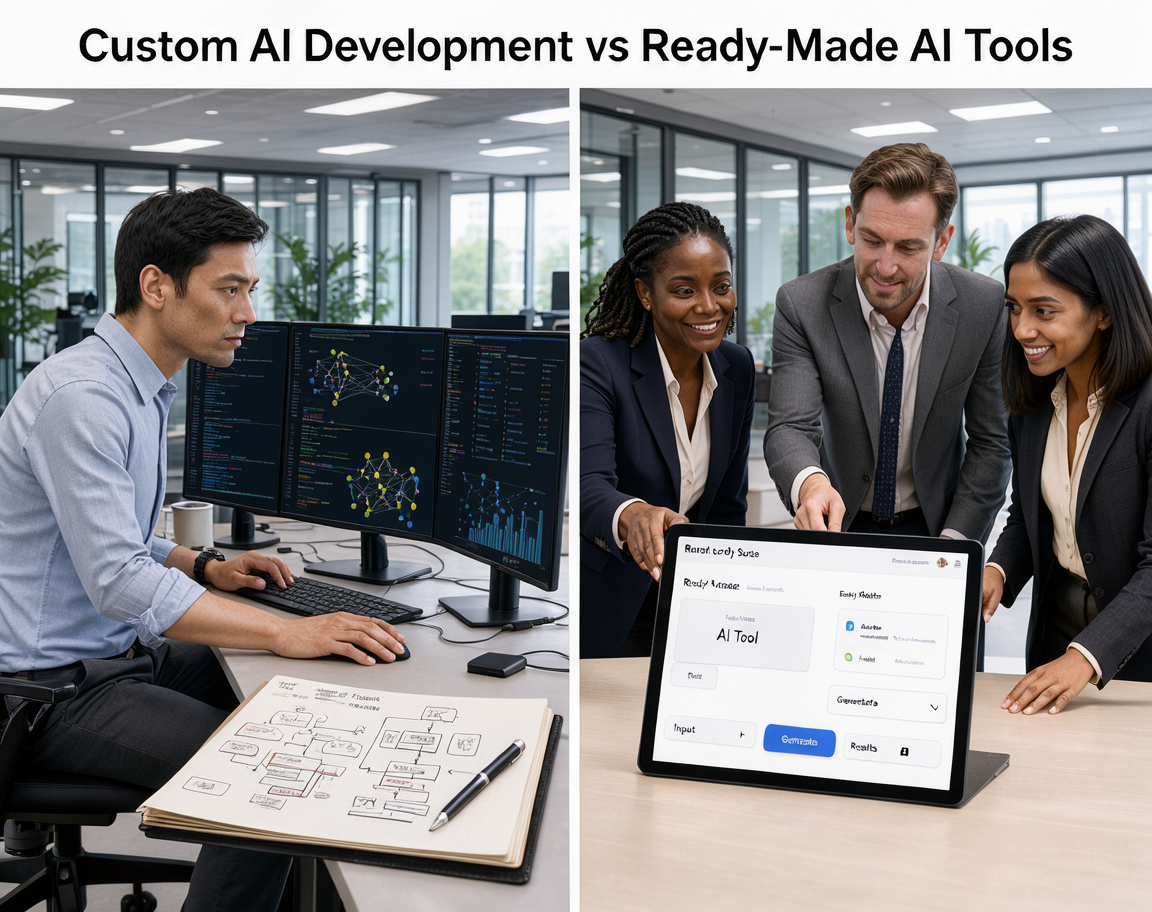
Choosing how to add machine learning to your operations is a major milestone. Many leaders compare custom AI development vs ready-made AI tools. This choice affects how your company manages data and grows over time.
Commercial software gives teams immediate access to powerful features. These products help teams start fast without a large engineering budget. However, they may lack features for unique industry challenges.
A bespoke system, however, gives you complete control over workflows. This option suits firms that must protect proprietary data or gain a competitive edge. The best business AI solutions depend on your goals, risk tolerance, and long-term vision.
Table of Contents
Key Takeaways
- Ready-made software offers speed and lower upfront costs for most teams.
- Bespoke systems provide superior control over specialized internal workflows.
- Consider your budget and integration needs before making a final choice.
- Proprietary data security is often easier to manage with a tailored approach.
- Success depends on balancing your immediate goals with future scalability.
Why the AI Investment Decision Matters for Business Growth
Your AI choice can speed growth or create unexpected bottlenecks. When you use AI tools for businesses, you change how your organization works. This decision affects daily costs and long-term revenue potential.

How AI Choices Affect Revenue, Efficiency, and Customer Experience
Strategic technology investments improve your bottom line by streamlining repetitive tasks. When used correctly, AI automation can raise employee productivity and support high-value creative work. This change can bring faster customer replies and more consistent service.
However, the impact goes beyond speed. A well-chosen system can find new revenue opportunities by spotting customer patterns humans might miss. Efficiency gains matter only when they improve results for clients and staff.
Why the Cheapest or Fastest Option Is Not Always the Best Fit
Choosing the cheapest or fastest solution may seem tempting. However, a tool chosen only for price can create hidden costs later. Poorly integrated systems cause delays, require rework, and may frustrate customers.
A tool that does not fit your workflows may create more work than it saves. Sustainable growth needs a solution that meets your operational needs, not a generic fix. Rushing a purchase can waste resources and reduce momentum.
The Business Questions Leaders Should Answer Before Choosing
Before choosing a vendor or development path, clearly define your AI business strategy. Leaders should ask critical questions to ensure their choice supports company goals:
- What specific problem are we trying to solve, and who are the primary users?
- What are the measurable outcomes we expect to see within the first six months?
- Do we have the necessary data quality to support this technology?
- What is our threshold for acceptable risk regarding security and performance?
Answering these questions creates a roadmap for your investment. This approach helps you avoid common problems and choose technology that supports your company’s broader vision.
What Custom AI Development and Ready-Made AI Tools Actually Mean
Choosing the right AI strategy starts with deciding between a custom engine and a plug-and-play product. Both can improve business results, but they differ in design, management, and daily use.

How Custom AI Development Is Designed Around Specific Business Needs
Custom AI development is a highly tailored process. It creates unique data pipelines, machine learning models, and user interfaces for your organization’s needs.
Instead of changing your business to fit software, you build software around existing workflows. This approach enables deep integration with proprietary data, so the AI solves problems standard tools cannot address.
How Ready-Made AI Tools Deliver Prebuilt Capabilities
In contrast, ready-made AI tools provide immediate functionality through standardized products. These products serve broad audiences and work right away without extensive engineering.
Companies can deploy powerful technology in days rather than months. This choice suits businesses with common needs, such as customer support automation or basic data analysis. It avoids the added work of a custom build.
Where AI APIs, SaaS Platforms, and Internal Systems Fit
Modern technology includes several delivery models. Many companies use AI APIs to connect internal systems with powerful external models. This adds intelligence to existing applications with little effort.
Likewise, AI SaaS platforms provide subscription access to advanced tools hosted and maintained by third-party vendors. They provide advanced capabilities while the vendor manages the infrastructure.
“The most successful companies are those that know when to buy a standard tool to save time and when to build a custom solution to gain a competitive edge.”
Key Differences in Ownership, Control, and Implementation
Understanding these models helps companies plan for long-term success. With custom solutions, you usually own the code and underlying models. This gives you control over data privacy and future updates.
Ready-made options often create vendor lock-in. You rely on the provider for maintenance and security. The following table shows the main differences between these approaches:
| Feature | Custom AI Development | Ready-Made AI Tools |
|---|---|---|
| Implementation Speed | Slow (Months) | Fast (Days/Weeks) |
| Customization Level | High (Bespoke) | Low (Standardized) |
| Ownership & Control | Full Ownership | Vendor Managed |
| Maintenance Burden | High (Internal Team) | Low (Vendor Support) |
Custom AI Development vs Ready-Made AI Tools: A Side-by-Side Comparison
Choosing between custom AI development vs ready-made AI tools can shape a growing business. Both can improve efficiency, but they differ in control and flexibility. Knowing these differences helps match technology spending with your long-term vision.

Comparing Cost, Implementation Speed, and Long-Term Value
Ready-made tools offer a faster path to market because engineers have built the core system. You can subscribe and see results within days or weeks. Yet recurring fees may rise as your usage grows.
Custom development needs a large upfront investment in discovery and engineering. Its initial price is higher, but its long-term value can come from owning the intellectual property. You avoid vendor lock-in and can solve unique problems that standard software cannot address.
Comparing Customization, Scalability, and Integration Options
For AI integration, ready-made platforms often offer standard connectors for software like Salesforce or Slack. These connectors fit existing workflows without a large technical team. However, you can use only the features each vendor supports.
Custom solutions offer nearly limitless customization and can create features that set your business apart. Custom architecture can also make AI scalability easier by matching your specific data loads. You avoid third-party limits and pricing tiers.
Comparing Data Control, Security, and Compliance Responsibilities
Data privacy matters to modern enterprises. With ready-made tools, you rely on vendor security protocols and compliance certifications. You may not see how vendors process your data or use it to train their models.
Building your own system gives you full control over your data environment. You can add security measures for strict industry rules, including HIPAA or GDPR. This governance often decides the choice for companies in highly sensitive sectors.
Comparison Table: Which Option Performs Better Across Business Priorities
| Business Priority | Ready-Made AI Tools | Custom AI Development |
|---|---|---|
| Implementation Speed | Very Fast | Slow |
| Upfront Cost | Low | High |
| Customization Level | Limited | High |
| Data Control | Shared/Vendor | Full Ownership |
| Maintenance Burden | Low | High |
How Much Do Custom AI Solutions and Ready-Made Tools Cost?
Planning for artificial intelligence requires clear insight into upfront and long-term operating expenses. Understanding AI implementation costs supports successful digital transformation for your organization.
Custom Development Expenses, Including Discovery, Engineering, and Testing
A bespoke system requires significant initial funding. During discovery, experts define your project’s scope and technical requirements.
Engineering and testing make up most of the investment. These stages ensure your business AI solutions remain strong, secure, and tailored to your workflows.
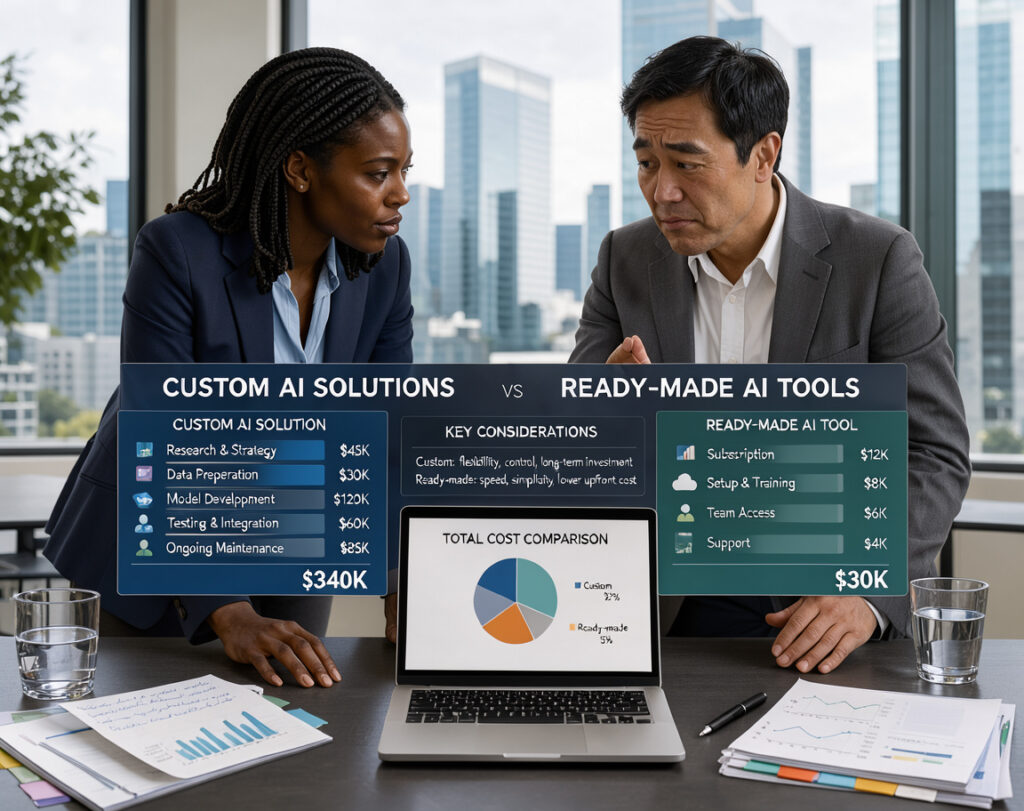
Ready-Made Pricing Models, From Subscriptions to Usage-Based Fees
Off-the-shelf software usually has more predictable costs. Most vendors offer monthly or annual subscriptions based on users or seats.
Some platforms charge based on usage, such as API requests or tokens used. This model lets companies match spending with actual technology use.
Hidden Costs for Data Preparation, Integration, Training, and Support
Beyond the listed price, consider the resources needed to make the software work. Data preparation often gets overlooked, but clean data supports accurate results.
Connecting legacy systems and internal databases often needs custom coding or middleware. Also, budget for employee training and ongoing technical support to encourage adoption.
Calculating Total Cost of Ownership and Expected Return on Investment
To find the true value, calculate the Total Cost of Ownership (TCO) over several years. Include licensing, maintenance, and internal staff time.
Compare these costs with your AI return on investment by measuring clear gains. Track better efficiency, revenue growth, and time saved on repetitive tasks.
| Cost Factor | Custom AI Development | Ready-Made AI Tools |
|---|---|---|
| Initial Investment | High (Discovery & Build) | Low (Setup & Licensing) |
| Maintenance | High (Internal Team) | Low (Vendor Managed) |
| Scalability | Flexible but Costly | Predictable Tiers |
| Expected ROI | Long-term Strategic Value | Immediate Operational Gains |
Which Option Delivers Business Results Faster?
Every business leader wants to know how quickly AI investments can create value. Your choice affects deployment time, so weigh speed against customization. This balance helps your business stay competitive.

Typical Timelines for Deploying Ready-Made AI Tools
Most ready-made AI tools help companies get started quickly. Their infrastructure, interface, and model access already exist. You can often connect them to workflows within days or weeks.
Many AI SaaS platforms provide plug-and-play features with little technical work. They suit teams solving specific problems without waiting for lengthy development.
Why Custom AI Projects Require More Planning and Validation
Custom development takes longer than a quick sprint. Teams must gather requirements, validate data, and review security. These steps help the system match your needs.
Building from the ground up requires several time-consuming steps:
- Detailed architectural design and data mapping.
- Rigorous security and compliance testing.
- Comprehensive user acceptance training.
- Iterative feedback loops to refine model performance.
When a Fast Pilot Is More Valuable Than a Fully Tailored System
Sometimes, a fast pilot proves the concept before a major build. Existing AI tools for businesses can provide early evidence of ROI.
A pilot helps you collect real-world data and gain stakeholder support quickly. If it succeeds, you can scale it or later adopt a stronger custom architecture.
Balancing Time to Market With Long-Term Operational Fit
Speed matters, but fast deployment does not always guarantee a perfect fit. Ready-made AI tools may solve immediate problems but lack flexibility for complex, long-term work.
Weigh a quick launch against possible future technical debt. Choosing between AI SaaS platforms and custom systems requires a clear view of your company’s growth and operational needs.
How Flexibility and Business Fit Differ Between the Two Approaches
When operational needs go beyond industry standards, choosing between ready-made tools and custom AI development becomes important. Every organization has unique workflows that shape its market position. The right technology balances quick convenience with long-term specialized needs.

Adapting Custom AI to Unique Processes, Rules, and Customer Journeys
A custom AI solution mirrors the specific logic that drives your business. Unlike generic platforms, it can learn from proprietary data, industry terms, and internal decision rules. This helps it understand customer journeys that standard models often miss.
When unique business rules guide the system, AI becomes an extension of your team. It follows your compliance standards and operational goals instead of general patterns. This alignment is essential for companies that depend on specialized expertise.
Working Within the Capabilities and Limits of Ready-Made Software
Ready-made software offers a strong base for common business tasks. However, these tools serve broad audiences and favor general use over niche needs. You can adjust settings, but the vendor controls the roadmap and features.
When a process falls outside the software’s limits, your team may need to change its workflow. This can cause inefficiency and frustration when users force tasks into rigid fields or approval paths. Over time, these limits can slow innovation and reduce effectiveness.
Supporting Specialized Use Cases That Standard Tools Cannot Handle
Some business challenges need more complexity than off-the-shelf products can support. Standard tools may lack depth for complex data relationships or strict regulatory requirements. A tailored approach adds custom logic for handling these exceptions.
This matters most in industries with complex compliance needs or unusual data structures. Deep customization lets you automate tasks that would otherwise need manual work. This flexibility helps your technology grow with the business instead of becoming a bottleneck.
Evaluating Whether Differentiation Justifies Custom Development
Choosing a bespoke system is a strategic decision based on the value of your intellectual property. If unique processes set you apart, technology can protect and scale them. You must compare development costs with possible gains in efficiency and market distinction.
| Feature | Ready-Made Tools | Custom AI Development |
|---|---|---|
| Flexibility | Limited to vendor settings | Fully adaptable to needs |
| Business Fit | General industry standards | Proprietary logic integration |
| Implementation | Fast and predictable | Requires planning and time |
| Competitive Edge | Accessible to everyone | Unique to your business |
Ultimately, a custom solution can repay its cost if you seek a significant advantage in your sector. By focusing on specific needs, you create a system that becomes central to your business strategy.
Data Privacy, Security, and Regulatory Considerations
When you choose an AI solution, you also choose a partner for your data security strategy. Protecting information is not just technical work; it is a fundamental business requirement that shapes customer and regulator relationships.

Controlling Sensitive Data in a Custom AI Environment
A custom system lets you control your infrastructure. You can use robust encryption for data at rest and in transit, keeping proprietary information private. Keeping data in your environment lowers the risk of unauthorized exposure.
You can also set strict data residency policies for specific geographic requirements. This oversight matters for companies handling sensitive intellectual property or private user records.
Reviewing Vendor Data Practices, Terms, and Model Training Policies
With ready-made tools, carefully review how the provider handles your information. Many vendors use customer data to train models, which could expose trade secrets to competitors. Read the fine print about AI data privacy to keep your inputs confidential.
Check whether the vendor offers an “opt-out” for model training. A transparent contract helps prevent unexpected data leaks or policy changes that could weaken security.
Managing Requirements Under the California Consumer Privacy Act and HIPAA
Regulations keep changing, so your AI strategy must keep pace. For healthcare providers, HIPAA compliance is non-negotiable when handling protected health information. Any clinical AI tool must meet standards for data protection and auditability.
The California Consumer Privacy Act (CCPA) also sets strict rules for collecting and processing consumer data. Failure to align AI tools with these laws can create significant legal risks. Prioritizing AI security and compliance helps avoid these risks while building audience trust.
Assigning Responsibility for Access Controls, Audits, and Incident Response
Even with strong software, you remain responsible for your data governance. Assign clear owners to manage access controls and conduct regular security audits. Do not assume a vendor’s security certificate covers your internal operational gaps.
A formal incident response plan is crucial for business continuity. Documenting processes and assigning accountability helps your organization withstand potential threats. Effective HIPAA compliance and general AI security and compliance depend on human oversight as much as technology.
Integration With Existing Business Systems and Workflows
Artificial intelligence shows its real power when it connects with your current software stack. True AI integration joins new tools into one system, helping data move through daily operations.
Connecting Custom AI With CRMs, ERPs, Data Warehouses, and Internal Applications
Custom solutions provide deep, purpose-built connections. Direct pipelines to your CRM or ERP give AI the context it needs for accurate decisions.
This approach supports tailored data ingestion, so AI can use proprietary data warehouses that standard tools may miss. When systems communicate well, AI automation becomes a natural part of your team.
Using Ready-Made Integrations, Connectors, and Application Programming Interfaces
Ready-made tools include connectors for platforms such as Salesforce, SAP, and Microsoft Dynamics. These APIs speed deployment, helping you launch in days instead of months.
“The best integration strategy balances the speed of off-the-shelf connectors with the precision of custom-built data pipelines.”
Ready-made options are convenient, but they may not support specialized workflows. You must balance the speed of implementation with the long-term need for detailed control of data streams.
Handling Legacy Systems, Inconsistent Data, and Workflow Exceptions
Many businesses rely on legacy systems that were not built for modern data exchange. Inconsistent records and missing fields often create problems in any AI integration project.
Your strategy must include strong exception handling. Set clear rules for incomplete data and unexpected process changes.
- Data Cleansing: Standardize inputs before they reach the AI model.
- Permission Mapping: Ensure security protocols remain intact across all systems.
- Error Logging: Track failures to improve future model performance.
Measuring Integration Quality Through Adoption and Process Efficiency
How can you tell whether your AI automation works? Look beyond technical uptime and measure its effect on your bottom line.
| Metric | Goal | Impact |
|---|---|---|
| Adoption Rate | High user engagement | Increased ROI |
| Cycle Time | Reduced processing duration | Faster output |
| Error Reduction | Lower manual intervention | Higher accuracy |
These metrics reveal bottlenecks and help you improve workflows. Continuous monitoring keeps integrated systems reliable and valuable as your business grows.
Accuracy, Performance, Maintenance, and Reliability
When you deploy AI, the work continues as you keep models accurate and reliable. Performance is not static; AI model accuracy changes with your operating environment.
Defining Accuracy and Success Metrics for a Specific Business Use Case
No single score measures success because each business task has different needs. A customer service chatbot needs fluent conversation, while a financial forecasting tool needs extreme numerical precision.
Defining clear KPIs—such as error rates, latency, or user satisfaction scores—helps you track system performance. Without tailored metrics, you may optimize the wrong outcomes.
“The true measure of an AI system is not how well it performs in a lab, but how reliably it solves the specific problems your business faces every single day.”
Maintaining Custom Models Through Monitoring, Retraining, and Testing
Effective AI maintenance keeps systems healthy through proactive care. Models can experience “drift” when real-world data changes beyond their training set.
Your team must use continuous monitoring and regular retraining to address drift. Regression testing ensures updates do not break existing features or add unexpected workflow errors.
Understanding the Reliability Limits of General-Purpose AI Tools
General-purpose tools are powerful, but they have limits in specialized fields. Broad training data may not include the details your industry requires.
Off-the-shelf solutions can produce inconsistent results in high-stakes situations. Know when a general tool reaches its limit and a controlled, specialized environment becomes necessary.
Reducing Hallucinations, Bias, Downtime, and Poor User Experiences
Use strict technical controls and human-in-the-loop safeguards to reduce these risks. Confidence thresholds let systems act only when they meet a required certainty level. Human review provides a final safety check for critical decisions.
| Risk Factor | Mitigation Strategy | Primary Benefit |
|---|---|---|
| Hallucinations | Retrieval-Augmented Generation | Increased Factual Accuracy |
| Algorithmic Bias | Diverse Data Auditing | Fairer Outcomes |
| System Downtime | Redundant Infrastructure | High Availability |
| Poor User Experience | Feedback Loops | Continuous Improvement |
Combining these safeguards with a strong AI maintenance plan protects your business from common AI adoption problems. Prioritizing AI model accuracy through these steps keeps your technology a reliable asset for years.
Scalability, Ownership, and Vendor Lock-In
Long-term AI success depends on system growth and ownership of its core logic. Choosing a custom AI solution or commercial platform means weighing convenience against future flexibility. Consider how your infrastructure will handle demand while you control key business assets.
Scaling Custom AI Infrastructure as Data and Usage Increase
When you build a bespoke system, you gain full control over AI scalability. You can adjust storage, model service, and security controls for your growth patterns. This lets your team scale resources where they matter most.
However, this flexibility requires dedicated operations staff. You must maintain hardware and software as data volume grows. Although this takes more effort, it keeps infrastructure aligned with your business goals.
Scaling Ready-Made Tools Within Vendor Limits and Pricing Tiers
Commercial tools offer a faster path to deployment, but they have built-in limits. You may reach usage limits or enter higher pricing tiers as your business grows. These limits can create vendor lock-in, tying operations to the provider’s roadmap.
Review the service terms for rate limits and product dependencies. If a vendor changes its API or pricing, your business could face disruptions. Decide whether convenience outweighs the risk of losing control over operating costs.
Comparing Ownership of Models, Data, Code, and Business Knowledge
Ownership supports long-term AI data privacy and competitive advantage. With a custom system, your organization keeps full rights to models, training data, and source code. This protects proprietary knowledge from competitors.
Third-party platforms often let you rent intelligence instead of owning it. Carefully examine how the vendor uses your data to train its models. Protecting intellectual property matters when choosing an AI partner.
Planning for Provider Changes, Migration Costs, and Business Continuity
Every business needs an exit plan to reduce vendor lock-in risks. Ensure data portability before moving information to another provider. Run regular migration tests to check whether workflows transfer smoothly.
Business continuity depends on staying flexible in a changing market. Document dependencies and maintain clean data formats to reduce future transition costs. Preparing today protects operations from future instability.
| Feature | Custom AI Solution | Ready-Made Tools |
|---|---|---|
| Scalability | Highly flexible, manual control | Limited by vendor tiers |
| Ownership | Full control of code/data | Shared or vendor-owned |
| Exit Strategy | High portability | Complex migration risks |
| Maintenance | Internal team required | Managed by provider |
Skills, Teams, and Operating Models Required for AI Success
Effective AI projects depend on people, clear roles, and strong operating models. Technology powers the work, but your team guides it toward useful business results.
Technical Roles Needed to Build and Govern Custom AI
Custom solutions need varied experts to keep systems strong and secure. You need data engineers to prepare information, machine learning specialists to train models, and software developers to connect systems.
After building the system, cybersecurity experts must protect data, while product managers align features with user needs. A strong governance team keeps AI compliant with changing regulations and internal policies.
Business and Operations Skills Needed to Deploy Ready-Made Tools
Even with prebuilt software, you cannot simply “set it and forget it.” Success requires process owners who fit the tool into daily workflows and administrators who manage access and settings.
Data stewards must maintain the quality of information that feeds the system. Trainers and support staff help employees adopt the technology, so your AI business strategy creates real value across the organization.
When Managed Services or an AI Development Partner Make Sense
Many companies lack the talent needed to expand their internal AI skills. An AI development partner provides specialized expertise without the cost of hiring a full-time team.
“The best technology in the world is useless if you do not have the right people to guide its implementation and manage its growth.”
Managed services are especially useful for ongoing AI maintenance, keeping systems updated and performing well. This approach lets internal staff focus on core business goals while experts manage complex infrastructure tasks.
Creating Human Oversight for High-Impact AI Decisions
Automation should not replace human judgment in sensitive areas. When AI affects high-impact decisions in healthcare, employment, finance, housing, or legal services, human oversight is required.
Your AI business strategy needs clear human-review rules to prevent bias and errors. This “human-in-the-loop” model ensures your AI maintenance efforts support ethical outcomes and build trust with customers.
A Practical Framework for Choosing the Right AI Approach
When you weigh custom AI development vs ready-made AI tools, the best path depends on your operational goals. A clear framework can balance immediate needs with your long-term vision. By reviewing your requirements, you can avoid pitfalls and make technology investments create real value.
Choose Custom Development When the Use Case Is Strategic or Highly Specialized
Custom solutions work best when your business relies on proprietary data or unique workflows. If you want a defensible competitive advantage, a tailored system may offer the best path. You can own its logic and adapt the model as your business changes.
Choose Ready-Made Tools When Speed, Simplicity, and Predictable Access Matter
For many organizations, ready-made AI tools provide fast functionality without major engineering work. These platforms support standard tasks like customer support, data entry, and content generation. They offer reliable access while your team focuses on core business activities.
Score Data Sensitivity, Integration Complexity, and Required Differentiation
To make an informed decision, score each project using three critical factors. First, assess data sensitivity; regulated industries may need strict control in custom environments. Second, review integration complexity; legacy systems may need custom connectors. Finally, consider differentiation; standard tools rarely provide a unique edge over competitors.
Compare Pilot Results, Total Costs, and Operational Risks Before Committing
Before you commit, run a small pilot program to test your assumptions. Track AI implementation costs, including hidden expenses for training, maintenance, and data preparation. Review these metrics to find risks early and adjust your plan before scaling across your organization.
Align the Decision With Business Size, Budget, and Growth Plans
Your AI strategy should match your current size and future growth plans. A startup may value speed and low upfront costs, while a large enterprise may focus on long-term AI return on investment and system ownership. Use the following table to help leaders compare these two approaches.
| Factor | Custom AI Development | Ready-Made AI Tools |
|---|---|---|
| Time to Market | Slow (Months) | Fast (Days/Weeks) |
| Initial Investment | High | Low to Moderate |
| Control & Ownership | Full | Limited |
| Maintenance Needs | High (Internal Team) | Low (Vendor Managed) |
| Competitive Edge | High (Unique) | Low (Commoditized) |
When a Hybrid AI Strategy Provides the Best Path Forward
A hybrid AI strategy gives companies a flexible way to innovate with less risk. Businesses can combine fast commercial software with precise, custom engineering. This approach keeps teams flexible while building valuable, private technology where it matters most.
Combining Ready-Made Tools With Custom Models and Internal Data
Most organizations begin by adding AI APIs to existing workflows for quick results. Connecting these commercial tools to internal data helps them understand each company’s needs. This mix produces useful results that fit your specific operations, rather than generic answers.
Starting With a Proven Platform Before Building High-Value Capabilities
Many companies begin with a proven platform to test key ideas before making major investments. Real usage shows which processes gain the most from automation. After clear results appear, teams can use custom AI development in areas that offer a competitive edge.
Using Custom Components Around Commercial Large Language Models
Many firms place custom software layers around commercial Large Language Models to enforce strict business rules. This approach uses powerful models while protecting your private business logic. These custom layers help the AI follow your brand’s standards across customer interactions.
Creating a Migration Plan From Off-the-Shelf Tools to Custom Systems
To avoid vendor lock-in, plan future changes from the start. Document your interfaces and keep your data portable to maintain long-term control. Staged testing and fallback options protect your business from sudden price increases or service changes.
The best AI systems grow with the business. They balance quick deployment with the need for long-term ownership.
Conclusion
Choosing the right technology can shape a growing organization. The choice between custom AI development vs ready-made AI tools depends on operational goals and long-term vision. Custom solutions provide deep control and unique competitive advantages, while off-the-shelf software offers speed and ease of use.
Your AI business strategy should focus on your most pressing needs. Consider data sensitivity, integration requirements, and your team’s available technical talent. A balanced approach often delivers the best results for modern enterprises.
Begin with small pilots to test performance and real-world utility. Compare the total cost of ownership with the measurable outcomes you expect to achieve. This review helps you avoid common pitfalls and supports sustainable growth through technology investments.
Align technical choices with your broader company objectives. Whether you build a proprietary system or adopt a proven platform, clear requirements support success. Your commitment to a well-researched plan will shape how effectively your business uses intelligence in the years ahead.