






Turning a business idea into a hit software product needs careful planning and execution. It’s key to check if your idea works before diving into Software Product Development. This step is vital in today’s fast-paced tech world.
The journey includes several important steps. These are idea validation, product design, and development. Knowing these steps helps entrepreneurs and businesses make a software product that people want.
Table of Contents
Key Takeaways
- Understand the importance of validating your business idea before starting software product development.
- Learn the key steps involved in converting a business idea into a software product.
- Discover how to design a software product that meets the needs of your target audience.
- Gain insights into the software product development process.
- Find out how to increase your chances of creating a successful software product.
Understanding Your Business Idea
Getting to know your business idea well is key to making successful software products. You need to explore the main parts that make your idea work and valuable.
Identifying Core Value Propositions
A core value proposition is what makes your business unique. It’s the special benefit you offer to your customers. This is what makes your product stand out in the market.
Unique Selling Points
Unique Selling Points (USPs) are what make your product different from others. Finding these is important for your marketing and sales plans.
Customer Pain Points Addressed
Knowing the customer pain points your idea solves is crucial. It helps you make your product fit exactly what customers need. This makes your product more appealing and useful.
Defining Problem-Solution Fit
It’s important to know how your business idea solves a problem. You need to clearly state the problem and how your solution fits.
Articulating the Problem Statement
A clear problem statement is essential. It tells exactly what problem your business idea aims to solve. This step is key in checking if your business idea is valid.
Mapping Solutions to Problems
After stating the problem, you need to map the solution to it. This means explaining how your business idea or software product will solve the problem.

| Key Aspect | Description | Importance |
|---|---|---|
| Core Value Proposition | Unique benefit offered to customers | High |
| Unique Selling Points | Differentiates the product from competitors | High |
| Customer Pain Points | Specific needs or issues addressed by the product | High |
Conducting Market Research
Market research is key in making software products. It helps understand what customers need and what’s trending. This is how good ideas turn into real products.
Identifying Target Audience
Knowing who might use your product is essential. You create user personas to picture your audience.
User Personas Development
Creating user personas means collecting data on potential users. This includes their demographics, likes, and how they behave. It helps shape your product to fit their needs.
Market Segmentation
Market segmentation breaks down a big market into smaller groups. These groups share similar traits. It makes marketing and product development more focused.

Analyzing Competitors
It’s important to know who you’re up against. This means looking at both direct and indirect competitors.
Direct and Indirect Competitors
Direct competitors offer similar things. Indirect competitors offer different solutions but still meet the same need.
Competitive Advantage Analysis
Understanding what makes your product stand out is key. This could be through unique features, pricing, or how easy it is to use.
Assessing Market Size and Potential
Knowing the market size and potential is crucial. It helps decide if a software product is worth making.
TAM, SAM, and SOM Calculations
Calculating Total Addressable Market (TAM), Serviceable Available Market (SAM), and Serviceable Obtainable Market (SOM) helps gauge market size. It shows how much of the market you can realistically get.
Growth Trend Analysis
Looking at historical data and forecasts helps understand market growth. It shows if the market is growing and how fast.
Good market research helps businesses make smart choices about their software. It lowers the risk of launching a product that won’t meet customer needs.
Validating Your Software Product Concept
A solid software product concept is key to a successful launch. It makes sure your product meets your audience’s needs and expectations.
Creating a Minimum Viable Product (MVP)
Creating an MVP is a great way to validate your concept. An MVP has only the most important features.
Defining Core Features
To make a good MVP, you must pick the most valuable features. These should be prioritized based on user needs and business goals. Consider:
- User needs and pain points
- Business objectives and key performance indicators (KPIs)
- Competitor analysis and market trends
MVP Development Approaches
There are several ways to develop an MVP, including:
- Lean Startup: Focus on rapid experimentation and iteration
- Agile Development: Emphasize collaboration and continuous improvement
- Prototype Development: Create a functional prototype to test assumptions
Gathering User Feedback
Getting user feedback is crucial for validating your concept. It shows how users interact with your product and where it can improve.
User Testing Methodologies
Effective user testing methods include:
- A/B testing and experimentation
- User interviews and surveys
- Usability testing and feedback sessions
Implementing Feedback Loops
It’s vital to have feedback loops for continuous improvement. This lets you refine your product based on user feedback.

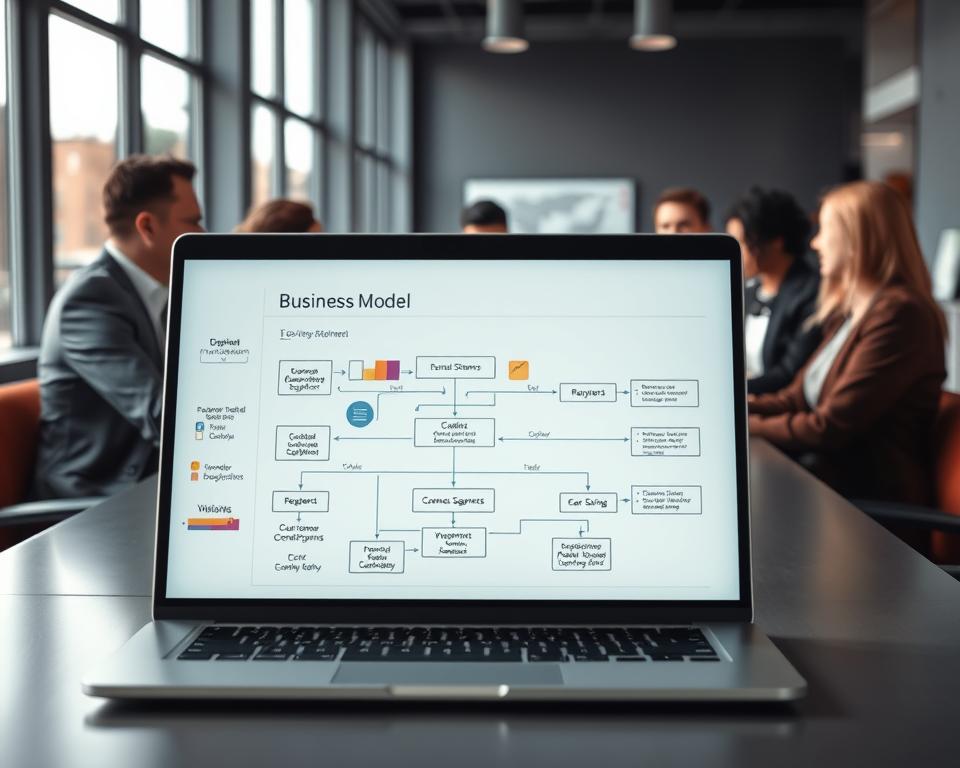
Developing a Business Model
Creating a solid business model is key to turning your idea into a software product. A good business model shows how your product will make money. It also guides your overall strategy.
Revenue Streams and Pricing Strategies
Finding the right ways to make money and set prices is crucial. You might use subscription, one-time purchase, or freemium models.
Subscription vs. One-time Purchase Models
Choosing between subscription and one-time purchase models depends on your product and audience. Subscription models bring in ongoing money and keep customers coming back. One-time purchase models are simple and upfront.
Freemium and Premium Tiers
Using freemium and premium tiers can draw in users and sell more features. Users get the basic version for free, but premium features cost money.
Cost Structure Analysis
Knowing your costs is key to staying profitable. This includes looking at development, operational, and customer acquisition costs.
Development and Operational Costs
Development costs cover building your software, like salaries and tech. Operational costs are for ongoing needs like maintenance and servers.
Customer Acquisition Costs
Customer acquisition costs are for getting new customers, like marketing. It’s important to match these costs with your income for a successful model.
| Cost Component | Description | Estimated Cost |
|---|---|---|
| Development Costs | Expenses related to building the software product | $100,000 |
| Operational Costs | Ongoing expenses for maintenance and support | $20,000/month |
| Customer Acquisition Costs | Expenses for marketing and sales | $50,000/quarter |
Creating a Product Roadmap
A well-structured product roadmap is key for guiding your software development. It outlines the development plan, including key features, milestones, and timelines. This ensures your development meets your business objectives.
Short-term and Long-term Goals
Setting both short-term and long-term goals is crucial. Short-term goals focus on immediate needs and quick wins. Long-term goals align with your overall business strategy.
Milestone Planning
Milestone planning breaks down your product development into significant achievements. This helps in tracking progress and staying focused on key objectives.
Version Release Planning
Version release planning schedules the release of different software versions. It ensures each release adds value and meets user needs.
Feature Prioritization
Feature prioritization is vital for your product roadmap. It involves evaluating features based on their importance, feasibility, and business impact.
MoSCoW Method
The MoSCoW method categorizes features into Must, Should, Could, and Won’t. This helps in making informed decisions about feature prioritization.
Impact vs. Effort Matrix
The Impact vs. Effort Matrix evaluates features based on their potential impact and implementation effort. It helps identify high-impact, low-effort features.

By using these strategies, your software development process will align with your business goals and customer needs.
Assembling Your Development Team
The success of your software product depends a lot on your development team. A well-organized team can greatly improve your product’s quality and timing.
In-house vs. Outsourced Development
Choosing between in-house and outsourced development is a big decision. Each option has its own advantages and disadvantages.
Cost-Benefit Analysis
Doing a cost-benefit analysis helps decide between in-house and outsourced development. In-house development gives you more control but can be expensive. Outsourced development is cheaper but might make communication harder and give you less control.
Hybrid Team Models
A hybrid team model combines the best of both worlds. It lets you control important parts of the project while outsourcing less critical tasks.

Key Roles and Responsibilities
It’s important to define roles and responsibilities, no matter your development choice. This ensures all project aspects are covered and everyone knows their role.
Technical Team Structure
A typical technical team includes software developers, quality assurance engineers, and DevOps specialists. Each role is crucial for the project’s success.
Product Management Roles
Product management roles, like product managers and owners, define product needs. They make sure the development team understands the product vision.
| Role | Responsibilities |
|---|---|
| Software Developers | Develop software features and functionalities |
| Quality Assurance Engineers | Test software for bugs and ensure quality |
| Product Managers | Define product requirements and roadmap |
How to Convert Business Ideas into Software Products
Turning business ideas into software products requires a clear plan. You need to translate business needs into technical details. This ensures the product works well and meets the business goals.
Translating Business Requirements into Technical Specifications
It’s important to turn business needs into technical plans. This step helps the development team know what to do. It makes sure the product will work as needed.
Requirements Gathering Techniques
To get business needs, you can use several methods. These include:
- Stakeholder interviews
- Surveys and questionnaires
- Workshops and focus groups
- Observation and job shadowing
Creating User Stories and Use Cases
User stories and use cases help capture needs. User stories describe what users want. Use cases show how the system will work with users.

Bridging the Business-Technical Gap
It’s crucial to connect business and tech teams for product success. Good communication strategies and documentation best practices help a lot.
Communication Strategies
Good communication between teams is key. You can achieve this through:
- Regular meetings and updates
- Clear and concise documentation
- Collaborative project management tools
Documentation Best Practices
Quality documentation is essential for team alignment. It includes:
| Documentation Type | Purpose | Best Practices |
|---|---|---|
| Business Requirements Document | Captures business needs and requirements | Clear, concise, and regularly updated |
| Technical Specifications Document | Outlines technical details for development | Detailed, accurate, and accessible |
| User Manual | Guides end-users on product usage | Easy to understand, illustrated, and regularly updated |
“The key to successful software product development lies in the effective translation of business requirements into technical specifications and maintaining clear communication between stakeholders.”
By following these steps and best practices, businesses can turn their ideas into useful software. This software will meet both business and technical needs.
Choosing the Right Technology Stack
A good technology stack is key to a successful software project. It includes different technologies that help in making, running, and keeping a software app alive.
Choosing the right tech stack involves many factors. These include the app’s type, how it will grow, and your team’s skills.
Frontend Technologies
Frontend techs handle the app’s look and feel. Important things to think about include:
Web vs. Mobile Considerations
Deciding between web and mobile depends on who you’re making it for and where they like to use it.
Framework Selection Criteria
When picking a frontend framework, look at its speed, community backing, and how easy it is to learn.
Backend Technologies
Backend techs manage the server, database, and API connections of your app.
Programming Languages Comparison
Popular backend languages are Java, Python, and Node.js. Each has its own good points and areas for improvement.
API Architecture Options
RESTful APIs and GraphQL are two main API types. Each fits different needs.
Database and Infrastructure Considerations
Choosing the right database and infrastructure is crucial for your app’s speed and growth.
SQL vs. NoSQL Databases
SQL databases work well for organized data. NoSQL databases are better for flexible or changing data.
Cloud vs. On-premises Hosting
Cloud hosting is great for growing and saving money. On-premises hosting gives you more control over security and setup.
| Technology | Type | Key Features |
|---|---|---|
| React | Frontend Framework | Component-based, Virtual DOM |
| Node.js | Backend Runtime | Event-driven, Non-blocking I/O |
| MongoDB | NoSQL Database | Flexible Schema, Scalable |

Designing User Experience (UX) and User Interface (UI)
Creating a software product with a focus on User Experience (UX) and User Interface (UI) is key to its success. A good UX and UI make users happy and keep them coming back. They also help in converting users into customers.
User-Centered Design Principles
User-centered design puts the user first. It’s about knowing who your users are, what they do, and why. This way, you make a product that’s easy to use and understand.
Accessibility Considerations
Making sure your software is accessible to all is crucial. This means following rules like the Web Content Accessibility Guidelines (WCAG). It helps everyone use your product, including those with disabilities.
Usability Testing
Usability testing lets you see how real users interact with your product. It shows what works and what doesn’t. This feedback helps make your product better.
Prototyping and Wireframing
Prototyping and wireframing are key steps in designing UX/UI. They let designers test how the product looks and works before it’s built. This helps catch problems early.
Low-fidelity vs. High-fidelity Prototypes
Low-fidelity prototypes are simple, while high-fidelity ones are detailed and interactive. The choice depends on the design stage and goals.
Design System Implementation
A design system is a set of reusable parts that follow clear rules. It helps build different digital products consistently. This makes designing faster and more efficient.

By focusing on user-centered design, accessibility, and usability, developers can make great User Experience (UX) and User Interface (UI) products. Using prototyping, wireframing, and design systems helps achieve this goal.
Managing the Development Process
Managing the development process is key to making business ideas into successful software. It involves picking the right development method, planning, and executing the project well.
Agile vs. Waterfall Methodologies
Choosing between Agile and Waterfall depends on the project and the team’s skills. Agile, like Scrum and Kanban, is flexible and works in cycles. Waterfall is more straightforward and follows a sequence.
Scrum Framework Implementation
Scrum breaks down work into sprints with roles like Product Owner and Scrum Master. It helps teams work together and be flexible.
Kanban Approach
Kanban uses visual work, limits tasks in progress, and aims for constant improvement. It fits various team setups because it doesn’t require specific roles or cycles.
Sprint Planning and Execution
Sprint planning is vital in Agile, where teams pick tasks for a sprint. Good execution means daily updates and looking back to improve.
Story Point Estimation
Story points estimate task complexity. They help plan sprints by showing how hard tasks are compared to others.
Daily Stand-ups and Retrospectives
Daily stand-ups keep team members in the loop about project progress. Retrospectives let teams look back and find ways to get better.
Quality Assurance and Testing
Testing and quality assurance are key in software development. It’s vital to make sure a software product meets the needed standards. This is crucial for its success.
Types of Software Testing
There are many ways to test software to check its reliability and performance. Knowing these methods is important for a good testing plan.
Functional and Non-functional Testing
Functional testing checks if the software works as it should. It looks at the app’s features and how users interact with it. On the other hand, non-functional testing looks at things like how fast it runs, its security, and how easy it is to use.
Automated vs. Manual Testing
Automated testing uses tools to run tests, making it fast and efficient. Manual testing uses human testers to find problems. It gives a deeper look at how users experience the software.
Implementing Continuous Integration/Continuous Deployment (CI/CD)
CI/CD helps teams release software updates often and reliably. It means always integrating code changes into one place, then testing and deploying it automatically.
Testing Environments Setup
Creating the right testing environments is key for CI/CD. This means setting up servers, databases, and other parts of the infrastructure to act like real-world situations.
Deployment Pipeline Configuration
A good deployment pipeline makes building, testing, and deploying software automatic. This makes sure updates are delivered smoothly and quickly.
| Testing Type | Description | Benefits |
|---|---|---|
| Functional Testing | Verifies software functionality | Ensures application works as expected |
| Non-functional Testing | Examines performance, security, etc. | Enhances user experience and security |
| Automated Testing | Uses tools to execute tests | Increases efficiency and speed |
| Manual Testing | Relying on human testers | Provides nuanced understanding of user experience |
Legal and Intellectual Property Considerations
Turning business ideas into software products requires careful legal and intellectual property steps. It’s important to understand the legal aspects that can affect your product’s success.
Software Licensing Options
Choosing the right software licensing is key. It decides how your product can be used, shared, and changed. There are mainly two options: open source and proprietary.
Open Source vs. Proprietary Licensing
Open source licensing lets users freely view, modify, and share the software. This encourages community involvement. On the other hand, proprietary licensing limits these actions, keeping control over the software.
Third-party Component Licensing
Using third-party components requires following their licensing rules to avoid legal problems. It’s important to know the permissions and limits of each component.
Data Privacy and Security Compliance
Protecting user data and building trust is crucial. This means following data privacy and security rules like GDPR and CCPA.
GDPR and CCPA Requirements
The GDPR and CCPA are key rules for handling user data. They require clear data collection, user consent, and strong security.
“The true sign of intelligence is not knowledge but imagination.” – Albert Einstein
Security Best Practices
Using security measures like encryption and regular updates is vital. It helps prevent data breaches and cyber attacks.
| Regulation | Key Requirements | Impact on Software Development |
|---|---|---|
| GDPR | User consent, data minimization, transparency | Implement robust data protection measures |
| CCPA | User rights, data disclosure, opt-out options | Ensure compliance through clear data handling practices |
By focusing on legal and intellectual property issues, you can protect your software. This builds a solid base for its success.
Preparing for Product Launch
Getting ready to launch your software product is key. You need to think about many important things. A good launch needs beta testing, marketing, and careful planning for the big day.
Beta Testing Strategies
Beta testing is a must. It finds bugs, gets user feedback, and checks if the product is up to standard. There are two main ways to do beta testing:
Closed vs. Open Beta
A closed beta tests with a small, chosen group. An open beta lets more people join in. Pick what’s best for your product and audience.
Beta Tester Recruitment
Finding the right beta testers is crucial. You can find them through your users, social media, or beta testing sites. Make sure they match your target audience for useful feedback.
Marketing and Promotion
Good marketing and promotion are essential. They help build excitement for your launch. Here are some ideas:
Pre-launch Marketing Tactics
Get people excited before the launch with teasers, emails, and influencer partnerships. These strategies build anticipation and interest.
Launch Announcement Strategies
On the big day, share your product news through press releases, social media, and emails. Keep your message the same everywhere to make a strong impact.
Launch Day Preparations
Launch day needs careful planning for a smooth start. Important things include:
Technical Readiness Checklist
Make sure your system can handle the traffic. Do load tests and have a strong support team ready. A checklist helps keep you on track.
Support Team Preparation
Your support team must be ready for customer questions and problems. Give them the training and tools they need to help your users well.
| Launch Preparation Aspect | Description | Importance Level |
|---|---|---|
| Beta Testing | Identifying bugs and gathering user feedback | High |
| Marketing and Promotion | Creating buzz and generating interest | High |
| Technical Readiness | Ensuring infrastructure can handle traffic | High |
| Support Team Preparation | Training support staff for customer inquiries | High |
Post-Launch Activities and Product Iteration
After a software product is launched, it’s important to keep improving it. We need to watch how it performs, listen to what users say, and make it better. This helps keep the product growing and meeting user needs.
Monitoring and Analytics
Monitoring and analytics are key after a product is launched. They help us see how users use the product, find problems, and make smart choices based on data.
User Behavior Tracking
Tracking how users behave in the software is crucial. It helps us spot trends and understand what users find hard. Tools like Google Analytics give us important insights.
Performance Metrics Analysis
Checking the software’s performance is vital. We look at how fast it loads, how often it has errors, and how quickly the server responds. These checks help us find and fix problems.
| Metric | Description | Importance |
|---|---|---|
| Load Time | The time taken for the software to load | High |
| Error Rate | The frequency of errors encountered by users | High |
| Server Response Time | The time taken for the server to respond to user requests | Medium |
Continuous Improvement Cycle
The continuous improvement cycle is all about making the software better over time. We update and refine it based on what users say and how it performs. This keeps the software competitive and users happy.
Feature Enhancement Process
Improving features is a big part of this cycle. We listen to user feedback, decide what new features to add, and then add them. This makes sure the software stays relevant and useful.
Bug Fixing Prioritization
Fixing bugs is another important part. We focus on solving the most critical problems first. This ensures users have a smooth experience.
Scaling Your Software Product
Scaling a software product is a complex task. It involves both technical and business strategies for growth. As more users join, your setup must change to handle the extra load.
Technical Scaling Considerations
Technical scaling is key to keeping up with growth. You need to check your tech stack and infrastructure. This helps find what needs to be updated or replaced.
Infrastructure Scaling Options
There are several ways to scale your infrastructure. Cloud services offer flexibility and scalability. Containerization with tools like Docker makes deployment easier.
Database Optimization Techniques
Improving databases is crucial. This includes indexing, query optimization, and sharding or replication. These methods help spread out the load and keep data safe.
Business Growth Strategies
Business growth is just as important. It focuses on reaching more markets and keeping customers engaged.
Market Expansion Approaches
Expanding your market can be done in several ways. You can target new areas, reach new customers, or offer more products. This helps you meet a wider range of needs.
Customer Retention Tactics
Keeping customers is essential. You can do this with personalized experiences, responsive customer support, and loyalty programs. These build strong, lasting relationships.
By combining technical scaling with business growth, your software product can succeed in a competitive market.
Conclusion
Turning a business idea into a software product is a complex task. It involves understanding the idea, doing market research, and developing a business model. Launching the product is the final step. It’s crucial to stay focused on the core value and be ready to make changes based on user feedback.
Creating effective software products requires knowing your audience well. You need a solid product roadmap and a skilled team. Using the right technology, designing for the user, and ensuring quality are key. This way, your product will meet user needs and stand out.
When turning a business idea into a product, legal and intellectual property issues are important. You must prepare for the launch and plan for what happens after. This ensures your product’s long-term success and growth.
The secret to successful software development is continuous improvement. By always looking to improve, you can refine your product. This helps you stay ahead in the competitive market.