






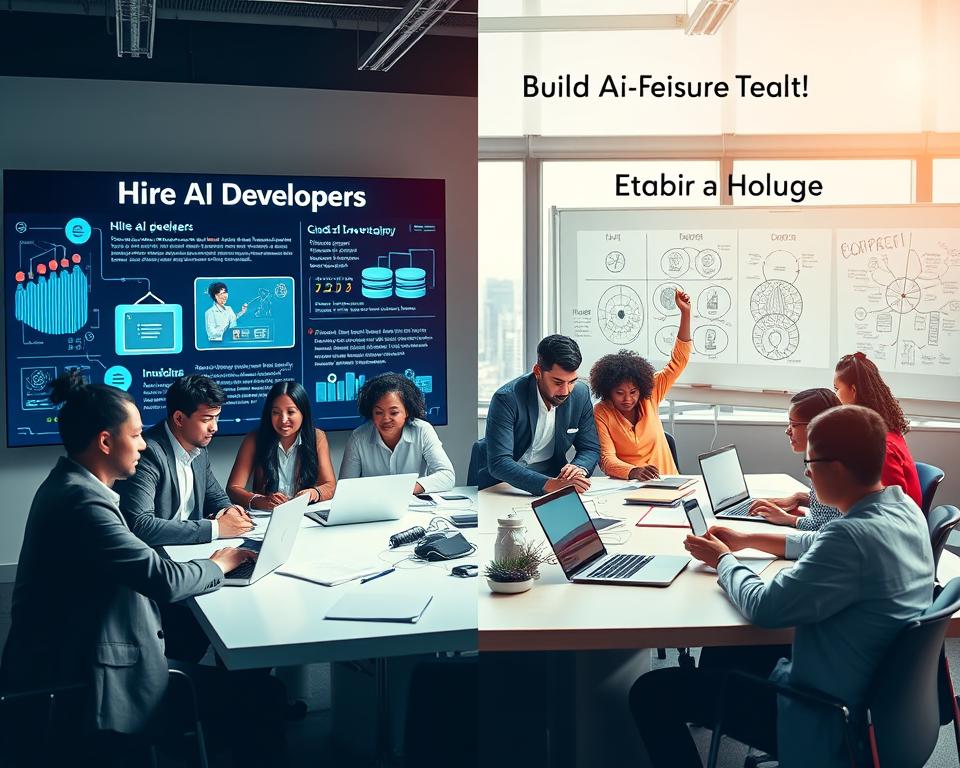
Scaling technical skills is a major step for any growing business in the United States. When planning the best AI hiring strategy, weigh external talent’s speed against internal staff’s long-term value.
These paths affect your budget, project timeline, and overall control. Every organization faces unique risks when it adds complex machine learning solutions to existing workflows.
This guide explores the Hire AI Developers vs Building an In-House AI Team debate. Your technical goals and plans for future growth can shape the best choice for your company.
Table of Contents
Key Takeaways
- External experts provide immediate access to specialized skills for urgent projects.
- Internal staff foster deeper institutional knowledge and long-term product ownership.
- Cost control varies significantly based on project duration and complexity.
- Risk management depends on your ability to oversee technical quality and security.
- A balanced approach often yields the best results for sustainable business growth.
What This AI Talent Decision Really Involves
Your approach to building an AI development team should reflect your unique business objectives. Many leaders first choose a staffing model without understanding their project’s scope. Success requires knowing whether you need a simple prototype or a complex, enterprise-grade production system.

Define the business outcome before choosing a hiring model
Before choosing a staffing strategy, define the exact business outcome you need. Will you automate one internal workflow or launch a new product for customers? A clear goal shows whether you need a small, agile contractor group or permanent, full-time staff.
For a quick proof of concept, prioritize speed and specialized expertise. For a core product that will shape your company for years, choose strong internal ownership. Defining your outcome is the most important step when selecting the right model.
Separate short-term delivery needs from long-term capability goals
Separate immediate project delivery from your goal of building long-term internal knowledge. Sometimes, an AI development team must solve a specific, urgent problem now. External experts can provide quick results without the burden of long-term recruitment.
If you seek lasting competitive advantage, plan for internal growth. Outside help alone can create a knowledge gap and slow future progress. Balancing these two needs supports sustainable growth.
Identify the people, technology, and leadership resources required
Building an effective AI development team requires more than data scientists. You also need the right technology stack, data infrastructure, and project leadership. Without strong management, talented engineers may struggle to connect their work with business goals.
Consider whether your current leaders have experience managing machine learning workflows effectively. If not, add fractional leadership or specialized consultants. Aligning your resources ensures your investment in artificial intelligence delivers real, measurable value.
Hire AI Developers vs Building an In-House AI Team
Organizations can choose between two paths for artificial intelligence development. The right choice depends on business needs, budget, and long-term technology goals.
What outsourced AI developers typically provide
When you partner with outsourced AI developers, you gain quick access to pre-vetted talent. These professionals bring experience from many industries and apply proven solutions to your challenges.
Agencies and specialized firms recruit, train, and manage these experts. This model is exceptionally useful for companies launching a prototype or filling a technical gap without hiring permanent staff.

What an in-house AI team controls directly
Building an in-house AI team gives your organization full control of development. You control your intellectual property, data security protocols, and engineers’ daily workflow.
This approach builds a stronger connection between technical staff and core business goals. Integrated employees often understand your product roadmap and customer needs better.
How the two approaches differ across cost, speed, control, and scalability
These models affect your bottom line and operational agility in different ways. External partners offer rapid deployment, while internal teams provide stability and institutional knowledge.
| Feature | Outsourced AI Developers | In-House AI Team |
|---|---|---|
| Speed to Market | High (Immediate start) | Low (Longer hiring cycle) |
| Control | Contractual oversight | Full operational control |
| Cost Structure | Variable/Project-based | Fixed/Salary-based |
| Scalability | Highly flexible | Requires recruitment |
Questions to answer before comparing vendors and employees
Before choosing a strategy, leaders should assess their internal readiness. Ask whether your infrastructure can support a full-time in-house AI team or your timeline requires outsourced AI developers.
Consider your data’s sensitivity and the proprietary knowledge needed for success. These answers help align your investment with broader organizational goals.
When Hiring AI Developers Is the Strongest Option
Scaling AI does not always require a massive, multi-year recruitment effort. Often, the fastest way to launch an initiative is to hire AI developers who can start at once. This choice helps your organization avoid common delays from internal hiring.

Launch an AI product without waiting for a lengthy recruitment cycle
Traditional hiring can take months to find, interview, and onboard the right talent. When you hire AI developers through established agencies or platforms, you access pre-vetted professionals. This speed is essential when you must seize a market opportunity before competitors do.
Access specialized skills for machine learning, generative AI, or computer vision
Finding machine learning engineers with niche skills in generative AI or computer vision is difficult in a tight labor market. External partners often have teams with these advanced technical skills. You can use their knowledge to solve complex problems without training your staff from scratch.
Support a focused project with a defined scope and deadline
For a project with a clear start and finish, outside help may beat expanding your permanent team. These experts work within strict timelines and deliver specific milestones. This keeps your project on track while your core team pursues long-term business goals.
Fill temporary capability gaps without expanding permanent headcount
Sometimes, your internal team lacks the capacity for a sudden surge in development work. Hiring machine learning engineers on contract lets you increase or reduce output as needed. This flexibility helps control costs while maintaining high-quality output.
| Project Type | Best Hiring Model | Primary Benefit |
|---|---|---|
| Rapid Prototyping | External Specialists | Speed to Market |
| Niche AI Research | Contracted Experts | Specialized Knowledge |
| Core Product Maintenance | In-House Team | Long-term Ownership |
| Seasonal Scaling | Staff Augmentation | Cost Efficiency |
When Building an In-House AI Team Makes More Sense
Choosing to build your own AI skills shows true digital maturity. While external partners offer speed, AI team building creates lasting growth under your control.

Create lasting ownership of AI products and data workflows
When you own development, you also own the core logic and data pipelines. This internal mastery helps proprietary models grow with your business needs.
“The best way to predict the future is to create it.”
Develop AI capabilities that support multiple business units
A central internal group can support innovation across the organization. By sharing tools and best practices, your AI team building efforts help departments share insights and scale solutions.
The following table shows the strategic benefits of bringing these functions inside:
| Feature | External Partner | In-House Team |
|---|---|---|
| Knowledge Retention | Low | High |
| Strategic Alignment | Variable | Complete |
| Long-term Cost | High | Optimized |
Keep product decisions closely connected to internal teams and customers
Internal developers work beside product managers and customer support staff. This closeness keeps every feature release perfectly aligned with user feedback and company goals.
When engineers understand customers, they build better products. Outsourced staff may lack daily contact with your culture, making this connection hard to match.
Invest in a long-term artificial intelligence strategy
Committing to AI team building supports your company’s future competitive advantage. When talent can grow, your organization stays ready for technological change.
Compare Upfront and Ongoing AI Development Costs
Calculating true AI costs requires more than reviewing the initial price. Leaders often focus on the invoice, but AI development costs include long-term operating needs.
Account for salaries, benefits, recruiting, and employee retention
Building an internal team makes the AI developer salary the main expense. Also include benefits, payroll taxes, and the time needed for recruiting.
Retention also affects your budget. Replacing high-quality United States talent costs much, and turnover can delay progress for months. This delay lasts while you search for a qualified replacement.

Include agency fees, contractor rates, and project management costs
Outsourcing often means higher hourly rates but lower long-term overhead. Review agency fees and define project management costs clearly in your contract.
Hidden expenses can come from communication gaps or outside consultants. These consultants may need to match your internal workflows. Check whether the quoted rate covers the full management team or adds fees for administrative oversight.
Budget for cloud computing, data storage, model usage, and software licenses
Infrastructure makes up a major part of your total AI development costs. Ongoing cloud bills can rise quickly when models move from training into production.
Include proprietary software licenses and API fees for large language models. These recurring costs are easy to miss at first but can greatly affect your monthly budget.
Measure the cost of delays, rework, and failed experiments
AI projects involve experiments, and some attempts will fail. Set aside contingency funds for rework and time lost to unexpected technical problems.
A delayed launch can cost more than development. When comparing the AI developer salary with a failed project’s cost, remember that speed to market often brings the best return on investment.
Build a three-year total cost of ownership estimate
To make an informed decision, create a detailed three-year projection. Combine setup expenses with ongoing maintenance, infrastructure, and talent retention costs.
By reviewing the long-term financial picture, you can compare in-house teams and external partners. This helps you choose the best value for your specific business goals. A clear three-year plan prevents surprises and keeps your AI strategy sustainable.
Evaluate Speed and Time to Value
When you launch an AI project, its path from concept to production depends on your hiring strategy. Time to value is often the key metric for leaders seeking an edge in the United States market. Understanding how talent choices affect your overall AI project timeline is essential for success.

How external developers can accelerate discovery and prototyping
External specialists often bring ready-made frameworks and existing codebases, so they can start work quickly. They know how to iterate rapidly, which suits an AI proof of concept. Their experience helps your business skip the early learning curve and test core ideas sooner.
Why internal hiring may delay the first production release
Recruiting a full-time team supports long-term growth, but it can cause major delays at the start. You must source, interview, and onboard employees before technical work begins. This administrative work can delay your first production release by several months.
Compare onboarding time, decision-making speed, and development cycles
External teams usually work independently, which enables faster technical decisions. In contrast, internal teams often need more time to align with company culture, internal security protocols, and cross-departmental stakeholders. Internal teams integrate better over time, but their early development cycles often move slower because of these organizational hurdles.
Set realistic milestones for a proof of concept and a production system
You must distinguish between a quick experiment and a strong, scalable system. An AI proof of concept should serve as a short learning phase with a fixed duration. A production system needs careful testing, monitoring, and maintenance plans beyond its initial launch date.
| Factor | External Specialists | In-House Team |
|---|---|---|
| Onboarding Speed | Very Fast | Slow |
| Initial Prototyping | Rapid | Moderate |
| Long-term Maintenance | Dependent on Contract | Full Ownership |
| Decision Velocity | High | Moderate |
Assess AI Expertise and Hiring Risk
Meeting the current AI talent shortage requires a smart plan for checking partners and hires. Many organizations struggle to find people who can turn a project concept into a reliable production system.

Find the specialized roles an effective AI project requires
A successful AI project rarely depends on one person. You need a balanced team. It should include data scientists for model development, data engineers for pipeline management, and MLOps specialists to ensure stability in production.
Defining roles early helps you avoid generalists when you need deep, niche expertise. Mapping project needs to specific job functions prevents costly misalignment later.
Distinguish practical production experience from impressive credentials
Academic degrees and certifications may look strong on paper, but they do not ensure real-world success. Prioritize candidates who have deployed models successfully in live environments.
Look for evidence of how candidates handled data drift, model retraining, or unexpected latency issues. Practical delivery is the clearest test of an expert’s ability.
Reduce dependence on one specialist or one external provider
Relying on a single “rockstar” developer or boutique agency creates major operational risk. If that person leaves or the firm changes focus, your project could stall indefinitely.
Build redundancy by documenting workflows and supporting regular knowledge transfer. Diversifying your talent pool helps reduce the AI talent shortage’s impact on your long-term goals.
Plan for recruiting competition in the United States AI labor market
The AI talent shortage makes competition for top-tier talent in the United States fierce. Major tech firms often offer compensation packages that smaller companies cannot match. Offer more than a salary, such as interesting technical challenges or a clear path for professional growth.
Evaluate portfolios, technical interviews, references, and deployed systems
When vetting, move beyond resumes to verify actual performance. Ask for deep-dive technical interviews focused on past failures and their solutions.
A portfolio of deployed systems offers the clearest view of how candidates manage an AI product’s full lifecycle. Use the following table to compare your evaluation criteria:
| Evaluation Method | Primary Goal | Risk Mitigation |
|---|---|---|
| Technical Interview | Assess problem-solving logic | Avoids theoretical-only hires |
| Portfolio Review | Verify past production work | Confirms real-world experience |
| Reference Checks | Validate team collaboration | Reduces cultural fit risk |
| System Audit | Check code and model quality | Ensures long-term maintainability |
Compare Control, Collaboration, and Intellectual Property
Protecting your company’s creative assets requires a clear plan when hiring external developers. Ensure your AI intellectual property stays secure while using outside experts. Strong legal agreements and technical oversight prevent disputes and protect your competitive edge.
Decide who owns source code, models, prompts, and training data
Before work begins, define who owns every digital asset. These assets include raw source code, trained models, and prompts for generative systems. Clear contracts help your business keep full rights to the final output and underlying data.
Training data is often the most valuable asset in a machine learning project. State that company-provided or project-generated data belongs only to you. This protects your AI intellectual property from third-party vendors.
Set expectations for documentation, knowledge transfer, and handoff
Documentation connects external work with internal maintenance. Require partners to provide detailed development logs and model architecture records. This lets your team take over without losing momentum or key insights.
Knowledge transfer should continue throughout the project, not happen only at the end. Schedule regular sessions where external developers explain their logic to internal staff. This collaborative approach reduces vendor lock-in and builds internal expertise.
Coordinate external developers with product, legal, and engineering teams
Effective collaboration connects external partners with internal departments. Product managers should set goals, while legal teams review compliance. Engineering teams must confirm that the code meets internal quality standards.
Cross-functional coordination keeps external work aligned with your broader business strategy. It also reveals security risks early in development. Involving internal teams maintains strategic control over the project’s direction.
Preserve strategic control while using outside technical expertise
Maintain control by setting milestones and acceptance criteria for every deliverable. Do not let external teams make major architectural decisions without approval. This oversight keeps the project focused on long-term goals instead of short-term tasks.
The following table shows how to manage key partnership areas. This helps protect your AI intellectual property.
| Asset Category | Ownership Status | Management Strategy |
|---|---|---|
| Source Code | Company Owned | Version control access |
| Training Data | Company Owned | Strict data governance |
| Model Weights | Company Owned | Regular audit trails |
| Documentation | Company Owned | Mandatory handoff logs |
Protect Data, Security, and Regulatory Compliance
Managing AI data security needs a proactive approach to risk management. Whether you work with internal teams or external partners, protect sensitive information from unauthorized access. Trust is the foundation of every successful digital transformation.
Control access to customer data, proprietary information, and production systems
You must use strict access controls so only authorized personnel can access your core systems. Use the principle of least privilege to limit exposure. Restricting access to proprietary information reduces risks from accidental leaks or malicious interference.
Review vendor security practices and subcontractor policies
When you hire external developers, their security standards become your own. Always conduct a thorough audit of their AI compliance protocols before signing contracts. Also verify that their subcontractors follow the same rigorous safety standards, preventing hidden vulnerabilities.
Plan for privacy obligations involving personal and sensitive data
Handling personal data requires strict adherence to regulations like GDPR or CCPA. Ensure your AI models do not memorize or expose sensitive user details by mistake. Data anonymization and encryption should remain standard throughout the entire development lifecycle.
Establish model monitoring, audit trails, and incident response processes
Continuous monitoring helps detect anomalies in model behavior. Maintain detailed audit trails that track every interaction with your AI systems. A clear incident response plan helps your team act quickly after a security breach.
Clarify responsibility for security reviews and compliance documentation
Unclear responsibility weakens security. You must explicitly define who conducts security reviews and maintains compliance documentation. Whether an internal lead or external provider handles these tasks, everyone must understand their role in keeping the project safe and compliant.
Match the Team Model to Project Complexity
Matching your talent model to your AI project’s complexity is vital for lasting success. A clear AI team structure helps you avoid investing in resources your current development stage does not need.
Use external specialists for prototypes and narrowly defined applications
During early discovery, speed matters most. External specialists help you test ideas quickly without the burden of permanent hiring. Their niche knowledge can turn a rough concept into a working prototype within weeks, not months.
Build internal ownership for mission-critical AI systems
When a project becomes central to your business, relying only on outside help creates greater risks. You need a strong AI team structure that keeps core intellectual property and strategic decisions inside your organization. Internal teams can better align technical results with your company’s long-term vision.
Combine product managers, data scientists, machine learning engineers, and MLOps specialists
A mature AI initiative needs many skills to succeed. Integrate these roles so your systems stay innovative and reliable:
- Product Managers: To bridge the gap between business needs and technical capabilities.
- Data Scientists: To build and refine the models that drive your insights.
- Machine Learning Engineers: To turn research into scalable, production-ready code.
- MLOps Specialists: To manage the infrastructure, monitoring, and deployment pipelines.
Recognize when a simple automation does not require a full AI department
Not every task needs a complex neural network or a massive research team. Simple automation tools or off-the-shelf APIs may solve the problem well. Avoid over-engineering when a lighter approach offers the same value with less maintenance.
Scale staffing as the system moves from experimentation to production
Your AI team structure should remain flexible and adapt as needs change. Begin with a lean group focused on rapid experimentation to prove the concept. As the system moves into production, add specialized roles for stability, security, and continuous improvement.
Choose the Right AI Development Engagement Model
Choosing the right AI development engagement model aligns technical goals with daily business needs. Whether you launch a prototype or scale a complex system, this choice affects speed, cost, and lasting success.
Compare project-based development, dedicated teams, and staff augmentation
Project-based development suits a clearly defined scope and a fixed budget. The vendor owns one outcome and delivers it by an agreed date.
Dedicated teams work as an extension of your company. Staff augmentation adds needed talent to your current team. It meets urgent capacity needs without full-time hiring costs.
| Model | Control | Flexibility | Accountability |
|---|---|---|---|
| Project-Based | Low | Low | High |
| Dedicated Team | High | Medium | High |
| Staff Augmentation | High | High | Medium |
Use fractional specialists for targeted technical or strategic support
Sometimes, a complex problem does not require a full team. Fractional specialists bring expert skills in machine learning architecture or data strategy part time.
This option helps businesses gain senior guidance at a lower cost than a full-time executive. It brings elite talent to specific bottlenecks and helps solve them quickly.
Define deliverables, milestones, communication routines, and acceptance criteria
An effective AI development engagement model starts with clear expectations on day one. Set specific deliverables and milestones to keep both parties aligned throughout development.
Use regular communication routines to track progress and address blockers early. Set objective acceptance criteria so the final work meets your quality standards. These criteria also prevent disputes.
Choose employment, contracting, or partnership based on the work required
Let the work guide your hiring strategy. Employment suits core products that need deep company knowledge and long-term commitment.
Contracting suits specialized, short-term tasks that do not need permanent staff. Strategic partnerships fit long-term innovation, where shared risk and reward guide the relationship.
Include service levels, documentation, ownership, and exit terms in agreements
Every AI development engagement model agreement should protect your interests with clear service levels and performance standards. Explicit ownership clauses should keep all source code, models, and training data yours.
Require complete documentation to support knowledge transfer. Always include exit terms for a smooth transition if the partnership ends. This protects your business from needless downtime.
Build a Hybrid AI Delivery Strategy
A hybrid AI model gives you a flexible way to expand technical skills while protecting your core business vision. By combining internal oversight with external execution, you can move faster without losing control of long-term goals.
Keep product ownership and business knowledge inside the company
Your internal team knows your customers and business processes better than any outside partner. Keeping product ownership in-house ensures every AI feature supports your unique value proposition. This approach protects institutional knowledge, which fully outsourced projects can often lose.
Bring in external developers for specialized implementation work
External specialists can provide the needed technical horsepower when you deploy complex machine learning models or generative AI tools. A hybrid AI model lets you use niche expertise during specific sprints. This approach avoids the high cost of hiring full-time experts for temporary work.
Use internal leaders to manage architecture, governance, and priorities
Technical decisions should remain under your internal leaders’ guidance. Your managers can define the architectural standards and security protocols that protect your data. They ensure external contributors follow your company’s specific compliance requirements and strategic roadmap.
Transfer skills gradually instead of creating permanent vendor dependence
Depending on one vendor for years can create a dangerous bottleneck for your business. A successful strategy transfers knowledge from external contractors to your permanent staff through a clear plan. This hybrid AI model helps your team grow more capable during every project phase.
Set a clear path from outsourced delivery to internal ownership
Define milestones that shift responsibilities from the external team to your internal engineers. This transition plan helps staff learn the codebase and model maintenance over time. By the end of the engagement, your team should be fully equipped to manage the system independently.
| Responsibility | Internal Team | External Specialists |
|---|---|---|
| Product Strategy | Primary Owner | Consultative Support |
| Data Governance | Full Control | Compliance Adherence |
| Model Development | Collaborative | Primary Execution |
| System Maintenance | Long-term Ownership | Initial Handoff |
Use a Practical Framework to Make the Final Decision
Making the right choice for your AI project needs a clear plan. A reliable AI vendor selection framework removes guesswork from your hiring strategy and helps you focus on organizational value.
Score each option against budget, urgency, risk, and strategic importance
Start by scoring each option against your specific needs. Review available capital, the time needed for a working solution, and the risk your company can accept.
- Budget: Compare upfront costs versus long-term maintenance.
- Urgency: Determine if you need immediate results or if you can wait for internal training.
- Risk: Assess the potential for data leaks or project failure.
- Strategic Importance: Decide if this project is a core competency or a support function.
Choose hired AI developers when speed and specialization lead
When speed matters most, external experts are often the best choice. They offer immediate access to niche skills, such as computer vision and generative AI, and avoid lengthy recruitment.
Choose an in-house team when ownership and continuity matter most
An internal team suits long-term projects that need deep institutional knowledge. It keeps your data workflows and proprietary models under direct control, supporting greater continuity over time.
Choose a hybrid model when priorities and capabilities are mixed
Many companies succeed by combining both approaches. Keep core product strategy in-house, but use external partners for specialized technical implementation. This model balances flexibility with internal oversight.
| Model | Best For | Primary Benefit |
|---|---|---|
| Hired Developers | Rapid Prototyping | Speed to Market |
| In-House Team | Core IP Development | Long-term Control |
| Hybrid | Complex Scaling | Balanced Expertise |
Validate the recommendation with a limited pilot or discovery phase
Before a large investment, run a small pilot project. This discovery phase tests your AI vendor selection strategy in a low-stakes setting. It also checks whether the team’s workflow fits your company culture.
Define success metrics for cost, delivery time, quality, and business impact
Finally, establish clear KPIs to measure progress. Track total spend against the budget, time to reach key milestones, and the overall quality of AI output. Use these measures to confirm real business impact.
Conclusion
Choose the right path for your artificial intelligence journey by clarifying your specific business goals. You can hire external developers, build an internal team, or use a hybrid model for your unique needs. Each option affects speed, control, and long-term technical ownership, which can shape your AI ROI.
Prioritize the factors that support your success. Consider urgency, budget constraints, and specialized expertise when comparing your options. A well-planned approach helps your investment create real value instead of technical complexity.
Measure your AI ROI to track progress effectively. Look beyond output metrics and assess system quality, operational resilience, and your bottom line. High AI ROI comes from aligning your talent strategy with your broader corporate vision.
Evaluate your internal capabilities against your project’s demands. Whether you partner with firms like OpenAI or build custom solutions in-house, your primary goal is sustainable growth. Start your implementation today with measurable results and long-term business health.