







Creating a conversational AI app is now a big deal in tech. With more virtual assistants and chatbots, companies want to make intelligent interfaces. These interfaces should understand and answer user questions.
A ChatGPT-like app uses natural language processing for human-like talks. The AI app development process has several important parts. These include features, cost, tech stack, and timeline.
This article will give you a detailed guide on making a conversational AI app. We’ll cover the main points and share insights on the development journey.
Table of Contents
Key Takeaways
- Understanding the key features of a ChatGPT-like app
- Determining the cost of developing a conversational AI application
- Choosing the right tech stack for AI app development
- Estimating the timeline for building a ChatGPT-like app
- Best practices for developing a conversational AI application
Why Invest in ChatGPT-Like App Development?
ChatGPT-like apps are changing how businesses talk to their customers. They offer a chance for growth and better service. By investing in these apps, companies can use conversational AI to make customer experiences better, engage more, and maybe even earn more.
These apps have many benefits. They offer 24/7 customer support, helping businesses meet customer needs anytime. This boosts customer happiness and lets human support agents handle tougher issues.
Also, ChatGPT-like apps can personalize user experiences by learning from chats and adjusting their answers. This makes customers feel valued and more likely to stay loyal to the business.

To show why investing in ChatGPT-like apps is smart, let’s look at some key stats and benefits in the table below:
| Benefit | Description | Impact |
|---|---|---|
| Enhanced Customer Experience | 24/7 support and personalized interactions | Increased customer satisfaction and loyalty |
| Improved Engagement | Interactive and dynamic conversations | Higher user retention rates |
| Revenue Growth | Targeted marketing and sales through conversational AI | Potential increase in sales and revenue |
Understanding these benefits can help you decide if investing in ChatGPT-like app development is right for your business. As conversational AI gets better, companies that use it first will have an advantage in the market.
What is a ChatGPT-Like Application?
A ChatGPT-like application is changing how businesses talk to customers with advanced AI. These apps mimic human conversations, making digital interactions feel more natural and easy.
At its heart, these apps use smart algorithms and learning models. They can understand and create text like humans. This lets them have real conversations, answer questions, and give personalized advice.
Core Characteristics of Conversational AI Apps
Conversational AI apps, like ChatGPT, have key traits that make them useful and easy to use. Some of these traits include:
- Natural Language Understanding (NLU): They get the subtleties of human language, like context and idioms.
- Contextual Awareness: They keep track of the conversation, making sure their answers are on point.
- Personalization: They adjust their responses based on what you like and have done before.
- Continuous Learning: They get better with time, learning from what you say and do.

Use Cases Across Industries
Conversational AI apps are used in many ways across different fields. They show how versatile and impactful they can be. Here are a few examples:
| Industry | Use Case | Benefits |
|---|---|---|
| Customer Service | Automated support chatbots | 24/7 Support, Reduced Response Time |
| Healthcare | Patient engagement platforms | Improved Patient Experience, Personalized Care |
| E-commerce | Virtual shopping assistants | Enhanced User Experience, Increased Sales |
| Education | Interactive learning platforms | Personalized Learning, Improved Engagement |
These examples show how ChatGPT-like tech can change many areas of business and how we interact with digital tools.
Key Features to Include in Your ChatGPT-Like App
To make a chat app like ChatGPT, you need to know the key features. A good app should understand and respond to human language well. It should also keep a conversation going smoothly.
Natural Language Processing Capabilities
Natural Language Processing (NLP) is key for any chat app. It lets the app get the meaning of human language, including how words are used. NLP capabilities help the app answer questions correctly.
Google’s work in NLP has made AI talk more like humans. Google says, “NLP is crucial for making AI more like us.”
“The growth of NLP has helped create AI that can handle complex questions better.”
Conversational Interface with Real-Time Responses
A good chat interface needs to respond quickly. It should answer user questions fast, making the chat feel natural. This means understanding what the user says and responding fast.
Real-time responses are important in many apps. For example, Amazon’s Alexa answers voice commands right away. This makes users happy.
| Feature | Description | Importance |
|---|---|---|
| NLP Capabilities | Enables understanding of human language | High |
| Real-Time Responses | Provides immediate feedback to user queries | High |
| Context Retention | Maintains conversation context over time | Medium |
Context Retention and Memory Management
Context retention keeps a conversation flowing. It remembers what happened before and uses that to answer questions better. Good memory management keeps the app from sharing too much info.
A chat app that remembers your likes can give you better answers. This makes your experience better.
Multi-Language Support
In today’s world, multi-language support is a big plus. It lets the app help people who speak different languages. This makes the app more useful worldwide.
Adding support for many languages means more than just translating. It’s about understanding cultural and language differences. This makes the app more useful and popular in different places.
Advanced Features for Competitive Advantage
Advanced features are key to making your ChatGPT-like app stand out. It’s important to add features that improve user experience and make the app versatile.
Voice Input and Output Integration
Voice input and output can make your app more accessible and user-friendly. Users can talk to the app and get voice responses. This makes using the app more natural and easy.
- Implement speech-to-text technology for voice input
- Utilize text-to-speech technology for voice output
- Ensure compatibility with various voice assistants and devices
Personalization Engine with User Preferences
A personalization engine can make your app more engaging. It tailors the app’s responses to what each user likes. This means the app gets to know what you want and gives you what you need.
Key aspects of a personalization engine include:
- Collecting and analyzing user data and preferences
- Adapting app responses and content based on user behavior
- Providing users with customization options to enhance their experience
Third-Party Integration Capabilities
Integrating your app with other services can make it more useful. This can include working with CRM systems or customer support platforms.
Some benefits of third-party integration include:
- Enhanced functionality through access to external services
- Improved user experience by providing a more comprehensive solution
- Increased value proposition for your app
Analytics and Performance Monitoring Dashboard
A good analytics dashboard is essential. It shows how your app is doing and where it can get better. This feature gives insights into how users interact with your app.

- Real-time data on user interactions and app performance
- Customizable metrics and reporting to suit different needs
- Insights into user behavior to inform future development
ChatGPT Like App Development – Features, Cost, Tech Stack & Timeline
To create a ChatGPT-like app, it’s important to think about the features, cost, tech stack, and timeline. These elements are key to a successful project. Each one affects the overall cost and how long it takes to finish.
Overview of Development Components
Building a ChatGPT-like app requires several important parts. These include natural language processing (NLP) skills, a conversational interface, keeping context, and supporting many languages. Each part is crucial for a smooth user experience.
NLP Capabilities are key for understanding and handling user input. This means using advanced NLP models that can handle complex questions and give accurate answers.
| Component | Description | Impact on Development |
|---|---|---|
| NLP Capabilities | Understanding and processing user inputs | High complexity, requires advanced NLP models |
| Conversational Interface | User-friendly interface for interaction | Moderate complexity, requires UI/UX design |
| Context Retention | Ability to remember previous interactions | High complexity, requires advanced memory management |
How Features Impact Cost and Timeline
The features in a ChatGPT-like app greatly affect the cost and how long it takes to develop. For example, adding voice input and output makes the app more user-friendly but also raises the complexity and cost.
“The cost of developing a ChatGPT-like app can vary widely depending on the features and complexity involved. It’s essential to prioritize features based on user needs and business objectives.”
The tech stack used also influences the development timeline. Using a strong backend technology like Node.js can speed up development. But, adding third-party APIs can extend the timeline.

Understanding how different features affect cost and timeline helps developers make better choices. This ensures the project is completed successfully.
Technology Stack for Building a ChatGPT-Like App
A good technology stack is key for a ChatGPT-like app. It combines frontend and backend tech for a smooth user experience and fast data handling.
Frontend Technologies
Choosing tech for the frontend depends on the app type. React.js and Next.js are top picks for web apps. They help create interactive and fast user interfaces.
React.js and Next.js for Web Applications
React.js lets developers make reusable UI parts. Next.js adds server-side rendering and static site generation. This boosts app performance and SEO.
React Native and Flutter for Mobile Apps
React Native and Flutter lead in mobile app development. React Native uses JavaScript for cross-platform apps. Flutter, with Dart, creates apps that run natively.

Backend Technologies
The backend handles AI tasks, data storage, and API connections. Node.js, Python Django, and FastAPI are top choices for ChatGPT-like apps.
Node.js, Python Django, and FastAPI
Node.js is great for real-time apps with its event-driven design. Python Django is fast for development. FastAPI excels in API building.
PostgreSQL, MongoDB, and Redis
PostgreSQL and MongoDB are top picks for data storage. PostgreSQL is strong for relational data, while MongoDB is flexible. Redis speeds up app performance as a cache.
By picking and mixing these techs, developers can create a powerful ChatGPT-like app. It will meet user needs well.
AI Models and Machine Learning Frameworks
To make a ChatGPT-like app, you need to know about AI models and machine learning frameworks. These technologies are key to making apps that talk like humans.
Large Language Models Options
Large language models are at the heart of ChatGPT-like apps. They help understand and create human language. There are many options, each with its own strengths and weaknesses.
OpenAI GPT-4 and GPT-4 Turbo
OpenAI’s GPT-4 and GPT-4 Turbo are top-notch models. GPT-4 Turbo is faster and more efficient, perfect for apps that need quick responses.
Google PaLM 2 and Gemini
Google’s PaLM 2 and Gemini are also very powerful. They offer great language understanding and creation. These models work well with other Google services.
Anthropic Claude 2
Anthropic’s Claude 2 is known for its safety and complex understanding. It’s ideal for apps where safety and reliability matter most.
Open-Source Models: LLaMA 2 and Mistral
For those who want more control, open-source models like LLaMA 2 and Mistral are great. They offer customizable solutions for specific needs. These models let you tweak the AI’s behavior and performance.

Machine Learning Frameworks
Machine learning frameworks are crucial for building and training AI models. The right framework can make a big difference in how well your app works.
TensorFlow and PyTorch
TensorFlow and PyTorch are two leading frameworks. TensorFlow is great for big projects and distributed training. PyTorch is known for being easy to use and quick to prototype.
Hugging Face Transformers
The Hugging Face Transformers library offers many pre-trained models and an easy interface. It works with both TensorFlow and PyTorch, making it flexible and easy to use.
When picking AI models and frameworks, think about performance, scalability, and ease of use. This will help you make a successful ChatGPT-like app.
- Evaluate the strengths and weaknesses of different large language models.
- Consider the specific requirements of your application.
- Choose machine learning frameworks that align with your development needs.
Development Process and Timeline
Creating a ChatGPT-like app is a detailed process. It needs careful planning and execution. The time it takes can change based on the app’s features, the technology used, and the team size.
Phase 1: Planning and Requirements Analysis (2-3 weeks)
The first step is to gather all the project needs and plan it out. This means figuring out the app’s purpose, who it’s for, and what features it will have. Important tasks include doing market research, looking at competitors, and making a detailed plan.
Phase 2: UI/UX Design and Prototyping (3-4 weeks)
Next, the focus is on making the app easy to use and look good. Designers work on making the app’s interface user-friendly and create prototypes to test it. The goal is to make sure the app works well and is fun to use.
Phase 3: Core Development (12-16 weeks)
The core development phase is the longest part. It includes several key steps:
- Backend Infrastructure Setup: Building a strong backend is key for handling user data and making the app grow.
- Frontend Interface Development: Creating a frontend that is responsive and interactive, matching the UI/UX design.
- AI Model Integration and Fine-Tuning: Adding the AI model and adjusting it to fit the app’s needs.

Phase 4: Testing and Quality Assurance (3-4 weeks)
In this phase, the app is tested thoroughly. This is to find and fix bugs, check performance, and make sure it meets the initial goals. Testing includes unit testing, integration testing, and user acceptance testing (UAT).
Phase 5: Deployment and Launch (1-2 weeks)
The last phase is deploying the app on the chosen platforms and making it public. After launch, the focus is on watching how the app does, getting user feedback, and planning for updates.
Knowing the development process and timeline helps businesses plan better. It ensures they can build a successful ChatGPT-like app.
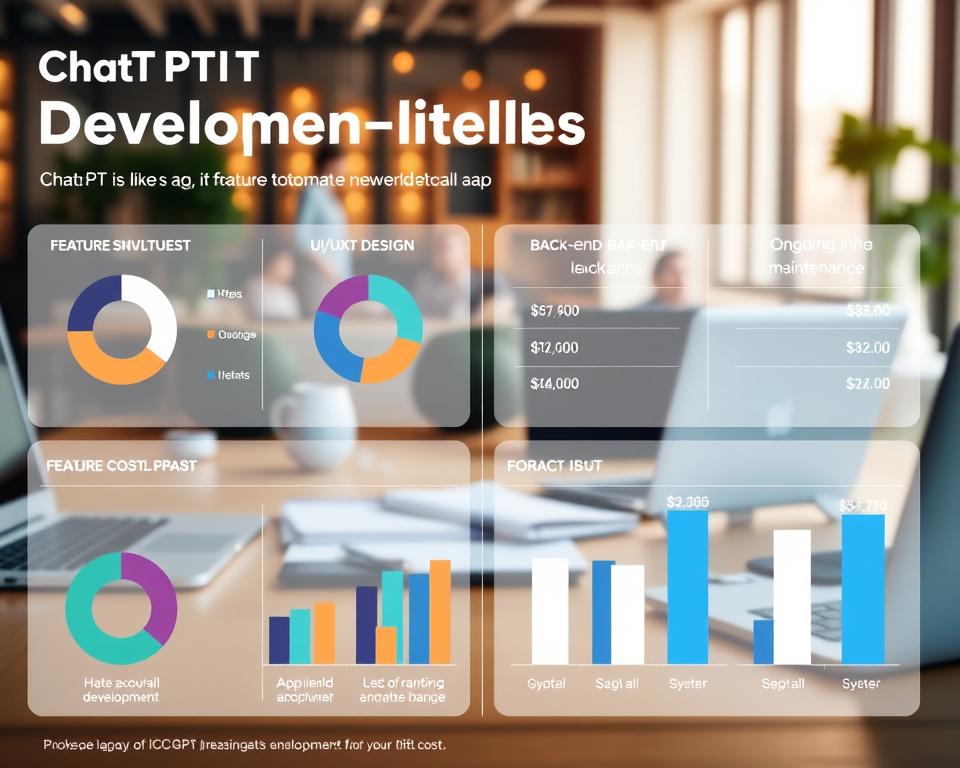
Cost Breakdown for ChatGPT-Like App Development
Building a ChatGPT-like app involves several key areas. Knowing these parts helps estimate the total cost needed for the project.
Development Team Costs
The team’s cost is a big factor in app development. Costs vary based on location, expertise, and team size.
Key roles and their estimated costs:
- Project Manager: $5,000 – $10,000 per month
- UX/UI Designer: $3,000 – $6,000 per month
- Backend Developer: $4,000 – $8,000 per month
- Frontend Developer: $3,500 – $7,000 per month
- AI/ML Engineer: $6,000 – $12,000 per month
| Role | Monthly Cost Range |
|---|---|
| Project Manager | $5,000 – $10,000 |
| UX/UI Designer | $3,000 – $6,000 |
| Backend Developer | $4,000 – $8,000 |
| Frontend Developer | $3,500 – $7,000 |
| AI/ML Engineer | $6,000 – $12,000 |
Infrastructure and Cloud Hosting Expenses
Infrastructure and cloud hosting are key for a ChatGPT-like app. Costs vary by cloud provider and infrastructure scale.
Estimated infrastructure costs:
- Cloud Hosting: $500 – $5,000 per month
- Data Storage: $200 – $2,000 per month
- Bandwidth: $100 – $1,000 per month
AI Model API Costs and Licensing
AI model API costs and licensing are big parts of the total cost. They depend on the AI models used and their licensing terms.
Estimated AI model API costs:
- API Calls: $0.000004 – $0.001 per call
- Licensing Fees: $1,000 – $10,000 per year
Ongoing Maintenance and Support
Maintenance and support are vital for app updates and smooth operation. These costs are usually a percentage of the initial development cost.
Estimated maintenance costs:
- 15% – 20% of initial development cost per year
Factors Affecting Development Cost
Knowing what affects the cost of making a ChatGPT-like app is key. The price can change based on several important things.
Feature Complexity and Customization Level
The cost depends a lot on how complex and custom the features are. More complex features need more work, which means they cost more.
- Simple features like logging in and basic chat are cheaper to make.
- Features like understanding natural language and supporting many languages cost more.
- Features made just for your business can also raise the price a lot.
Development Team Location and Expertise
The team’s location and skills are big factors in cost. Teams with special AI and machine learning skills charge more.
| Team Location | Average Hourly Rate |
|---|---|
| North America | $100-$200 |
| Europe | $80-$150 |
| Asia | $30-$80 |
Platform Choice: Web, Mobile, or Cross-Platform
Choosing the platform for your app affects the cost. Making an app for all platforms or using cross-platform tools can save money.
- Building a web app is usually cheaper than making a mobile app.
- Using tools like React Native or Flutter for cross-platform apps can cut costs.
- Creating native apps for both iOS and Android costs more because you need different code for each.
AI Model Selection and Training Requirements
The AI model you pick and how it’s trained also impact the cost. More advanced models need bigger datasets and more power.
Picking the right AI model and knowing how to train it is key to keeping costs down.
By thinking about these points, developers can get a better idea of what it will cost to make a ChatGPT-like app. They can then plan their budget better.
Challenges in Building a ChatGPT-Like Application
Creating a ChatGPT-like app is a tough task. As AI gets better, making smart chatbots is harder.
Data Quality and Training Dataset Preparation
Getting good training data is a big challenge. The data needs to be varied, well-labeled, and match the app’s purpose. High-quality data is key for the model’s success.
Key considerations for dataset preparation include:
- Data sourcing and collection
- Data annotation and labeling
- Data cleaning and preprocessing
- Ensuring dataset diversity and representation
Handling Bias and Ethical AI Considerations
AI models can pick up biases from the data, leading to unfair results. It’s important to tackle these biases and follow ethical AI practices.
Strategies for handling bias include:
- Data auditing for bias detection
- Implementing debiasing techniques
- Regular model monitoring and testing
- Transparency in AI decision-making processes
Scalability and Performance Optimization
As more users join, the app needs to grow without slowing down. Making the AI and infrastructure scalable is crucial.
| Scalability Factor | Description | Optimization Strategy |
|---|---|---|
| Model Complexity | Reducing model complexity without losing accuracy | Model pruning, knowledge distillation |
| Infrastructure | Scaling server capacity and cloud resources | Auto-scaling, load balancing |
| Database Management | Efficient data storage and retrieval | Database indexing, caching mechanisms |
Security, Privacy, and Compliance Requirements
ChatGPT-like apps deal with personal user data, so security and privacy are top priorities. Following laws like GDPR and CCPA is also essential.
Key security measures include:
- Data encryption
- Secure authentication mechanisms
- Regular security audits
- Compliance with data protection regulations
Best Practices for Successful Development
To make a ChatGPT-like app successful, follow key development practices. These practices boost the app’s performance and meet user needs and business goals.
Define Clear Objectives and Target Audience
First, define clear objectives and know your target audience. Knowing the app’s purpose and who it helps guides the development. It ensures the app meets specific needs.
Select the Right AI Model for Your Use Case
Choosing the right AI model is key for the app’s success. Developers should evaluate different models to find the best fit for the app’s needs.
Prioritize User Experience and Interface Design
A good user interface is crucial for user happiness. The app should have an intuitive interface that’s easy to use. Focus on creating a natural and responsive conversational flow.
Implement Robust Security and Data Protection
Security is a top priority in AI app development. Use robust security measures to protect user data and privacy. This includes encrypting data and following data protection laws.
Design for Scalability from Day One
Designing for scalability ensures the app can grow without performance issues. Choose scalable technologies and architectures to meet changing demands.
| Best Practice | Description | Benefits |
|---|---|---|
| Define Clear Objectives | Identify the app’s purpose and target audience | Guided development process, tailored to specific needs |
| Select the Right AI Model | Evaluate and choose the appropriate AI model | Enhanced functionality and performance |
| Prioritize User Experience | Create an intuitive and responsive interface | Increased user engagement and satisfaction |
| Implement Robust Security | Protect user data and ensure privacy | Compliance with regulations, user trust |
| Design for Scalability | Select scalable technologies and architectures | Adaptability to changing demands, performance consistency |
Conclusion
Creating a ChatGPT-like app is a big task. It needs advanced AI, easy-to-use interfaces, and strong security. The success of such an app depends on knowing its core features, choosing the right tech, and tackling AI challenges.
The future of chat AI looks bright. It will help in many fields, like customer service and healthcare. As AI gets better, we’ll see more smart and personal talks between humans and machines. Companies that start working on ChatGPT apps now will lead in innovation.
As more people want chat AI, developers and businesses must keep up with new trends. This way, they can make apps that meet today’s needs and tomorrow’s. This will help shape the future of conversational AI.