





Businesses often face a big choice: should they use off-the-shelf tools or custom software development? Off-the-shelf tools might seem cheaper at first. But they can cause problems and extra costs later because they’re made for everyone.
Tailor-made software, on the other hand, is made just for your business. It makes things run smoother and saves money in the long run. Custom software boosts productivity and cuts down on costs.
Table of Contents
Key Takeaways
- Custom software is designed to meet specific business needs, improving efficiency.
- Off-the-shelf tools can lead to additional costs due to their generic functionality.
- Investing in custom software can result in significant long-term cost savings.
- Tailor-made software enhances productivity by streamlining business processes.
- Custom software development offers long-term benefits for businesses.
The Software Dilemma: Custom vs Off-the-Shelf Solutions
Businesses often face a big decision: custom software or off-the-shelf products. This choice affects the initial cost and long-term efficiency. It shapes the company’s operational costs.
Defining Custom Software Development
Custom software is made just for a company. It solves unique challenges and opportunities. It’s built from scratch to fit the company’s needs perfectly.
Understanding Off-the-Shelf Software Products
Off-the-shelf software is ready-made and available to many. It’s designed for a wide market, offering a universal solution. While cheaper upfront, it might need businesses to change their ways to fit the software.
The Initial Cost Perception Gap
The cost difference between custom and off-the-shelf software is big. Custom software needs a big upfront investment. Off-the-shelf seems cheaper at first.
Upfront Investment vs Long-term Value
Costs of software solutions go beyond the first payment. It’s important to look at long-term value. Here’s a simple comparison of costs over time.
| Cost Component | Custom Software | Off-the-Shelf Software |
|---|---|---|
| Initial Development/Purchase Cost | High | Low |
| Customization Costs | Low (built to spec) | High (if customizable) |
| Maintenance and Support | Variable (can be in-house) | Recurring (vendor-dependent) |
| Scalability Costs | Lower (designed to scale) | Higher (may require new licenses) |
Understanding these costs is key for businesses. It helps make a choice that fits their goals and budget.

The True Cost Equation: Looking Beyond Purchase Price
Businesses often overlook the full cost of software by ignoring extra fees. It’s key to look at the total cost of ownership to make smart choices.
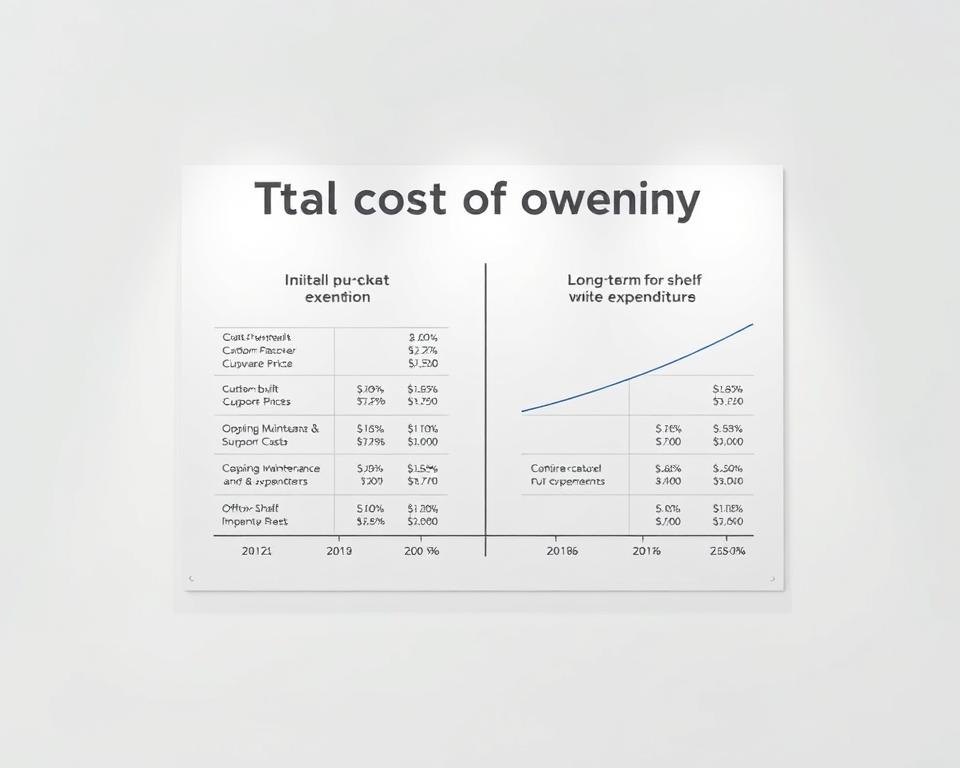
Total Cost of Ownership (TCO) Analysis
Doing a TCO analysis means looking at all costs of software. This includes the initial price, licensing fees, and ongoing costs like support.
Hidden Expenses in Commercial Software
Commercial software can have hidden expenses that raise the total cost. These costs fall into a few main areas:
- Licensing Fees: These ongoing fees can quickly add up.
- Implementation Costs: The cost of setting up new software, including training, can be high.
- Training Expenses: Teaching employees to use new software can also be costly.
Long-term Financial Impact Assessment
It’s crucial to think about the long-term financial effects of software choices. Looking at the total cost and potential return on investment helps make better decisions. For more on custom software vs. off-the-shelf, check out this resource.
Understanding the true cost helps businesses make choices that fit their long-term financial plans.
Why Custom Software Saves Money in the Long Run (vs Off-the-Shelf Tools)
Businesses often find that custom software development leads to reduced operational costs over time. This is due to several key factors that differentiate custom solutions from their off-the-shelf counterparts.
Elimination of Unnecessary Features and Bloatware
One of the primary advantages of custom software is the elimination of unnecessary features and bloatware. Off-the-shelf software often includes a wide range of functionalities to appeal to a broad user base, many of which may not be relevant to a specific business. By opting for custom software, companies can avoid paying for features they don’t need.
Perfect Alignment with Business Processes
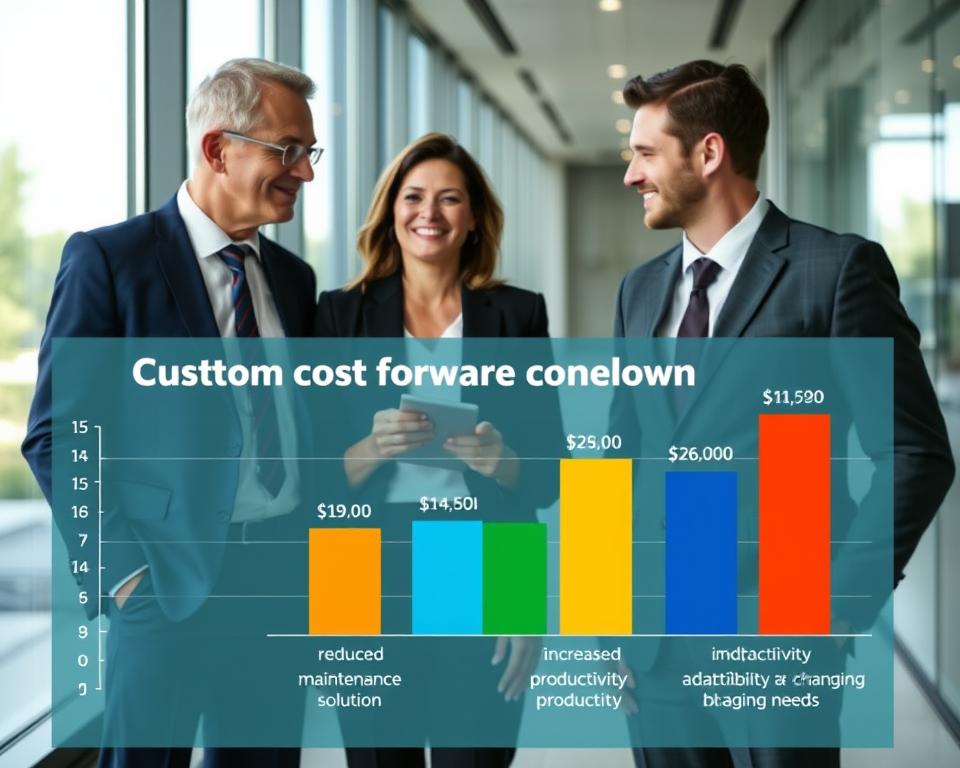
Custom software is designed to align perfectly with a company’s existing business processes. This tailored approach not only enhances efficiency but also reduces the need for workarounds or manual processes that can be time-consuming and costly. For more information on customized software development, visit Next Big Technology.
Reduced Training and Adaptation Costs
Because custom software is designed with the end-user in mind, it typically requires less training and adaptation. Employees can more easily navigate systems that are intuitive and tailored to their workflow, reducing the time and resources spent on training.
Ownership Benefits vs Perpetual Renting
Owning custom software eliminates the need for perpetual renting or licensing fees associated with off-the-shelf products. This ownership model can lead to significant long-term savings. To illustrate the potential savings, consider the following comparison:
| Cost Factor | Custom Software | Off-the-Shelf Software |
|---|---|---|
| Initial Development Cost | Higher | Lower |
| Recurring Licensing Fees | No | Yes |
| Customization Costs | Included | Additional |
| Training Costs | Lower | Higher |
In conclusion, while the initial cost of custom software development may be higher, the long-term benefits and cost savings make it a financially prudent choice for many businesses.
The Subscription Trap: How Recurring Fees Add Up
The subscription trap is a financial pitfall many businesses fall into. At first, the cost seems okay, but over time, it adds up. This can become a big expense.

Annual License Renewal Costs
Annual license renewal costs are a big part of the subscription trap. These costs can be huge, especially for big companies with lots of employees. For example, a company with 100 employees might spend a lot on renewing licenses for productivity software.
| Number of Users | Annual License Cost per User | Total Annual Cost |
|---|---|---|
| 100 | $50 | $5,000 |
| 500 | $50 | $25,000 |
| 1000 | $50 | $50,000 |
Per-User Pricing Models and Their Impact
Per-user pricing models can really hit a company’s wallet. As more users are added, the cost goes up. This can lead to unexpected expenses if not managed well.
“The costs associated with per-user pricing can be staggering, especially for large or growing organizations.”
Escalating Fees Over Time
Over time, the fees for off-the-shelf software can go up. This is often because vendors add new features or upgrade their products. This can mean higher renewal costs.
Vendor Lock-in Consequences
Vendor lock-in happens when a business relies too much on one software vendor. Switching to another solution becomes too expensive or hard. This can mean higher costs and less flexibility.
To avoid the subscription trap, businesses should think about custom software development. As recent analyses show, custom development can save money in the long run and offer more flexibility.
Scalability Economics: Growing Without Breaking the Bank
Growing businesses need software that grows with them without costing too much. Scalability is key for business growth. The right software can make a big difference.
How Custom Solutions Scale with Your Business
Custom software is made for your business’s specific needs. As your business grows, your software can adapt and scale. This means you don’t need big changes or expensive upgrades.
- Flexibility to adapt to changing business needs
- Scalability to handle increased traffic or data
- Ease of integration with new systems or tools
The Cost of Scaling Commercial Software
Commercial software often has limits on how much it can grow. As your business expands, you might face big costs to upgrade or change your software.
Tier Pricing Jumps
Many commercial software solutions have tiered pricing. As you grow, you’ll need to move to higher tiers. This can be expensive.
Enterprise Edition Upsells
Some software vendors offer basic versions at lower prices. But, they charge more for “enterprise” editions with advanced features or support.

Future-Proofing Your Technology Investment
Investing in custom software is a smart move for the future. It lets you adapt to future challenges and opportunities. This way, you’re ready for anything.
Key benefits include:
- Reduced dependency on specific vendors
- Ability to innovate and differentiate
- Long-term cost savings through scalability and adaptability
By choosing custom software, businesses can make a smart, scalable, and future-proof technology investment.
Integration Capabilities: The Hidden Cost Saver
Custom software offers a big advantage by fitting smoothly into your current systems. This saves money by improving data flow and cutting down on the cost of middleware. It’s designed to work well with what you already have, making it easier and cheaper to connect different systems.
Seamless Connection with Existing Systems
Custom software is made to work perfectly with your systems, making things more efficient. It gets rid of the need to manually move data between systems. This cuts down on mistakes and boosts productivity.

Avoiding Middleware and Connector Expenses
By making software that connects directly with your systems, you skip the extra costs of middleware and connectors. This saves money upfront and keeps costs down over time.
Data Flow Optimization Benefits
Custom software makes sure data flows well between systems. This means your information is always up-to-date and correct. It helps you make better decisions and work more efficiently.
Automation Opportunities
Optimized data flow also opens up chances for automation. With data always available and correct, you can automate many tasks. This cuts down on costs and boosts productivity even more.
| Integration Benefits | Cost Savings | Operational Efficiency |
|---|---|---|
| Seamless Connection | Reduced Middleware Costs | Improved Data Accuracy |
| Data Flow Optimization | Minimized Manual Data Transfer | Enhanced Productivity |
| Automation Opportunities | Lower Operational Costs | Increased Efficiency |
Maintenance and Support: Controlling Ongoing Expenses
Custom software development helps control maintenance and support costs. It’s different from off-the-shelf solutions that can have hidden costs. Custom software lets businesses manage their expenses better.
Self-Directed Maintenance vs Vendor Dependence
Custom software allows businesses to handle maintenance themselves. This means they don’t need the original vendor for updates or fixes. They can make changes in-house or with a chosen developer, avoiding vendor lock-in.
For example, a company with a custom CRM system can update it without waiting for a vendor. This saves money and lets them respond quickly to business changes.
Predictable Support Costs
Custom software makes it easier to predict support costs. Companies can plan maintenance and allocate resources better. This is a big plus compared to commercial software, where costs can be unpredictable.
| Support Aspect | Custom Software | Off-the-Shelf Software |
|---|---|---|
| Maintenance Control | In-house or chosen developer | Vendor-dependent |
| Cost Predictability | High | Variable |
| Upgrade Flexibility | Flexible | Limited |
Avoiding Forced Upgrades and Migrations
Commercial software vendors often push for upgrades, which can be costly. Custom software lets businesses choose when to update, avoiding forced upgrades.
End-of-Life Software Challenges
Off-the-shelf software can reach end-of-life, where support stops. Custom software can be updated forever, as the company controls its evolution.
Choosing a reliable custom solutions development company is key. Companies like those on Next Big Technology can provide the needed support and maintenance.

Real-World Success Stories: Custom Software ROI in Action
Custom software ROI can be huge for businesses. They see big financial gains and better operations when they use software made just for them. Companies in many fields have seen great results from custom software.
Manufacturing Industry Case Study
A top manufacturing company made a special production planning system. It worked with their ERP software. This helped them plan better, cut waste, and get things to customers faster.
They saved 15% on production costs and 20% more on-time deliveries in just one year.

Healthcare Organization Implementation
A big healthcare group got custom software for managing patient data and scheduling. It made data more accurate, cut down on paperwork, and made patients happier.
They spent 30% less on admin and 25% more on patient happiness.
Financial Services Transformation
A financial company made custom software for better risk checks and following rules. It made complex tasks easier, reports more accurate, and cut down on mistakes.
They saved 40% on risk checks and 35% on following rules.
Key Metrics and Outcomes
Looking at key metrics shows how custom software helps. Here’s a table with results from the examples above:
| Industry | Key Metric | Improvement |
|---|---|---|
| Manufacturing | Production Costs | 15% reduction |
| Manufacturing | On-time Deliveries | 20% increase |
| Healthcare | Administrative Costs | 30% reduction |
| Healthcare | Patient Satisfaction | 25% improvement |
| Financial Services | Risk Assessment Processing Time | 40% reduction |
| Financial Services | Compliance-related Costs | 35% decrease |
For more on custom software costs, check out our guide on CRM software development costs.
Competitive Advantage: Monetizing Your Software Investment
Custom software does more than just make things run smoothly. It can give you a big edge over others. By making software just for your business, you can add special features that make you stand out.

Proprietary Features as Revenue Generators
Custom software lets you create proprietary features that can make money. These special features can be used to offer top-notch services or products. This makes your business unique in the market.
- Make unique features that meet specific customer needs.
- Offer premium services or products with your custom software.
- Look into licensing your custom software to other companies.
Market Differentiation Through Custom Functionality
In a busy market, custom functionality can be what sets you apart. By investing in software made just for your business, you can offer something special. This attracts and keeps customers.
- Study your competitors to find what they’re missing.
- Make custom features that meet these needs and more.
- Use your custom software to give customers a better experience.
Intellectual Property Value Creation
Creating custom software can lead to valuable intellectual property. This IP can be protected and even licensed, adding to your income.
Potential for Licensing Your Solution
Good custom software can be licensed to other companies with similar problems. This not only brings in money but also makes your company a leader in your field.
By investing in custom software, businesses can gain a lasting edge. They can make money with unique features and create valuable intellectual property. This smart move can lead to lasting success and set you apart in the market.
Risk Mitigation: Avoiding Costly Software Failures
Choosing custom software helps businesses avoid risks like vendor lock-in and security issues. It lets companies control their software, reducing reliance on outside vendors.
Vendor Dependency Risks with Commercial Software
Using commercial software can tie a company to one vendor. This makes it hard and expensive to switch to other options. For example, custom software development offers tailored solutions, avoiding these issues.
- Loss of control over software development and updates
- Potential for vendor pricing strategies to impact budget
- Limited flexibility in customizing the software
Obsolescence and End-of-Life Concerns
Commercial software has unpredictable lifecycles, with vendors ending support suddenly. Custom software, however, can be updated as needed, keeping it relevant and supported.
Custom software offers several benefits:
- Long-term viability due to in-house control
- Ability to adapt to changing business needs
- Avoidance of costly migrations or upgrades forced by vendor decisions
Security Vulnerability Management
Custom software is designed with specific security needs in mind. This makes it more secure than commercial software, which has a wider attack surface.
Compliance and Regulatory Control
Custom software gives companies better control over compliance. This is crucial in regulated industries like healthcare and finance, where non-compliance can lead to big fines.
Custom software development reduces costs and boosts efficiency and security.
Decision Framework: Determining the Right Approach for Your Business
Finding the right software for your business is a detailed process. It depends on your company’s size, how complex it is, and what your industry needs. Choosing between custom software and off-the-shelf solutions is a big decision. It depends on many factors.
Business Size and Complexity Considerations
The size and complexity of your business are key in picking software. Big, complex companies often need custom software to fit their unique needs. Smaller businesses might find off-the-shelf solutions work well for their simpler tasks.
Industry-Specific Requirements Analysis
Each industry has its own needs that off-the-shelf software might not meet. For example, healthcare needs software that follows HIPAA rules, and finance needs software that’s very secure. Custom software can be made to meet these specific needs.
Hybrid Approaches for Optimal Value
At times, a mix of both off-the-shelf and custom software is the best choice. This means using off-the-shelf software for common tasks and custom software for special, important tasks. For instance, a company might use a commercial CRM but also create custom manufacturing systems.
When Off-the-Shelf Makes Sense
Off-the-shelf software is good when your business needs are simple and not complex. It’s also a good choice for small businesses or startups with limited budgets. Examples include basic accounting software or general office tools.
When Custom Development Is Essential
Custom software is needed when your business has unique processes or needs that commercial products can’t meet. This is common in industries with special operations, like advanced manufacturing or finance and healthcare, which have strict rules.
| Criteria | Off-the-Shelf Software | Custom Software |
|---|---|---|
| Cost | Lower upfront costs | Higher initial investment |
| Customization | Limited flexibility | Tailored to specific needs |
| Scalability | May require additional licenses | Scales with business needs |
| Integration | May require middleware | Seamless integration with existing systems |
Implementation Strategies: Maximizing Return on Custom Development
Getting the most out of custom software development is key. A well-thought-out plan ensures your software does what it’s meant to do. This makes sure it brings value to your business.
Phased Development to Distribute Costs
Breaking down software development into phases is smart. It spreads out the costs, easing the financial burden. This way, you can test and improve the software step by step. It helps ensure it meets your needs perfectly.
Agile Methodologies for Early Value Capture
Agile methods are another great strategy. They let you start seeing benefits early on. Agile also means you can easily change things as needed. This keeps your project on track with your goals.
Selecting the Right Development Partner
Choosing the right partner is crucial for success. Look for someone with the right skills, experience, and fit. A good partnership makes development smoother, improves software quality, and boosts ROI.
In-House vs Outsourced Development Economics
Deciding between in-house and outsourced development is important. In-house gives you control but costs a lot upfront. Outsourced can save money but managing vendors can be tricky.
| Development Approach | Cost Considerations | Benefits |
|---|---|---|
| In-House Development | High upfront costs for talent and infrastructure | Direct control, immediate oversight |
| Outsourced Development | Reduced upfront costs, variable vendor costs | Access to specialized expertise, reduced infrastructure needs |
Conclusion: Making the Long-Term Investment Decision
When looking at software options, businesses need to think about the long run. Custom software is a great choice because it fits exactly what a company needs. It’s not just a one-size-fits-all solution.
Custom software saves money by cutting out features you don’t need and reducing training costs. It also grows with your business, avoiding expensive updates. For those ready to invest in software for the long haul, custom is a smart pick.
Choosing custom software depends on knowing your business’s specific needs and the savings it can bring over time. By looking at the total cost and benefits, companies can make a choice that helps them grow and stay profitable.