






Creating a digital product needs a clear plan and a strong foundation. It must grow with your user base without slowing down. Our team crafts secure software that meets your business goals.
Starting a Scalable SaaS means planning for growth from day one. Using a cloud-native architecture keeps your system fast and responsive, even with lots of users. This makes your software ready for big traffic and worldwide use.
We handle the platform development from start to launch. Our experts create secure subscription models for growth from MVP to full enterprise. True success is in designing a product that grows with the market.
Table of Contents
Key Takeaways
- Design for long-term growth starting with the initial concept.
- Implement modern structures to maintain high system performance.
- Build secure and reliable models for subscription management.
- Transition smoothly from a minimum viable product to enterprise scale.
- Ensure high availability for users across the globe.
- Optimize technical costs during periods of rapid expansion.
What Are Scalable SaaS Platforms and Why They Matter
SaaS platforms that scale well can handle more users and traffic without slowing down. This is key for companies wanting to grow and reach more customers.
Defining Software as a Service Scalability
SaaS scalability means a software can handle more users without losing performance. It’s about the app’s design and the tech behind it.
The Business Case for Scalable Architecture
Scalable architecture is vital for growth. It lets companies add more users without spending a lot. It supports exponential growth, keeps users happy, and runs smoothly.
Market Demands Driving SaaS Scalability
The market wants flexibility, reliability, and cost-effectiveness in SaaS. Companies must quickly adjust to new needs and trends.
| Demand | Description | Impact on SaaS |
|---|---|---|
| Flexibility | Ability to adapt to changing business needs | Enables quick responses to market changes |
| Reliability | Consistent performance under varying loads | Maintains user trust and satisfaction |
| Cost-Effectiveness | Efficient resource utilization | Reduces operational costs |

Understanding these points helps businesses see why scalable SaaS platforms are crucial today.
Key Benefits of Scalable SaaS Platform Development Services
Scalable SaaS platforms help businesses grow without losing performance. They offer many benefits that improve profits and customer happiness.
Supporting Exponential User Growth
A scalable SaaS platform handles sudden user increases easily. This means your platform can grow with your business, keeping users happy.
Key advantages of supporting exponential user growth include:
- Increased customer satisfaction due to consistent performance
- Improved brand reputation as the platform can handle high traffic
- Better scalability for future growth, allowing for more aggressive marketing strategies
Optimizing Infrastructure Costs
Scalable SaaS platforms help businesses save on infrastructure costs. They only use what they need, scaling up or down as needed.
For example, a company might use custom SaaS development services to create a cloud solution that adjusts resources based on demand.
Ensuring Consistent Performance Under Load
Scalable SaaS platforms keep performing well even when busy. This is key because, as noted, “Performance and reliability are product features. Slow dashboards, delayed notifications, or frequent downtime quickly erode trust.”
Businesses can use strategies like load balancing and auto-scaling to keep their SaaS platform fast and reliable. This is especially important during busy times.
In conclusion, scalable SaaS platforms offer many benefits. They support rapid user growth, save on infrastructure costs, and ensure performance even when busy. By using these benefits, businesses can create a strong and reliable SaaS solution that grows with them.

Essential Architecture Components for SaaS Scalability
To grow, SaaS platforms need specific parts in their design. A good architecture is key for a SaaS to handle more users and data. It keeps the platform running smoothly even when it gets busier.
Microservices vs Monolithic Architecture
Choosing between microservices and monolithic architecture is important. Microservices architecture splits the app into smaller, independent parts. Each part can be updated and scaled on its own. On the other hand, a monolithic architecture keeps everything together in one unit.
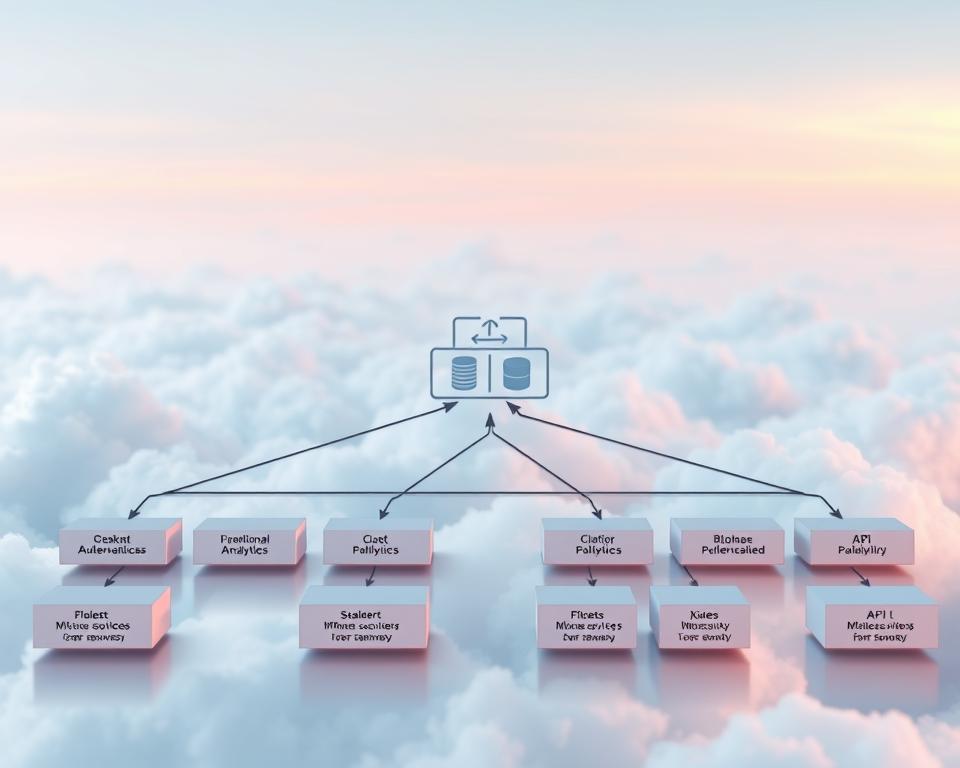
Database Sharding and Partitioning
Database sharding and partitioning spread data across servers, making it easier to manage. Database sharding divides data into smaller pieces called shards. Partitioning splits big tables into smaller ones for better data handling.
Stateless Application Design
A stateless app design is vital for scalability. In this design, each request from the client has all the needed info. This makes scaling and handling errors easier.
By using microservices, database sharding, and stateless design, SaaS platforms can grow. They can meet the needs of more users and changing business goals.
Cloud Infrastructure Selection and Setup
Choosing the right cloud infrastructure is key for a scalable SaaS platform. The cloud makes scaling easier but can be pricey if not managed well.
You have several cloud providers to choose from, like AWS, Azure, and Google Cloud Platform. Each offers services that help your SaaS app scale.
AWS, Azure, and Google Cloud Platform Comparison
The three major cloud providers have unique strengths. Here’s a look at their main features:
| Feature | AWS | Azure | Google Cloud |
|---|---|---|---|
| Scalability | Highly scalable with auto-scaling | Supports large-scale applications | Global scalability with load balancing |
| Security | Robust security features | Advanced threat protection | Enterprise-grade security |
| Cost | Pay-as-you-go pricing | Hybrid pricing models | Competitive pricing with discounts |
Kubernetes and Container Orchestration
Kubernetes is a top tool for managing containers. It helps you scale and manage containerized apps efficiently. It automates deployment and scaling across clusters of hosts.

Serverless Computing Options
Serverless computing, like AWS Lambda, Azure Functions, and Google Cloud Functions, lets you run code without servers. This can cut costs and boost scalability.
By picking and setting up your cloud infrastructure wisely, your SaaS platform will be scalable, secure, and cost-effective.
Multi-Tenancy Models for SaaS Applications
Multi-tenancy is key for SaaS apps, affecting scalability, security, and cost. SaaS providers aim to give secure, isolated spaces for many companies on one platform. Choosing the right multi-tenancy model is crucial.
Each model has its pros and cons for serving many tenants. A good multi-tenancy setup lets SaaS apps grow well while keeping data safe and separate.
Single-Tenant Architecture Considerations
Single-tenant architecture means each tenant gets their own app instance. This offers better security and customization. But, it can be pricey and hard to manage for many users.
Multi-Tenant Data Isolation Strategies
In multi-tenancy, keeping data separate is vital. Ways to do this include database-level isolation and row-level security. Database-level isolation uses separate databases or schemas for each tenant. Row-level security isolates data in a shared database.
- Database-level isolation
- Schema-level isolation
- Row-level security
Hybrid Tenancy Approaches
Hybrid models mix single-tenant and multi-tenant features. They aim for a balance between growth, security, and cost. For example, a SaaS app might use multi-tenancy for small clients and single-tenancy for big ones.

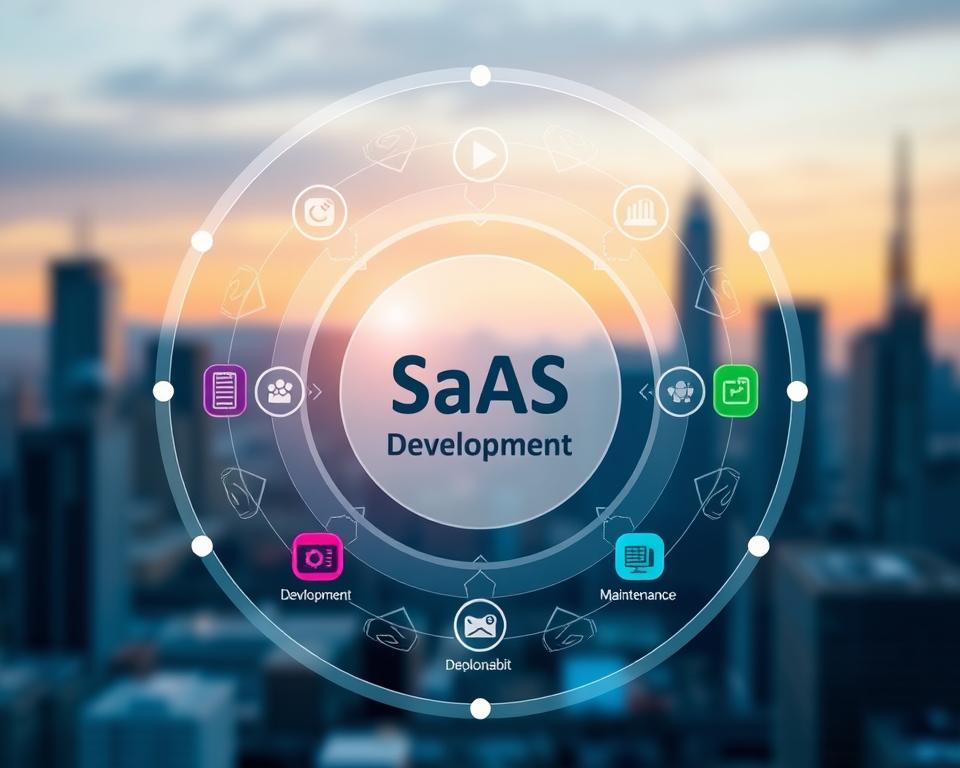
The Complete SaaS Development Lifecycle
A well-structured SaaS development lifecycle is key for a successful platform. It includes several stages to ensure the product meets market needs and grows with demand.
Requirements Gathering and Planning
The first step is gathering requirements and planning. This phase is vital for defining the project’s scope and identifying target audiences. It also involves market research and competitor analysis to meet real market needs.
MVP Development and Validation
The next step is MVP (Minimum Viable Product) development. The MVP has the core features needed to satisfy early users and validate the product. This stage is crucial for testing the market and the product’s value with minimal investment.
Iterative Development Sprints
After validating the MVP, the development moves to iterative development sprints. These sprints involve cycles of development, testing, and feedback. This approach ensures continuous improvement and adaptation to user needs and market changes.
Deployment and Launch Strategy
The final stage is the deployment and launch strategy. This involves planning the rollout, including infrastructure setup and marketing preparations. A well-planned launch is essential for a successful market entry and long-term success.
By following this lifecycle, businesses can ensure their platform is scalable and meets evolving user needs.
Performance Optimization Strategies
Improving performance is key in SaaS development. It affects how users feel and how well a business does. As SaaS apps grow, they must stay fast and work well even when more people use them.
Load Balancing and Auto-Scaling
Load balancing and auto-scaling are vital. They spread traffic evenly and adjust server numbers as needed. This makes apps faster and uses resources better.
- Load Balancing: Spreads traffic across many servers to avoid one server getting too busy.
- Auto-Scaling: Changes server numbers based on demand, making sure resources are used well.
Caching Mechanisms and CDN Integration
Caching and CDNs can make apps much faster. Caching stores data in memory, and CDNs speed up static content by placing it closer to users.
“Caching is a powerful technique for improving application performance by reducing the need to repeatedly fetch or compute the same data.”
Creating a strong caching plan means:
- Using Redis for quick data access.
- Using CDNs to speed up static content by placing it near users.
Database Query Optimization
Improving database queries is crucial for SaaS apps. This includes indexing, making queries simpler, and getting data efficiently.

By using these strategies, SaaS companies can keep their apps fast and ready for more users.
Security Architecture for Enterprise SaaS Platforms
In the world of enterprise SaaS, security is key, not just a feature. These platforms deal with sensitive data and grow complex. Their security must keep up to fight new threats and keep users’ trust.
End-to-End Encryption Implementation is vital for SaaS security. It makes data unreadable if stolen, keeping it safe. This is crucial for companies with sensitive info.
End-to-End Encryption Implementation
Setting up end-to-end encryption needs careful planning. It means choosing the right encryption and securing all data paths. This protects against outside threats and insider breaches.
Role-Based Access Control Systems
Role-Based Access Control (RBAC) is also key. It limits who can see or change sensitive data. This lowers the chance of data leaks. A good RBAC system is flexible and detailed.
Good RBAC means clear roles and the right permissions. It also means checking access often to match business changes and role shifts.
Penetration Testing and Security Audits
Regular Penetration Testing and Security Audits find and fix weaknesses. They keep the SaaS platform’s security strong against new threats.
With end-to-end encryption, RBAC, and security checks, SaaS platforms can protect data well. This keeps users’ trust.

Compliance and Data Governance
For SaaS companies serving users worldwide, compliance and data governance are key. They must follow various rules to protect user data. This is especially true when they operate in different regions.
GDPR and Data Privacy Requirements
The General Data Protection Regulation (GDPR) is a strict law in the European Union (EU). It controls how companies handle personal data of EU residents. SaaS businesses must get user consent, use data wisely, and allow data to be moved easily.
HIPAA Compliance for Healthcare SaaS
Healthcare SaaS platforms must follow the Health Insurance Portability and Accountability Act (HIPAA). HIPAA protects patient health information. SaaS providers need strong security, like encryption, to keep this information safe.
SOC 2 and ISO Certifications
SOC 2 and ISO certifications show a SaaS company’s dedication to data security. SOC 2 checks if a system is secure and private. ISO certifications, like ISO 27001, mean a company follows global information security standards.
| Compliance Standard | Description | Industry Focus |
|---|---|---|
| GDPR | Regulates personal data protection | General (EU Focus) |
| HIPAA | Protects patient health information | Healthcare |
| SOC 2 | Evaluates security and privacy controls | General (Service Organizations) |
| ISO 27001 | Information security management system | General |

In conclusion, for SaaS companies, compliance and data governance are essential. They help build trust with users and avoid legal issues. By following GDPR, HIPAA, SOC 2, and ISO standards, SaaS companies can thrive in a regulated world.
API Development and Integration Ecosystem
A well-designed API is key for a scalable SaaS platform. It lets businesses connect with many third-party services and tools. This makes the SaaS apps more functional and improves user experience.
RESTful and GraphQL API Design
There are two main API design methods: RESTful and GraphQL. RESTful APIs are simple and scalable. GraphQL APIs are more flexible and efficient. The choice depends on the app’s needs and user requirements.
Webhook Implementation
Webhook implementation is vital for API development. It allows SaaS platforms to send data to external services instantly. This supports features like automated updates and syncs with other tools.
Third-Party Service Integrations
Integrating with third-party services is crucial for expanding a SaaS platform. By linking with services like payment gateways and CRM systems, businesses offer a more complete solution. This benefits users greatly.
DevOps and Continuous Delivery Practices
DevOps and Continuous Delivery change how SaaS apps are made and released. They bring together development and operations for quicker, more reliable updates. Cloud app development companies are using these methods to better their SaaS products.
Effective DevOps and Continuous Delivery include several important parts:
- CI/CD pipeline architecture
- Automated testing frameworks
- Infrastructure as code
CI/CD Pipeline Architecture
A good CI/CD pipeline is key to Continuous Delivery. It automates building, testing, and deploying, leading to faster and more reliable releases. This lets developers write code without worrying about deployment.
Automated Testing Frameworks
Automated testing is vital for SaaS app quality and reliability. Automated testing frameworks help run tests fast, catching problems early.
Infrastructure as Code
Infrastructure as code (IaC) manages infrastructure through code, not manual steps. This improves consistency and cuts down human error. Tools like Terraform and AWS CloudFormation help track and maintain infrastructure changes.
By using DevOps and Continuous Delivery, SaaS providers can make their development and deployment better. This means faster releases, better quality, and happier customers.
Monitoring, Analytics, and Maintenance
SaaS platforms need strong monitoring, analytics, and maintenance to work well. These steps help find and fix problems early. This way, users have a smooth experience.
Real-Time Performance Monitoring
Watching how a SaaS app performs in real-time is key. Observability tools gather data to show how the system works. This helps teams fix problems fast, keeping the app up and running.
User Behavior Analytics
Knowing how users use a SaaS app is important. Analytics tools show trends and what users like or don’t like. This info helps improve the app based on real data.
Proactive Maintenance Strategies
Keeping the app running smoothly means regular checks and updates. This way, problems are caught before they cause big issues. It keeps the app safe and working well.
| Maintenance Activity | Frequency | Benefits |
|---|---|---|
| System Updates | Quarterly | Enhanced Security, Improved Performance |
| Performance Monitoring | Continuous | Early Issue Detection, Reduced Downtime |
| User Feedback Analysis | Monthly | Informed Development Decisions |
For more on building scalable SaaS apps, check outNext Big Technology.
Technology Stack Selection for SaaS Development
Choosing the right technology stack is key for building strong, growing, and safe SaaS apps. The right mix of tech can make your SaaS platform perform better, stay easy to update, and grow well.
The tech stack for SaaS includes frontend, backend, and database layers. Each part is vital for how well the SaaS app works and how well it meets user needs.
Frontend Frameworks and Technologies
Frontend tech is important for making user-friendly and quick interfaces. Some top picks are:
- React: Known for its component-based architecture and virtual DOM, enhancing performance and maintainability.
- Angular: Offers a comprehensive framework with a strong emphasis on structure and maintainability.
- Vue.js: Provides a progressive and flexible framework that is gaining popularity for its simplicity and robust ecosystem.
These frameworks help developers make interactive and fast user interfaces. They can handle complex interactions and show data well.
Backend Languages and Frameworks
The backend is the core of any SaaS app, handling business logic, database work, and integrations. Some top backend techs are:
- Node.js: A JavaScript runtime built on Chrome’s V8 engine, ideal for real-time applications and microservices architecture.
- Python with Django or Flask: Offers a robust ecosystem for building scalable and maintainable backend services.
- Ruby on Rails: Known for its convention over configuration approach, enhancing development speed and maintainability.
These techs give developers the tools and frameworks to build scalable, secure, and easy-to-maintain backend services.
Database Management Systems
Database systems are key for storing and managing data well. Some top picks are:
- MongoDB: A NoSQL database ideal for handling large volumes of unstructured or semi-structured data.
- PostgreSQL: A powerful, open-source relational database known for its reliability and ability to handle complex queries.
- Redis: An in-memory data store that can be used as a database, cache, or message broker, enhancing performance.
Picking the right database system depends on the SaaS app’s data needs, growth goals, and performance needs.
Industry-Specific SaaS Solutions
Industry-specific SaaS solutions are changing how businesses work. They offer custom tools for healthcare, finance, e-commerce, and education. These solutions meet each industry’s unique needs, making work more efficient and productive.
Healthcare and Telemedicine Platforms
Healthcare SaaS solutions focus on managing patients, telemedicine, and data analysis. They let healthcare providers do remote consultations, keep patient records safe, and analyze health data. This helps improve patient care.
Financial Technology Applications
Fintech SaaS platforms offer services like payment processing, lending, and wealth management. They help financial institutions work better, improve customer service, and follow rules.
E-Commerce and Retail Solutions
E-commerce SaaS platforms have tools for managing inventory, processing orders, and handling customer relationships. They help online stores manage their websites, improve supply chains, and make customers happier.
Education and Learning Management Systems
Education SaaS solutions include learning management systems (LMS) for creating, delivering, and tracking courses. These platforms help schools manage courses, check student progress, and make learning better.
| Industry | SaaS Solution | Key Features |
|---|---|---|
| Healthcare | Telemedicine Platforms | Remote consultations, patient record management |
| Finance | Payment Processing | Secure transactions, compliance management |
| E-commerce | Inventory Management | Stock tracking, order fulfillment |
| Education | Learning Management Systems | Course creation, student assessment |
Selecting Your Scalable SaaS Platform Development Services Provider
Choosing the right SaaS development services provider is key to your product’s success. It’s important to find a reliable partner who knows your product strategy and architecture. They should also understand the full SaaS product lifecycle.
Evaluating Technical Expertise and Portfolio
When looking at potential providers, their technical skills and portfolio are crucial. Find a provider with a history of creating scalable SaaS platforms. Check their portfolio for case studies and success stories.
A good provider should know the latest technologies and development methods. Experts say, “A solid technical base is vital for a scalable SaaS platform that meets growing needs.”
Understanding Development Methodologies
It’s important to know the development methods your provider uses. Agile methods like Scrum or Kanban are popular for their flexibility and iterative approach.
- Agile development methodologies
- DevOps practices
- Continuous Integration and Continuous Deployment (CI/CD)
Assessing Post-Launch Support Capabilities
Post-launch support is crucial for SaaS platforms. Your provider should offer full support, including monitoring, maintenance, and updates.
| Support Features | Description |
|---|---|
| Monitoring | Real-time monitoring of platform performance |
| Maintenance | Regular updates and bug fixes |
| Scalability Planning | Planning for future growth and scalability |
Reviewing Client Testimonials and Case Studies
Client feedback and case studies offer insights into a provider’s capabilities. Look for providers with a strong reputation and positive client feedback.
For more information on finding the right development partner, visit Next Big Technology, a trusted resource for businesses seeking top software development companies.
By carefully evaluating these factors, you can choose a SaaS development services provider that meets your needs. This will help drive the success of your scalable SaaS platform.
Investment Considerations and Pricing Models
When planning a scalable SaaS platform, it’s key to grasp investment considerations and pricing models. The cost to build a SaaS platform varies. This depends on the app’s complexity, the tech used, and the team’s skills.
The cost for a SaaS MVP (Minimum Viable Product) can be between $60,000 and $150,000. But, costs like hosting, legal fees, and marketing can add 20-30% more. It’s vital to think about these when budgeting for your SaaS project.
Fixed Price vs Time and Materials
There are two main pricing models in SaaS development: Fixed Price and Time and Materials. The Fixed Price model means a set cost for the whole project, giving clear costs upfront. The Time and Materials model charges for actual time and resources, offering flexibility for changing projects.
Factors Affecting Development Costs
Several things can change the cost of a SaaS platform, including:
- The project’s complexity and scope
- The tech stack and tools used
- The team’s experience and location
- The need for third-party integrations and APIs
Third-Party IntegrationsFew integrationsSeveral integrationsMultiple, complex integrations
| Factor | Low Complexity | Medium Complexity | High Complexity |
|---|---|---|---|
| Project Scope | Limited features | Standard features | Advanced features |
| Technology Stack | Simple, open-source | Standard, commercial | Complex, custom |
| Development Team | Junior developers | Experienced developers | Senior, specialized developers |
Total Cost of Ownership Analysis
Doing a Total Cost of Ownership (TCO) analysis is key to understanding your SaaS’s long-term costs. TCO includes initial costs and ongoing expenses like maintenance, updates, and support. This helps you make better investment decisions for your SaaS.
Conclusion
Building for millions of users isn’t about starting big. It’s about starting smart. Using scalable SaaS platform development and cloud-native architecture helps businesses grow.
A well-designed SaaS platform works well under heavy use. It also saves on costs and grows with users. Focus on user experience, data insights, and security is key.
Working with experienced SaaS development services is beneficial. It helps businesses handle SaaS development’s complexities. For more on successful SaaS strategies, check out Agility Portal’s blog.
A scalable SaaS platform is vital for success in today’s market. Prioritizing scalability helps businesses grow and stay competitive.