






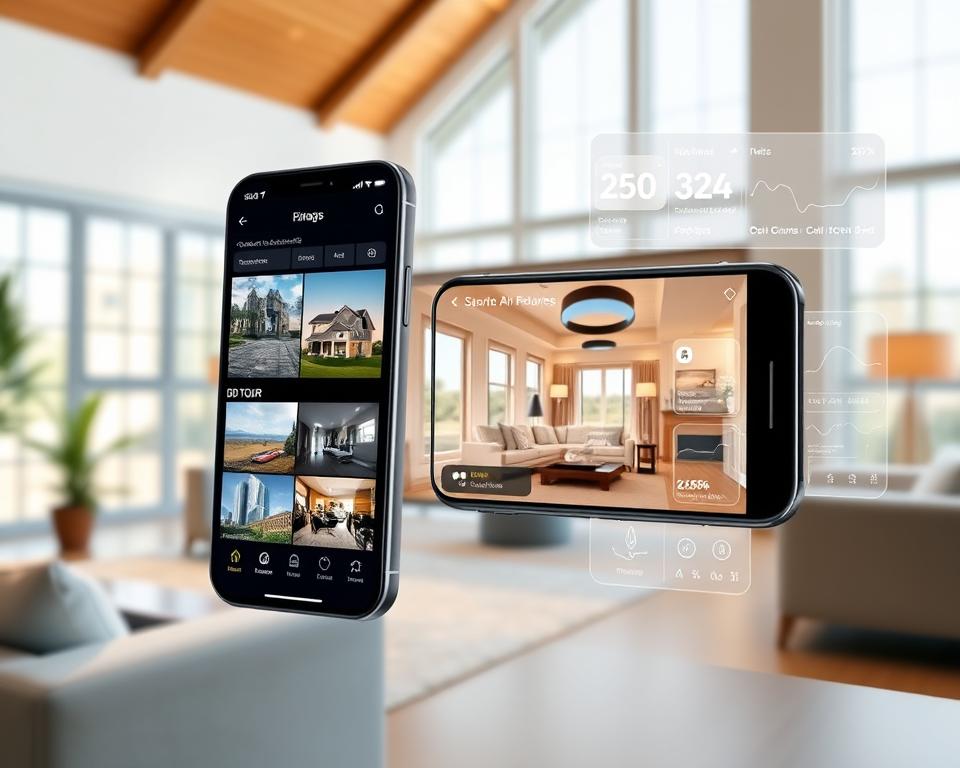
The world of real estate transactions is changing fast. New tech and what users want are leading the way. This change brings us advanced real estate apps that make using them easy and fun.
Today’s real estate apps have cool features like IDX integration and MLS integration. These let users see lots of property listings. Plus, 3D virtual tours let people check out places without leaving home.
AI-powered search makes these apps even better. It gives users property suggestions that fit what they like. As the real estate world keeps growing, apps need to be both useful and easy to use.
Table of Contents
Key Takeaways
- Modern real estate applications are being transformed by advanced technologies.
- IDX and MLS integration provide users with comprehensive property listings.
- 3D virtual tours offer an immersive property exploration experience.
- AI-powered search functionality enhances user experience with personalized recommendations.
- The development of feature-rich real estate apps is crucial for industry success.
The Evolution of Real Estate Technology
Real estate technology has changed a lot. It’s moved from simple online listings to complex AI-driven platforms. This change has greatly affected how real estate businesses work and talk to clients.
From Print Listings to Digital Platforms
The move from print listings to digital platforms was a big step. Digital platforms have made it easier for buyers to find properties online. This has cut down the need for in-person visits and made searching for properties smoother.

The Mobile Revolution in Real Estate
The mobile revolution has also changed real estate a lot. It lets people search for properties on their phones. Mobile apps are now key for real estate businesses. They offer a handy and easy experience for clients.
| Technology | Impact on Real Estate |
|---|---|
| Digital Platforms | Streamlined property search, reduced need for physical visits |
| Mobile Revolution | Enabled on-the-go property search, enhanced user experience |
Why Develop a Real Estate App in 2023?
In 2023, the real estate world is moving fast towards mobile apps. This change comes from how people now use digital tools to find and buy homes. Having a real estate app can really set your business apart.
Market Demand and Opportunities
More and more people want easy-to-use apps for finding and buying homes. This demand opens up big chances for businesses. Here are some key ones:
- Enhanced customer engagement through personalized experiences
- Access to a broader audience through mobile marketing
- Improved operational efficiency through streamlined processes
By making a real estate app, businesses can grab these chances and make a big splash in the market.
Competitive Advantages for Real Estate Businesses
A good real estate app brings many benefits. Here are some:
- Increased visibility through app store listings and in-app marketing
- Improved customer retention through personalized push notifications and updates
- Enhanced data analysis capabilities to inform business decisions
Using these benefits, real estate businesses can stay on top and grow in 2023.

Essential Features for Modern Real Estate Apps
A real estate app’s success depends on its key features. These features should make searching for properties easy. Apps need to offer both basic and new features to stand out.
Core Functionality Requirements
Core features are the heart of any real estate app. These include:
Property Listings and Search
A good app has a big database of properties. It should let users search by location, price, and type. This makes finding properties easier.
User Accounts and Saved Properties
Users can save their favorite properties with accounts. This lets them track changes and new listings. It keeps them engaged.
Advanced Features That Set Apps Apart
Advanced features can make an app better. They can set it apart from others.
Mortgage Calculators and Financing Tools
Mortgage calculators help users figure out their payments. They can see how much they can afford. Tools for financing give insights into different mortgage options.
Neighborhood Information and Analytics
Apps that offer neighborhood information and analytics are valuable. They provide data on schools, crime, and commute times. This helps users understand the area better.
Understanding IDX/MLS Integration
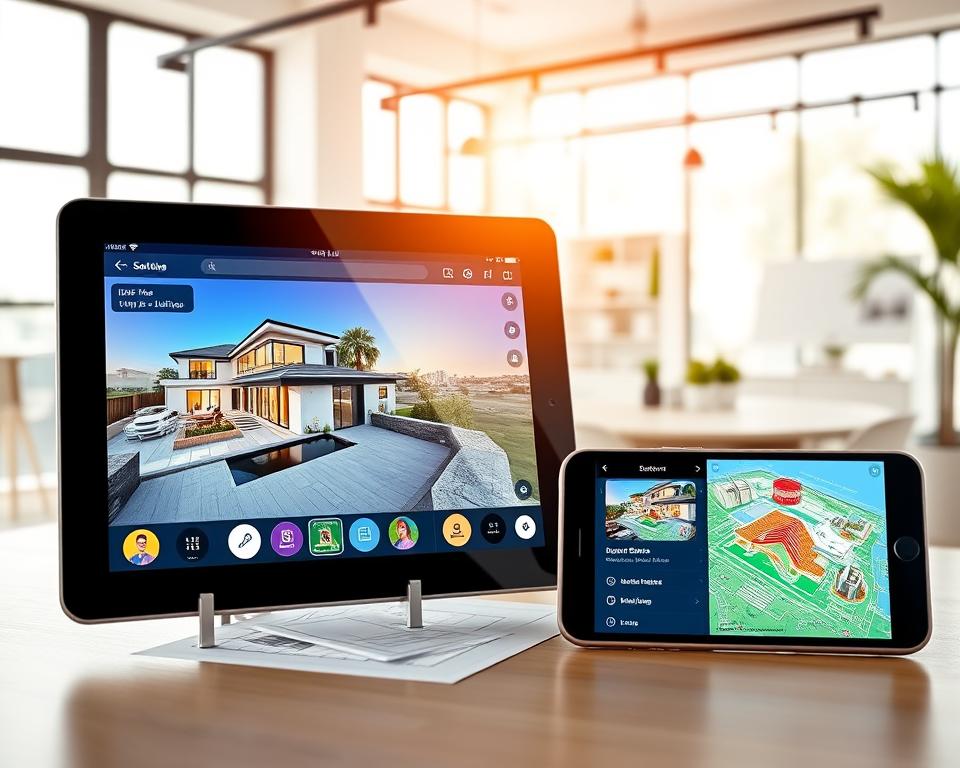
Getting to know IDX/MLS integration is vital for making a top-notch real estate app today. It lets apps show property listings from Multiple Listing Services (MLS). This gives users the latest and most detailed info.
What is IDX/MLS and Why It Matters
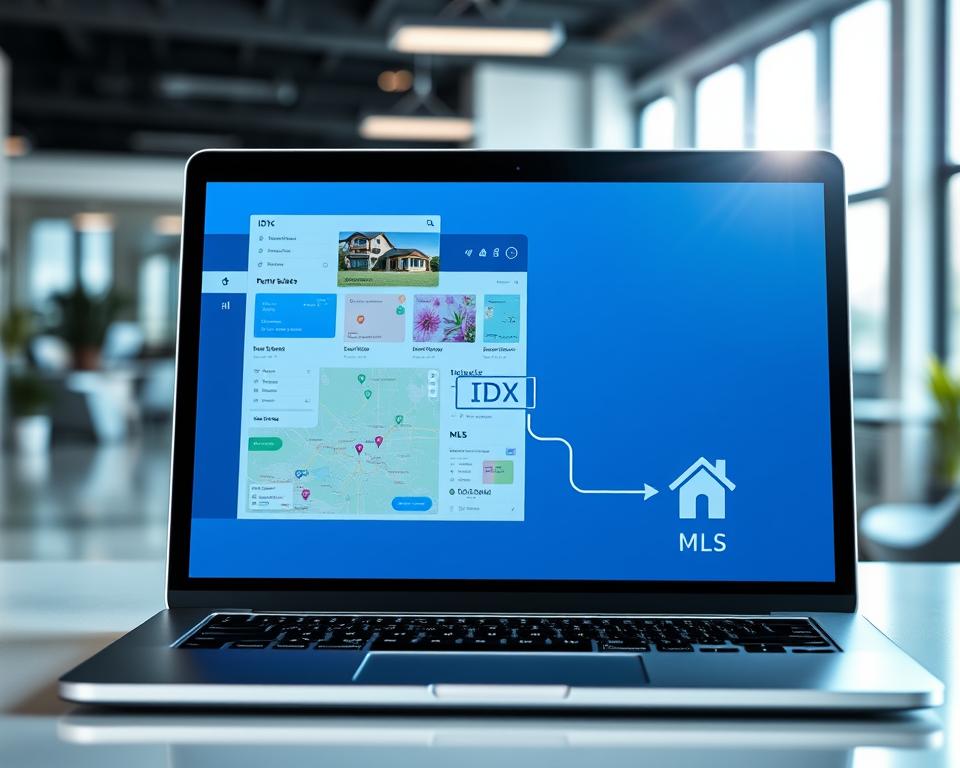
IDX (Internet Data Exchange) makes it easy to share MLS listings on websites and apps. MLS is a big database of properties that agents use to market them. Having IDX/MLS in real estate apps is key. It lets users search properties live from the MLS database, without visiting agent sites.
Key benefits of IDX/MLS integration include:
- Access to a vast database of property listings
- Real-time updates on property availability and status
- Enhanced user experience through comprehensive search functionality
Types of IDX Solutions
There are many IDX solutions for real estate app development. Each has its own features and ways to implement them.
RETS vs. RESO Web API
RETS (Real Estate Transaction Standard) and RESO (Real Estate Standards Organization) Web API are two ways to get MLS listings. RETS is older, while RESO Web API is newer and more flexible.
The main differences between RETS and RESO Web API are:
| Feature | RETS | RESO Web API |
|---|---|---|
| Data Retrieval | Uses a pull-based system | Utilizes RESTful API principles |
| Flexibility | Limited flexibility in data handling | Offers greater flexibility and customization |
Framed IDX vs. FTP IDX vs. API Solutions
Framed IDX, FTP IDX, and API solutions are different ways to add IDX/MLS integration.
- Framed IDX: Shows MLS listings in an iframe on the app, simple but less customizable.
- FTP IDX: Downloads MLS listings via FTP, gives more control over how data is shown.
- API Solutions: Uses APIs to get MLS listings live, for a highly customized and dynamic experience.
Implementing IDX/MLS in Your Real Estate App
Adding IDX/MLS to your real estate app is a big task. It needs careful planning and execution. You must think about the technical needs and the rules you need to follow.
Technical Requirements and Considerations
Several technical things are important when adding IDX/MLS. First, your app must handle the MLS data feed well. This means having a strong backend to update listings fast. Your app also needs to show this data in a way that’s easy for users.
Some key technical things to think about include:
- Data storage and management capabilities
- API integration for real-time updates
- User interface design for easy navigation of IDX/MLS listings
Compliance and Data Management Best Practices
Following National Association of Realtors (NAR) and local MLS rules is key. Your app must follow these rules to avoid legal problems and keep access to MLS data.
NAR and Local MLS Regulations
The NAR has strict rules for MLS data use, like how it’s shown and updated in your app. To follow these rules, you need to:
- Know NAR’s rules on data display and usage
- Follow local MLS rules on data access and privacy
Data Refresh Rates and Synchronization
Keeping listings up to date is crucial. Best practices include:
| Update Frequency | Method | Benefits |
|---|---|---|
| Real-time | API Integration | Ensures up-to-date listings |
| Daily | Batch Updates | Reduces server load |
As
“The key to successful IDX/MLS integration lies in balancing technical capability with regulatory compliance.”
, a principle that shows the importance of a good plan for adding IDX/MLS.
3D Virtual Tours: Transforming Property Viewing
3D virtual tours are changing how we look at properties. They let people see homes online, making it more fun and real.
Technologies Behind 3D Tour Creation
Creating 3D virtual tours needs advanced tech. Companies like Matterport and Zillow 3D Home lead this field.
Matterport, Zillow 3D Home, and Other Solutions
Matterport uses special cameras for detailed 3D models. Zillow 3D Home helps real estate agents show homes online easily.
360° Photography vs. True 3D Modeling
There are two ways to make virtual tours. 360° photography shows a wide view. true 3D modeling lets you move around freely. Knowing the difference helps pick the best option.
| Feature | 360° Photography | True 3D Modeling |
|---|---|---|
| Interactivity | Limited to predefined viewpoints | Fully interactive, allowing users to explore freely |
| Cost | Generally less expensive | More costly due to the complexity of capturing detailed 3D models |
| User Experience | Provides a panoramic view | Offers a more immersive experience with the ability to measure spaces and navigate through properties |
Benefits of Virtual Tours for Buyers and Sellers
Virtual tours help both buyers and sellers. Buyers can see homes easily from anywhere. Sellers get more views and better leads.

Real estate pros can lead by using 3D virtual tours. It helps them serve clients better and stay competitive.
Integrating 3D Tours into Your Real Estate App
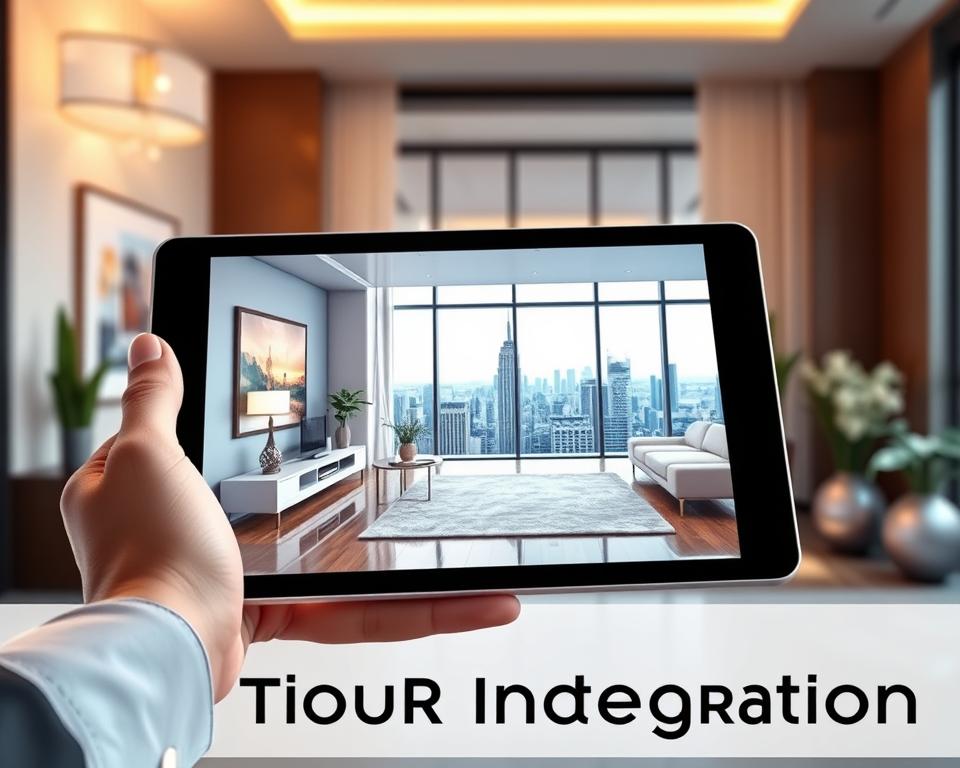
Adding 3D tours to real estate apps is changing how people view properties. It lets potential buyers see places online, making it easier to explore without visiting in person.
Technical Implementation Options
There are two main ways to add 3D tours to real estate apps. You can either embed tours from other sources or create your own using special software.
Embedding Third-Party Tours
Embedding third-party tours means adding existing 3D tours from other providers to your app. This method is faster and uses content that’s already made.
Native 3D Rendering Solutions
Native 3D rendering solutions mean making 3D tours right in your app. This gives you more control and lets you customize the experience for your app.
User Experience Considerations
When adding 3D tours, making the user experience great is key. This ensures the feature works well and is enjoyed by users.
Mobile Performance Optimization
It’s important to make 3D tours work well on mobile devices. This means they load fast and are easy to move around in. Using tricks like compressing models and optimizing textures can help a lot.
Intuitive Navigation Controls
Having controls that are easy to use is crucial for a good experience. Controls that are simple and clear make users happy and keep them engaged.
AI-Powered Search Functionality
The use of AI in real estate apps is changing how we find properties. These apps now offer smarter and more tailored search experiences. This is thanks to advanced algorithms and machine learning.
Beyond Basic Filters: How AI Enhances Property Search
Older property search methods use basic filters like location and price. But AI-powered search adds more advanced features.
Natural Language Processing for Property Search
NLP lets users search for properties in everyday language. For instance, they can look for “homes near good schools” or “properties with a view.”
Image Recognition for Property Features
Image recognition technology analyzes property images. It spots features like hardwood floors or a backyard pool. This makes searching more precise.
Personalization and Recommendation Algorithms
AI personalization and recommendation algorithms improve the user experience. They tailor search results to what each user likes.
User Behavior Analysis
The app analyzes how users behave. It looks at their search history and what properties they view. This helps it give more relevant results over time.
Predictive Property Matching
Predictive property matching uses AI to guess what users might like. It suggests properties that might interest them, even before they search.
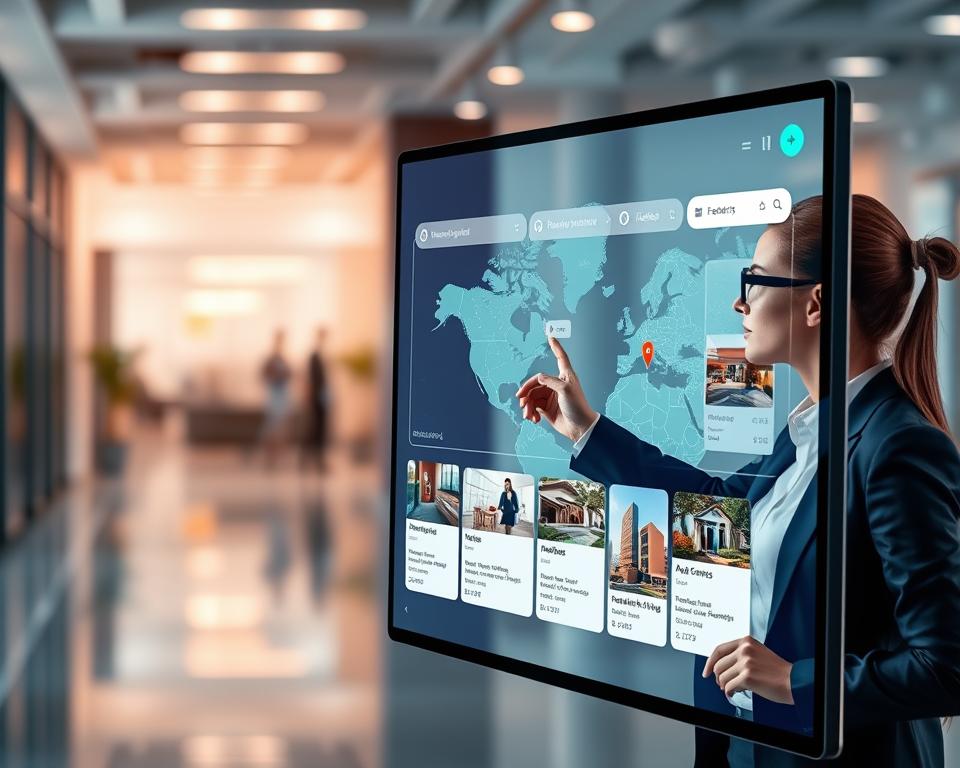
Real estate apps with AI features offer a better search experience. They make finding properties more efficient and fun for users.
Real Estate App Development: IDX/MLS, 3D Tours, AI Search Process
Creating a real estate app with features like IDX/MLS, 3D tours, and AI search is a detailed process. It goes from planning to deployment, making sure the app is useful for its users.
Planning and Research Phase
The first step is planning and research. Here, we figure out who the app is for, what it will do, and look at what others offer. Market analysis is key to knowing what users want.
Design and Development Stages
The design and development stages are crucial in making the app real.
UX/UI Design for Real Estate Applications
UX/UI design is essential for a good user experience. The design should be easy to use, with clear navigation and information.
Development Sprints and Milestones
The development is split into sprints with clear goals. This way, we can adjust to changes or new needs.
Testing and Deployment Considerations
Before launch, we do a lot of testing to find and fix bugs. We also think about how to release the app and follow app store rules.
Building a real estate app is a complex task. By knowing the steps, developers can make apps that are useful and competitive.

Technology Stack for Real Estate App Development
The success of a real estate app depends on its technology stack. Choosing the right frontend, backend, and third-party services is key. It ensures a smooth user experience and meets the real estate market’s demands.
Frontend Technologies
Developers often pick between native iOS and Android or cross-platform frameworks like React Native or Flutter. These options allow for one codebase across platforms. This saves time and money. “Cross-platform development is becoming increasingly popular due to its efficiency and cost-effectiveness,” notes a recent industry report.
Backend and Database Solutions
The backend uses strong frameworks like Node.js or Django. They ensure scalability and security for large data and user interactions. For databases, both MySQL and MongoDB are used, based on the app’s needs.
Third-Party APIs and Services
Adding third-party APIs is key for advanced features in real estate apps. This includes:
- Payment gateways like Stripe or PayPal for secure transactions
- CRM integrations to manage leads and client interactions effectively
- Mapping and geolocation services such as Google Maps to provide accurate property locations and directions
Payment Gateways and CRM Integrations
Payment gateways ensure secure transactions, while CRM integrations manage client relationships and leads. These services are crucial for app efficiency.
Mapping and Geolocation Services
Mapping services are vital for accurate property locations and directions. They improve the user experience by making it easier to find and visualize properties on a map.
By carefully choosing and integrating these technologies, developers can create powerful and user-friendly real estate apps. These apps meet the market’s evolving needs.
Data Security and Compliance in Real Estate Apps
Real estate apps deal with sensitive user data. This makes strong security measures essential. As tech in real estate grows, keeping apps secure and compliant is key. It protects user info and keeps trust high.
Privacy Regulations and Real Estate Data
Real estate apps must follow privacy laws like GDPR and CCPA. These rules say how to handle user data. Following these laws is not just legal; it builds trust with users.
- Understand applicable privacy laws
- Implement data minimization strategies
- Provide clear privacy policies
Securing User Information and Transactions
To keep user info and transactions safe, real estate apps need strong security. This includes:
Authentication and Authorization Best Practices
Strong authentication and access control are crucial. This means using multi-factor auth and role-based access. It makes sure only the right people see sensitive data.
Encryption and Secure Communication
End-to-end encryption is vital for data safety. It keeps data safe even if it’s caught in transit. Using HTTPS for all data exchanges is also key.
By focusing on data security and following rules, real estate apps can keep user info safe. This helps them stay compliant and earn trust in the market.
Cost Factors in Real Estate App Development
Real estate app development costs vary due to many factors. These include design and technology integration. It’s key for businesses to know these costs before investing in a real estate app.
Development and Design Expenses
The initial costs for development and design are big. They cover hiring developers, designers, and project managers. The app’s complexity, technology used, and team experience also affect these costs.
Adding advanced features like 3D tours or AI search boosts costs. This is because such features need specialized skills.
Ongoing Maintenance and Update Costs
After the app is built, ongoing care is needed. This includes server upkeep, bug fixes, and updates for new systems or rules. These costs keep the app running well and up-to-date.
IDX/MLS Licensing and API Fees
Apps that use IDX/MLS data have extra costs. These include licensing and API fees. The fees depend on the MLS provider and the agreement terms.
| Cost Component | Description | Estimated Cost Range |
|---|---|---|
| Development and Design | Includes hiring developers, designers, and project managers | $30,000 – $100,000 |
| Ongoing Maintenance | Server maintenance, bug fixing, and updates | $5,000 – $15,000 per year |
| IDX/MLS Licensing and API Fees | Fees for accessing MLS data | $1,000 – $5,000 per year |
Monetization Strategies for Real Estate Apps
Real estate apps can use different monetization strategies to make money. By having more than one way to earn, developers can keep their apps running for a long time.
Subscription Models and Premium Features
One good way to make money is through subscription models. Users pay a fee for extra features. These might include better search filters, secret listings, or advice from experts.
By offering these extra services, developers can get more subscribers. This means they can make money regularly.
Lead Generation and Referral Revenue
Apps can also make money by helping real estate agents find new clients. This is called lead generation. The app gets paid for each lead it sends.
Apps can also work with mortgage companies and home inspectors. This way, they earn money from referrals. It’s good for both the app and the service providers.
Marketing Your Real Estate App
Marketing your real estate app needs a mix of digital tactics and connections in the industry. A good plan starts with knowing who you’re trying to reach. Then, use the best ways to get your message out there.
Digital Marketing Strategies
Digital marketing is key to your strategy. Search Engine Optimization (SEO) helps your app show up in searches. Targeted advertising on Google Ads and Facebook Ads can boost downloads. Email marketing is also a strong tool for reaching out to users.
Industry Partnerships and Networking
Working with real estate agencies, developers, and others in the field can really help your app. It makes your app more credible and reaches more people. Going to industry events and conferences is a great way to make these connections and learn about the market.
| Partnership Type | Benefits |
|---|---|
| Real Estate Agencies | Increased listings, enhanced credibility |
| Property Developers | Exclusive property listings, promotional opportunities |
| Industry Events | Networking opportunities, market insights |
Case Studies: Successful Real Estate Apps
The real estate app world is led by a few big names. They use technology to make searching for homes better and offer lots of property listings. Zillow and Redfin are at the top, thanks to their cool features and strong tech.
Analysis of Market Leaders
Top real estate apps are really good at being innovative and keeping users happy. Zillow and Redfin are great examples. They use new tech to change how we search for homes.
Zillow and Redfin’s Technology Approach
Zillow and Redfin lead in using the latest tech in their apps. Zillow uses AI to suggest homes based on what you like. Redfin makes sure listings are always up to date.
- AI-driven Property Matching: Zillow’s AI finds homes that match what you’re looking for.
- Efficient Listing Updates: Redfin keeps listings current so you always have the latest info.
Realtor.com and Trulia’s Feature Sets
Realtor.com and Trulia, owned by Zillow, have lots of cool features. They help make buying and selling homes better. Their apps have lots of details, like photos and virtual tours, and info about neighborhoods.
| Feature | Realtor.com | Trulia |
|---|---|---|
| Detailed Property Listings | Yes | Yes |
| Virtual Tours | Yes | Yes |
| Neighborhood Insights | Yes | Yes |
Lessons from Innovative Startups
New startups in real estate tech are also worth watching. They’re quick to try new things and learn from users. This shows how to stay innovative and keep users happy.
Looking at both big names and new startups, we see what makes them successful. They use the latest tech, make things personal for users, and have accurate data.
Future Trends in Real Estate App Development
The future of real estate apps is exciting, thanks to new technologies. These advancements will change how we deal with properties. Several trends are shaping the next real estate apps.
Emerging Technologies on the Horizon
Artificial Intelligence (AI), Augmented Reality (AR), and Blockchain are key players. AI will help match properties better. AR will change how we view properties. Blockchain will make transactions safer. These technologies will make real estate apps more user-friendly, efficient, and secure.
Evolving User Expectations
As tech gets better, what users want changes too. Today, people want a smooth, tailored experience online. The table below shows how real estate apps are adapting to these new needs.
| Feature | Traditional Expectation | Modern Expectation |
|---|---|---|
| Property Search | Basic filters | AI-driven personalized recommendations |
| Property Viewing | Physical visits | Virtual tours with AR capabilities |
| Transaction Security | Standard payment processing | Blockchain-secured transactions |
Conclusion
Creating a real estate app with advanced features is key for businesses to stay ahead. Features like IDX/MLS integration, 3D tours, and AI-powered search improve user experience. They also give businesses a competitive edge and help them grow.
The real estate world is moving fast towards digital change. A well-made app meets the needs of buyers, sellers, and agents. It uses the latest tech to make operations smoother, engage customers better, and boost online visibility.
As the market keeps changing, it’s vital to keep up with new ideas. Investing in a top-notch app with lots of features can pay off big time. This way, businesses can thrive in a fast-paced market.