







The creation of systems that can work autonomously is changing technology fast. Multi-Agent AI systems, with many agents working together, lead this change.
These systems make autonomous decisions by interacting with their environment and other agents. This makes them very flexible and adaptable in complex situations.
Table of Contents
Key Takeaways
- Multi-Agent AI systems involve multiple autonomous agents interacting with each other.
- These systems enable complex decision-making and problem-solving.
- Autonomous agents can adapt to changing environments.
- The development of such systems is a significant technological advancement.
- Multi-Agent AI has various applications across different industries.
Understanding Multi-Agent AI Systems
It’s key to understand multi-agent AI systems to unlock their power. These systems let many agents work together. They solve problems that one agent can’t handle alone.
What Are Multi-Agent Systems
Multi-agent systems are a part of artificial intelligence. They focus on agents that interact with each other. These agents can be software, robots, or other entities that act on their own.
Key characteristics of these systems include being able to act alone, work together, and adapt to changes. These traits help them solve complex problems in a flexible way.

Autonomous Agents and Their Characteristics
Autonomous agents are the core of multi-agent systems. They make decisions on their own, based on their goals and what they learn from their environment.
The characteristics of autonomous agents include being able to react to changes, take the lead, and work with others. This lets them collaborate and coordinate with ease.
Collaborative Intelligence Framework
A framework for collaborative intelligence is vital for agents to work well together. It includes ways for agent communication, coordination, and making decisions.
With this framework, multi-agent systems can tackle complex tasks. This is crucial for smart manufacturing, where many agents must work together to improve production.
The Business Case for Multi-Agent AI Platform Development
Multi-agent AI platforms are key to success in today’s business world. Companies are using advanced AI to improve operations, cut costs, and innovate. This helps them stay ahead in a fast-changing market.
Operational Efficiency Improvements
AI systems can make operations smoother by automating tasks and making better decisions. For example, in supply chains, AI helps different parts work together better. This leads to more efficient and seamless operations.
A McKinsey report shows AI adoption can cut operational costs by up to 20%. AI’s ability to quickly analyze data and make decisions is a big reason for this improvement.
| Industry | Operational Efficiency Improvement | Cost Reduction |
|---|---|---|
| Manufacturing | 15% | 10% |
| Logistics | 20% | 12% |
| Finance | 18% | 8% |
Cost Reduction and Resource Optimization
AI helps cut costs and use resources better. It automates tasks and makes processes more efficient. For example, in energy, AI optimizes grid management, saving money.
“The use of multi-agent systems in energy grid management has enabled us to reduce operational costs by 15% and improve grid reliability by 20%.”
Cost reduction comes from:
- Automation of routine tasks
- Optimization of resource allocation
- Predictive maintenance and reduced downtime
Competitive Advantages in Modern Markets
Companies using AI gain a big edge in today’s fast market. AI helps them adapt quickly, innovate, and offer better customer experiences.

In retail, AI personalizes customer interactions and predicts what customers will buy. This leads to happier customers and loyalty.
The competitive advantages include:
- Enhanced customer experience through personalization
- Improved responsiveness to market changes
- Increased innovation through data-driven insights
Core Architecture of Multi-Agent AI Platforms
At the heart of multi-agent AI systems is a strong architecture. It supports the interaction of different agents. This architecture is key to enabling complex behaviors and collaborative decision-making.
Agent Design and Structural Components
The design of agents in a multi-agent AI platform is crucial. Agents can be categorized based on their decision-making and how they respond to their environment.
Reactive Agents
Reactive agents work on a simple stimulus-response mechanism. They are good for situations where quick action is needed.
Deliberative Agents
Deliberative agents use complex decision-making. They involve reasoning and planning, making them perfect for tasks that need foresight and strategy.
Hybrid Agent Models
Hybrid models mix the strengths of reactive and deliberative agents. They offer a balance between quick response and long-term planning.

Communication Infrastructure
Effective communication is vital for multi-agent systems. The communication infrastructure lets agents share information and coordinate actions.
Message Transport Layers
The message transport layer delivers messages between agents. It ensures information is sent reliably and efficiently.
Protocol Standards
Protocol standards set the rules for message exchange. They help agents from different backgrounds work together smoothly.
Experts say, “Standardizing communication protocols is key for seamless integration of diverse agents in a multi-agent system.”
“Using standardized protocols helps agents understand each other’s messages. This fosters collaboration and coordination.”
Coordination and Control Systems
Coordination and control systems are crucial for agents working together. These systems manage interactions, prevent conflicts, and optimize system performance.
| Coordination Mechanism | Description | Benefits |
|---|---|---|
| Centralized Control | A single controller manages all agents. | Simplified management, easier debugging. |
| Decentralized Control | Agents operate autonomously with local decision-making. | Scalability, robustness to failures. |
| Hybrid Control | Combines centralized and decentralized approaches. | Balances global oversight with local autonomy. |
The choice of coordination mechanism depends on the application’s needs. Factors like scalability, responsiveness, and complexity are important.
Essential Technologies for Building Multi-Agent Platforms
Building effective multi-agent AI platforms starts with the right tools and technologies. As these systems grow more complex, it’s key for developers and organizations to know what’s essential.
Programming Languages and Development Tools
The choice of programming languages and tools is crucial for multi-agent AI. Python is popular because it’s easy to use and has many libraries.
Python for Multi-Agent Development
Python is great for multi-agent development because of its libraries. NumPy and Pandas help with numbers and data. PyTorch and TensorFlow support advanced AI and machine learning.
“Python’s simplicity and the extensive support from its community make it an ideal choice for developing complex multi-agent systems.”
Java-Based Agent Frameworks
Java is also important for multi-agent development, especially with JADE (Java Agent Development Framework). JADE offers a strong environment for creating and testing multi-agent systems.
Emerging Language Options
New languages like Rust are also being considered. Rust is known for its safety and performance, making it good for fast multi-agent systems.
Leading Multi-Agent Frameworks
Several frameworks are key for multi-agent AI platforms. They offer tools and libraries that make development easier.
JADE Platform
The JADE platform is widely used for multi-agent systems. It supports agent development, debugging, and deployment.

Mesa is great for modeling and simulating complex systems. It helps developers create detailed models of agent behaviors and interactions.
Spade and PADE
Spade and PADE are Python-based frameworks for real-time multi-agent development. They’re good for applications needing asynchronous communication and complex agent interactions.
Cloud Infrastructure and Deployment Tools
Cloud infrastructure is crucial for deploying multi-agent AI platforms. Services like AWS, Azure, and Google Cloud offer scalable resources and tools for managing large-scale systems.
Using these essential technologies, developers can build advanced multi-agent AI platforms. These platforms can tackle complex real-world challenges.
Multi-Agent System Design Patterns and Methodologies
To build efficient multi-agent systems, it’s key to know various design patterns and methodologies. These systems need the coordination of many agents to reach complex goals. Their design is vital for success.
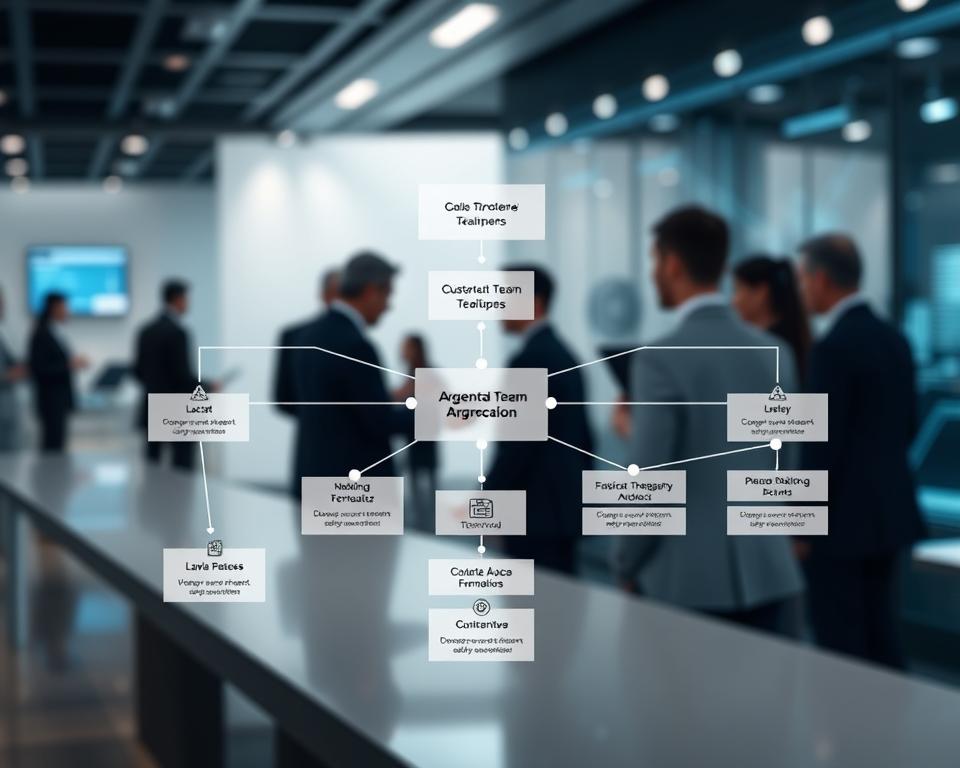
Organizational Structures for Agent Teams
The structure of an agent team greatly affects its teamwork and goal achievement. Different structures have their own benefits for different tasks.
Hierarchical Organizations
In hierarchical organizations, agents are arranged like a tree, with higher agents leading lower ones. This setup is good for tasks needing a clear order, like in the military or big companies.
Flat Peer-to-Peer Networks
Flat peer-to-peer networks let all agents talk directly to each other. This makes the team flexible and quick to adapt. It’s great for tasks that change fast and need quick action.
Market-Based Structures
Market-based structures use economic rules to assign tasks. Agents bid for tasks based on their skills. This method is excellent for changing environments where tasks often shift.
Task Allocation Strategies
How tasks are given out to agents is crucial in multi-agent systems. Good strategies can really boost performance.
- Centralized Allocation: A central controller gives tasks to agents based on their skills and free time.
- Decentralized Allocation: Agents talk to each other to decide who does what, making the team flexible and strong.
Decision-Making Models
Decision-making models help agents make smart choices. These models can use game theory, logic, or probability.
- Game-Theoretic Models: Agents think about what others might do and choose the best option for themselves.
- Logical Models: Agents use rules to figure out the best action based on what they know.
By using these design patterns and methods, developers can make better multi-agent systems.
Development Lifecycle for Multi-Agent AI Platforms
The lifecycle of multi-agent AI platforms is complex. It includes key phases essential for success. Developing these platforms requires a structured approach. This approach covers various stages, from initial requirements engineering to testing and validation.
Requirements Engineering and Agent Identification
Requirements engineering is the base of any successful multi-agent AI platform development. It identifies the roles and responsibilities of each agent. It also looks at their interactions and the system’s goals. Agent identification is key, as it sets the capabilities and limits of each agent.
- Identify system requirements and goals
- Determine the number and types of agents needed
- Define agent interactions and communication protocols
System Modeling and Simulation
System modeling and simulation are vital steps. They let developers create virtual models of the system. This allows them to test hypotheses and predict system behavior. Simulation helps spot issues before actual implementation.
“Simulation is a powerful tool for understanding complex systems and predicting their behavior under different scenarios.”
Implementation Phase Best Practices
During the implementation phase, several best practices are key. These include adopting modular designs and using the right development frameworks. Also, implementing robust testing mechanisms is crucial.
- Adopt modular and scalable architecture
- Utilize suitable programming languages and frameworks
- Implement continuous integration and testing
Testing and Validation Approaches
Testing and validation are vital parts of the development lifecycle. They ensure the multi-agent AI platform works as expected and meets requirements.
Unit Testing for Individual Agents
Unit testing checks if individual agents work correctly. It’s essential for ensuring the system’s reliability.
Integration Testing
Integration testing looks at how agents interact with other system components. It ensures agents work together smoothly to achieve system goals.
System-Level Performance Testing
System-level performance testing checks the platform’s overall performance. It evaluates scalability, robustness, and efficiency under various conditions.

Agent Communication Languages and Protocols
Agent communication languages and protocols are key in multi-agent AI systems. They help agents talk to each other smoothly. This is crucial for them to work together, share info, and reach goals.
FIPA Standards and Specifications
The Foundation for Intelligent Physical Agents (FIPA) has set standards for agent communication. These standards make sure different agent systems can work together. They define how messages are structured and what they mean.
FIPA-compliant agents use a common language like FIPA-ACL. This makes it easy for agents from different makers to talk to each other.

Message Formats and Ontologies
Message formats are important in agent communication. Agents send out messages to share info or make requests. These messages have a type, who sent them, who got them, and what they say.
Ontologies help understand the meaning of messages. They define the concepts and how they relate to each other. This way, agents can correctly interpret messages.
Synchronous and Asynchronous Communication
Agents can talk in two ways: synchronous or asynchronous. Synchronous means the sender waits for a reply. Asynchronous lets agents keep working without waiting for a reply.
Which method to use depends on the system’s needs and the tasks at hand.
Negotiation Protocols and Consensus Building
Negotiation protocols are vital for multi-agent systems. They help agents agree on tasks or decisions. These protocols guide how agents make and respond to proposals.
Consensus is key in negotiation. It means all agents agree on a plan. There are many ways to reach consensus, like voting or auctions, depending on the system’s needs.
Good negotiation protocols and consensus methods help agents work better together. This leads to better performance in multi-agent AI systems.
Industry Applications of Multi-Agent AI Systems
Multi-agent AI systems are used in many areas. They help solve complex problems and make things more efficient. They also help in making better decisions.
Supply Chain Management and Logistics
These systems are changing how we manage supply chains. They make logistics better in many ways.
Inventory Optimization
Businesses use AI to manage their stock better. AI agents look at past data and predict what will be needed. This helps avoid running out of stock or having too much.
Route Planning and Fleet Management
AI helps plan the best routes for delivery. It looks at traffic and road conditions in real-time. This makes deliveries faster and saves fuel.

Financial Services and Trading Systems
In finance, AI is used for trading and security. It helps make trading systems smarter and safer.
Algorithmic Trading Agents
AI trading agents quickly analyze market data. They find trends and make trades faster than humans. They can follow rules or learn from data.
Fraud Detection Networks
AI systems catch and stop fraud. They watch transactions and spot odd patterns. They alert teams to possible threats.
| Industry | Application | Benefits |
|---|---|---|
| Supply Chain | Inventory Optimization | Reduced stockouts, minimized overstocking |
| Financial Services | Algorithmic Trading | Faster execution, adaptive strategies |
| Healthcare | Patient Management | Improved care coordination, personalized treatment |
Healthcare Coordination and Patient Management
AI helps in healthcare by improving how patients are managed. It looks at patient data and makes treatment plans better. It also helps doctors talk to each other.
Smart Manufacturing and Industrial Automation
In smart manufacturing, AI optimizes production. It predicts when things need fixing and improves product quality. It adjusts production based on current data and forecasts.
Energy Grid Management
AI is used in managing energy grids. It optimizes energy distribution and predicts demand. It looks at smart grid data to adjust energy supply, making it more efficient and reliable.
Security and Privacy in Multi-Agent Platforms
As multi-agent AI platforms grow, keeping them secure and private is key. These systems are complex and spread out, making them vulnerable. We must tackle these challenges to avoid breaches and keep users’ trust.
Authentication Mechanisms for Agent Identity
Verifying agent identities is vital in multi-agent systems. Public Key Infrastructure (PKI) uses digital certificates for this. Strong authentication stops unauthorized access and ensures only real agents can interact.
Token-based authentication is another method. Agents get tokens after authenticating, which they use to access resources. This method keeps sensitive info safe.

Secure Communication Channels
Secure communication channels are crucial for agent data exchange. Transport Layer Security (TLS) and Secure Sockets Layer (SSL) encrypt data in transit. This makes data unreadable to anyone who intercepts it.
End-to-end encryption adds more security. It keeps data encrypted from sender to receiver, ensuring privacy.
Data Privacy and Confidentiality Controls
Data privacy and confidentiality are essential in multi-agent systems. Data encryption protects data at rest and in transit. Access controls, like role-based access control (RBAC), limit who can access data, reducing breach risks.
Differential privacy techniques also play a role. They make sure individual data can’t be traced or identified, adding privacy.
Malicious Agent Detection and Prevention
Spotting and stopping malicious agents is crucial. Anomaly detection finds unusual behavior that might mean a malicious agent is present. Once found, affected agents can be isolated or access revoked.
Reputation systems monitor agent behavior. They flag or exclude agents showing suspicious or malicious actions. This boosts the system’s security.
Performance Optimization Strategies
For multi-agent AI platforms, it’s key to optimize performance. As these systems grow, they need to work efficiently. This is a big challenge.
Improving performance covers several areas. These include scalability, load balancing, and making computations efficient. Also, optimizing network traffic is important. Each area helps the system handle more work without losing speed.
Scalability Techniques for Large Agent Populations
Scalability is vital for multi-agent AI platforms. They must handle more agents as they grow. Using distributed computing and cloud-based infrastructure helps them scale up easily.
| Scalability Technique | Description | Benefits |
|---|---|---|
| Distributed Computing | Distributing tasks across multiple computers | Increased processing power, improved fault tolerance |
| Cloud-Based Infrastructure | Utilizing cloud services for on-demand resources | Scalability, cost-effectiveness, flexibility |
Load Balancing and Resource Distribution
Load balancing is crucial to avoid bottlenecks. It ensures tasks are spread out evenly. Techniques like round-robin scheduling and dynamic load balancing help achieve this.
Good load balancing boosts system performance. It prevents any single point of failure. This makes the system more responsive and efficient.
Computational Efficiency Improvements
Improving computational efficiency is key. It involves optimizing algorithms and cutting down on unnecessary work. Techniques like algorithmic optimization and caching are very helpful.
By reducing unnecessary work, these platforms can process information faster. This makes them more efficient and effective.
Network Traffic Optimization
Optimizing network traffic is crucial for reducing latency. It ensures agents can communicate smoothly. Techniques like data compression and traffic shaping help with this.
By optimizing network traffic, the system’s performance improves. It also reduces the load on the network, making it more reliable and efficient.
Overcoming Implementation Challenges
Setting up multi-agent AI platforms is tough. It involves dealing with system complexity, integrating with old systems, and fixing bugs in distributed systems.
Managing System Complexity
It’s key to manage the complexity of multi-agent AI systems well. This means making systems that are easy to update and maintain. Modular design helps by letting developers change parts without messing up the whole system.
Using standard frameworks and protocols helps agents talk and work together better. For example, JADE (Java Agent Development Framework) helps in building these systems.
| Complexity Management Technique | Description | Benefits |
|---|---|---|
| Modular Design | Breaking down the system into smaller, independent modules | Easier maintenance, scalability, and flexibility |
| Standardized Frameworks | Using established frameworks for development | Improved interoperability, reduced development time |
Legacy System Integration Issues
It’s hard to link multi-agent AI with old systems because of tech and architecture differences. Legacy systems often can’t change easily, making it tough to integrate.
Developers can use middleware to connect old systems with new AI platforms. APIs and data adapters help systems talk to each other.
Debugging Distributed Agent Behaviors
Fixing bugs in distributed agent systems is hard because agents act on their own. Distributed debugging needs special tools to watch and understand agent actions across nodes.
Logging and tracing help see how agents behave. This lets developers find and fix problems. Simulation environments are also useful for testing and debugging in a safe space.
Monitoring and Observability Tools
Good monitoring and observability tools are vital for keeping multi-agent AI systems running well. Monitoring tools give real-time info on how the system is doing. This helps operators fix problems fast.
Observability tools offer deeper insights into the system. They help troubleshoot and improve the system. Distributed tracing and log aggregation are key for this.
Best Practices in Multi-Agent Platform Development
Best practices are key in making multi-agent AI platforms. They affect how the platform is built and its quality. By following these practices, developers can make their systems better, faster, and more reliable.
Modular and Reusable Agent Design
Creating agents that are modular and reusable is important. Modular design makes it easier to update and maintain the system. This is because you can change parts without messing up the whole thing.
“The modularity of a system determines its ability to adapt to changing requirements.”
Reusable agents save time and money by being used in many projects. They also help agents share knowledge and skills, making the system smarter.
Comprehensive Documentation Standards
Having detailed documentation is crucial for multi-agent AI platforms. Clear and detailed documentation helps developers understand how agents work together. This makes learning and teamwork easier. It’s important to follow standards for quality and consistency.
Version Control and Configuration Management
Good version control and configuration management are essential. They help manage the complexity of multi-agent systems. Tools like Git are used to track changes and keep the system stable.
Continuous Integration and Deployment
Continuous Integration (CI) and Continuous Deployment (CD) make development smoother. CI checks code for errors before it’s used. CD then puts the code into action, making sure new features are quickly available.
By using these best practices, developers can build strong, adaptable, and scalable multi-agent AI platforms.
Measuring Platform Performance and Business Impact
To check how well multi-agent AI systems work, we need to look at both their technical skills and their business benefits. This two-part approach helps us fully understand what the system can do and how it helps the company.
Technical Performance Metrics
Technical performance metrics are key to seeing how well multi-agent AI platforms run. These metrics include:
Response Time and Latency
Response time is how fast the system answers questions or inputs. Latency is the delay from asking a question to getting an answer. Making these times shorter is crucial for systems that need to work fast.
Throughput and Processing Capacity
Throughput is how much data the system can handle in a set time. Processing capacity is the system’s maximum workload. Both are important for dealing with lots of data.
System Reliability and Uptime
System reliability is how steady the system’s performance is over time. Uptime is how often the system is working and available. Keeping reliability and uptime high is key for constant operation.
| Metric | Description | Importance |
|---|---|---|
| Response Time | Time taken to respond to inputs or queries | High |
| Throughput | Amount of data processed within a given timeframe | High |
| System Uptime | Percentage of time the system is operational | Critical |
Business Value Indicators
Business value indicators show how much money and benefits a multi-agent AI platform brings to a company. Key indicators include:
Return on Investment Calculations
Return on Investment (ROI) compares the money made from the system to its costs. A positive ROI means the system is adding value to the company.
Operational Cost Savings
Operational cost savings are the money saved by using the multi-agent AI platform efficiently. This can include less spending on labor, energy, and other resources.
By looking at both technical performance and business value, companies can fully understand their multi-agent AI platforms. This helps them make smart choices about future investments.
Emerging Trends and Future Directions
The future of multi-agent AI systems is exciting. New trends will shape their development. We can look forward to big changes in how these systems work and are used.
Integration with Large Language Models
Multi-agent AI will get a big boost from large language models (LLMs). LLMs bring advanced natural language skills. This means better communication between humans and agents, and between agents themselves.
Key Benefits:
- Improved communication between agents and humans
- Enhanced decision-making through better information processing
- Increased adaptability in complex environments
Quantum Computing for Multi-Agent Systems
Quantum computing could change multi-agent AI forever. It offers incredible power for complex simulations and fast decision-making. This could make agent behaviors more efficient.
| Aspect | Classical Computing | Quantum Computing |
|---|---|---|
| Processing Power | Limited by transistor size and architecture | Exponential scaling with qubits |
| Simulation Capability | Limited complexity | Highly complex simulations possible |
| Optimization | Sequential processing | Parallel processing capabilities |
Edge Computing and Distributed Intelligence
Edge computing is key for multi-agent AI’s future. It allows for distributed intelligence. This means faster, more accurate decisions by processing data locally.
Ethical AI and Governance Frameworks
As multi-agent AI grows, so does the need for ethical AI and strong governance. It’s vital that these systems are transparent, fair, and align with human values. This ensures their acceptance and success.
Key Considerations:
- Transparency in decision-making processes
- Fairness and bias mitigation
- Accountability and responsibility frameworks
- Privacy and data protection measures
Conclusion
Multi-agent AI platforms are a big step forward in artificial intelligence. They let complex systems work on their own and make decisions together. We’ve looked at how these systems work, the tech behind them, and how they’re used in different fields.
Companies that use multi-agent AI can see big improvements in how they work. They can save money and stay ahead of the competition. But, they need to deal with the challenges of using these systems, like keeping them safe and making them work well with others.
The future of multi-agent AI looks bright with new tech like big language models and quantum computing. Knowing where AI is now and where it’s going helps businesses stay ahead. They can be leaders in this exciting new field.