






Modern retail success depends on understanding shoppers at every touchpoint. A customer data platform unites scattered information into one useful view for your business.
It combines website and mobile app signals with point-of-sale data and loyalty program insights. This creates a complete profile for each person. This guide helps you learn how to build customer data platform infrastructure that can grow.
We examine key areas: strategic architecture, identity resolution, and privacy compliance. You will learn ways to activate data, measure results, and support lasting operations. These skills help your brand create personal experiences that build lasting loyalty.
Table of Contents
Key Takeaways
- Centralize information from both digital and physical retail channels.
- Prioritize identity resolution to create accurate shopper profiles.
- Ensure strict privacy compliance throughout your entire architecture.
- Focus on actionable activation to improve marketing efficiency.
- Implement robust measurement tools to track long-term growth.
Define the Business Goals and CDP Requirements
An effective customer data platform connects technology with better business results. When you learn how to build customer data platform infrastructure, place business value before technology. This focus helps your investment support long-term growth.

Connect the CDP to Revenue and Customer Experience Goals
Your platform should drive measurable success. By linking data collection to revenue targets, you can show the direct impact on the bottom line. This alignment helps stakeholders value better customer experiences across every touchpoint.
For a CDP for e-commerce, teams often track conversion rates and customer lifetime value. Connecting these metrics to your data strategy turns the platform into a revenue driver. This change helps secure continued executive support.
Identify the Teams and Use Cases the Platform Must Support
A successful implementation needs input from the entire organization. Identify which teams will use the data in their daily work. Marketing, analytics, merchandising, and customer service each have different needs.
Store operations can use real-time insights to improve the in-store experience. Document these use cases early so the system solves real-world problems. This teamwork keeps the platform from becoming an isolated project.
Set Requirements for Scalability, Usability, and Integration
Define technical requirements with future growth in mind. CDP scalability matters because data volume will likely grow with your business. The system must handle high traffic during peak retail seasons without losing performance.
Usability matters just as much for internal teams. A complex interface can limit adoption and leave data unused. Also, require seamless integration with your existing tech stack to prevent data silos.
Separate Essential Capabilities from Nice-to-Have Features
Advanced features can distract you from needs during the initial launch. First, focus on core capabilities that solve your biggest business challenges. Add more complex functions after the foundation becomes stable.
Use a simple framework to sort your requirements. Separate features that are mission-critical for day-one operations from those that can wait. This discipline keeps the project on track and within budget.
How to Build Customer Data Platform Strategy
Building the right data infrastructure means balancing technical goals with business needs. When you learn how to build customer data platform capabilities, weigh speed, cost, and long-term control. Each organization has different needs, so choose between a custom solution and a commercial product.
Choose Between Building, Buying, and Extending a CDP
Choosing the right architecture is a major milestone. You can build a custom system, buy a commercial platform, or extend your existing data warehouse. Each option offers different levels of flexibility and maintenance.

| Strategy | Control | Speed | Cost |
|---|---|---|---|
| Build | High | Slow | High |
| Buy | Medium | Fast | Variable |
| Extend | Medium | Medium | Low |
Decide Which Capabilities to Develop In-House
Focus internal engineering efforts on differentiating capabilities instead of commodity features. For example, a proprietary identity resolution engine could give your brand a competitive edge. Established vendors can handle standard data connectors, saving time and reducing technical debt.
Prioritizing internal development helps your team build logic for your unique customer experience. Outsourcing data ingestion frees developers to build high-value activation tools. This hybrid approach often works well for modern retail businesses.
Create a Phased Implementation Plan for E-commerce and Retail
A successful CDP for e-commerce needs a structured, phased approach. Start with a strong foundation before adding complex personalization or real-time marketing. This approach keeps data clean and reliable before customer engagement begins.
Set Milestones for Data, Activation, and Optimization
Your CDP implementation should follow clear milestones for steady progress. First, focus on data collection and unification to create one source of truth. After your data is accurate, connect customer profiles to marketing channels.
Finally, improve performance by testing and refining your audience segments. This process helps you measure success at every stage. Meeting these milestones builds confidence and shows stakeholders clear value.
Map Every Customer Data Source Across the Business
Mapping your data landscape is the first step toward one unified customer view. Before designing ingestion workflows, identify exactly where your retail customer data comes from. This prevents silos and keeps valuable information from being lost during the move to a central platform.

List Digital Data Sources
E-commerce Websites and Mobile Applications
Digital storefronts often drive most behavioral data. Every click, page view, and cart addition offers critical insights into user intent. Accurate capture helps you understand shoppers’ digital journeys.
Search, Advertising, Email, and Social Platforms
Marketing touchpoints create valuable engagement data that teams must capture. Ad clicks, email open rates, and social media interactions show how audiences respond. Connecting these sources shows how channels affect final purchase decisions.
List Retail and Offline Data Sources
Point-of-Sale Systems and In-Store Purchases
Physical stores remain a major source of transaction data. Point-of-sale systems track purchased items, payment methods, and visited store locations. Connecting offline data supports effective customer data integration.
Loyalty Programs, Call Centers, and Store Events
Beyond transactions, loyalty programs and call centers hold useful qualitative data. Customer service logs and event records reveal preferences and possible pain points. These sources add the human context that digital data often misses.
Document Data Owners, Collection Methods, and Update Frequency
After finding your sources, document each source’s technical details. Record who owns the data and how teams collect it to protect accuracy. This process can reveal hidden gaps or needless duplication in current systems.
A clear update schedule also supports successful customer data integration. Mapping these details helps you choose sources based on business value. This plan keeps your retail customer data reliable, timely, and useful across the organization.
Design the CDP Architecture and Technology Stack
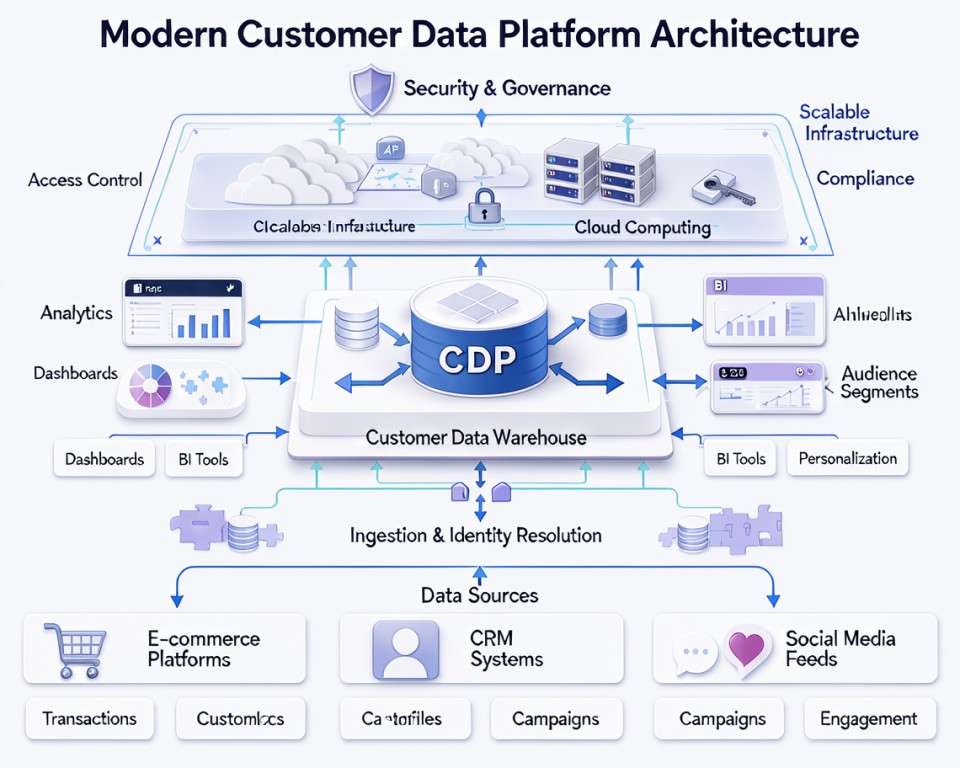
A strong customer data platform architecture balances storage, speed, and activation to create real business value. The right technology stack keeps data accessible, accurate, and ready across marketing channels.
Choose the Core Data Storage and Processing Layer
Data Warehouse, Data Lake, or Lakehouse Options
Modern businesses choose a data warehouse, data lake, or hybrid lakehouse model. A data warehouse stores structured data for reporting, while a data lake handles vast raw, unstructured data. Many organizations prefer the lakehouse architecture, which combines both models for complex analytics and machine learning.
Batch Processing Versus Real-Time Event Streaming
Your choice between batch processing and real-time streaming depends on your specific use cases. Batch processing efficiently handles large data updates that need no immediate action. However, real-time event streaming can trigger personalized messages when a customer interacts with your brand.
Select the Profile, Identity, and Activation Components
The heart of any customer data platform is unifying separate data points into one actionable profile. Choose components that resolve identities and link anonymous visitors with known customers correctly. After unifying profiles, the activation layer must send insights to marketing tools without delay.
Plan APIs, Software Development Kits, and Data Connectors
Seamless connectivity holds your system together. Use robust APIs and SDKs to collect data from websites, mobile apps, and offline retail systems. Well-maintained data connectors keep information moving between storage and end-user applications.
Use Tools Such as Snowflake, Databricks, Segment, and Hightouch Where They Fit
When building your stack, evaluate Snowflake and Databricks for storage and processing. Also consider Segment for data collection and Hightouch for activating data in downstream systems. Always prioritize fit over brand name; the best architecture solves your business challenges instead of following industry trends.
Create a Unified Customer Data Model
Build a strong data foundation with a unified customer data model. Organize retail customer data in a logical structure so every department uses the same language. This model removes silos and creates one trusted source of truth.
Define Customer, Account, Household, and Device Entities
Create a complete picture by sorting data into clear entities. A customer represents one person, while an account may group people under one billing or business entity. Households show shared buying patterns, and devices track engagement across platforms.
Correctly mapping these relationships helps maintain unified customer profiles. Linking a device to a known customer supports smooth experiences on mobile and desktop.

Standardize Profiles, Transactions, Events, and Product Attributes
Standardization supports every effective data strategy. Record each transaction and event in a consistent format across all systems.
Capture First-Party Behavioral and Purchase Data
First-party data is your most valuable asset. Capture direct interactions, such as browsing history and past purchases, to build a rich shopper history. Use this data to predict needs and offer relevant recommendations without third-party cookies.
Represent Consent, Preferences, and Loyalty Status
Respecting customers matters as much as understanding them. Your data model must track consent, communication preferences, and loyalty program tiers. This keeps marketing compliant and personal.
Build a Consistent Taxonomy for Events and Attributes
A messy data environment produces poor insights. Establish a clear taxonomy that defines event names and their attributes.
Use Clear Naming Rules for Events Such as Product Viewed and Order Completed
Clear names, such as Product Viewed and Order Completed, help analysts and marketers read data quickly. Shared terms make it easier to build unified customer profiles and support better decisions. Standard names reduce confusion and help automated systems trigger the right actions at the right time.
| Entity Type | Primary Purpose | Key Data Points |
|---|---|---|
| Customer | Individual identity | Name, Email, ID |
| Transaction | Revenue tracking | Order ID, Total, Date |
| Event | Behavioral insight | Timestamp, Action, URL |
| Preference | Communication control | Opt-in status, Channel |
Implement Identity Resolution and Profile Unification
Building unified customer profiles begins with identity management across digital and physical touchpoints. Effective identity resolution connects fragmented data and links each interaction to the right person. This process creates a seamless experience for customers, wherever they shop.

Combine Deterministic and Probabilistic Matching Methods
High accuracy requires two matching strategies. Deterministic matching uses verified data, such as login credentials, for greater certainty. Probabilistic matching uses statistical models to connect device patterns and behavior.
Combining these methods links anonymous browsing sessions to known customer records. Set confidence thresholds to manage risk. This helps the system merge profiles only when match probability is high enough.
Connect Identifiers Across Anonymous and Known Visitors
Your platform must collect many signals to show the complete customer journey. Mapping these identifiers tracks users from anonymous browsing to authenticated shopping.
Email Addresses, Loyalty IDs, Account IDs, and Phone Numbers
These identifiers provide your most reliable, high-confidence data. When customers log in or provide phone numbers at checkout, you gain a permanent link to historical data. These inputs anchor your identity graph.
Cookies, Mobile Advertising IDs, and Device Identifiers
Digital identifiers track behavior before users identify themselves. These signals are often temporary but remain essential for personalizing early customer experiences. Linking them to a persistent ID maintains continuity across browsers and devices.
Set Rules for Merging, Splitting, and Updating Profiles
Automated logic protects data integrity over time. Define clear rules for incoming information to keep your database clean and useful.
Prevent Duplicate Profiles and Incorrect Household Associations
Duplicate profiles often appear when customers use different email addresses or devices. Use deduplication logic to merge records with shared identifiers. Careful household rules also prevent unrelated people from being grouped through one shared home network.
Test Identity Accuracy Before Activating Audiences
Before sending data to marketing channels, validate your identity resolution logic. Run regular audits to keep your unified customer profiles accurate and free from conflicts. Testing catches errors early, protects your brand reputation, and keeps personalization relevant and trustworthy.
Build Reliable Data Ingestion and Integration Pipelines
Reliable data ingestion powers a successful customer data strategy. To build a unified shopper view, move information smoothly from every business area into one central hub. Effective customer data integration requires careful planning for moving, storing, and checking information.

Connect Transactional, Behavioral, and Operational Systems
Your business uses many tools, and each one captures part of the customer journey. Centralizing these inputs gives you a complete picture of every interaction.
Integrate Shopify, Adobe Commerce, Salesforce Commerce Cloud, and Custom Stores
Modern e-commerce platforms provide key records for purchase history and cart activity. Whether you use Shopify, Adobe Commerce, or Salesforce Commerce Cloud, your data ingestion pipelines must consistently collect orders and product interactions. For custom-built stores, use strong APIs so unique business rules do not interrupt information flow.
Connect Retail Point-of-Sale and Enterprise Resource Planning Systems
Physical stores and back-office systems hold critical data that teams often overlook. Connecting Point-of-Sale (POS) systems links online browsing with in-store purchases. Integrating Enterprise Resource Planning (ERP) software keeps inventory and customer account details accurate across channels.
Choose Batch, Near-Real-Time, and Real-Time Data Flows
Not all data must move at the same speed. Choose a delivery method based on your use case and technical limits.
| Method | Best For | Latency | Complexity |
|---|---|---|---|
| Batch | Historical reporting | High | Low |
| Near-Real-Time | Email triggers | Medium | Moderate |
| Real-Time | Personalization | Low | High |
Manage Schema Changes, Failed Events, and Data Latency
Data environments change often. When a source system updates its schema, flexible pipelines must handle the change without crashing. Automated validation checks can catch errors before they damage downstream profiles.
“Data quality is not a destination, but a continuous process of monitoring and refinement that ensures your business decisions are based on truth.”
Use Monitoring, Retries, Logging, and Alerting to Protect Data Availability
Even the best systems face problems. Setting up automated retries for failed events helps recover lost data without manual work. Detailed logging and alerting helps your team find and fix bottlenecks before they affect customers.
High availability keeps data dependable for marketing and service teams.
Establish Data Quality, Governance, and Ownership
A clear framework helps every team use the same facts. Strong data quality governance is a strategic need, not only a technical task, for modern retail businesses. Clear standards protect your brand and improve the customer experience.
Define Data Quality Rules and Validation Checks
Define rules that every data point must pass to keep your platform healthy. Automated checks stop bad information from entering customer profiles. Validate each record against these criteria as soon as it enters your system.
Check Completeness, Accuracy, Consistency, Timeliness, and Uniqueness
Your validation logic should cover five core pillars. Completeness ensures no critical fields are missing, while accuracy verifies that information reflects reality. Consistency keeps data uniform across systems, timeliness ensures data stays fresh, and uniqueness prevents duplicate records.
| Dimension | Definition | Business Impact |
|---|---|---|
| Completeness | All required fields are populated. | Prevents gaps in customer profiles. |
| Accuracy | Data matches the actual source. | Reduces errors in marketing outreach. |
| Consistency | Values match across all systems. | Ensures a single view of the customer. |
| Timeliness | Data is available when needed. | Enables real-time personalization. |
| Uniqueness | No duplicate entries exist. | Optimizes marketing spend efficiency. |
Assign Ownership for Critical Data Domains
Each piece of data needs a clear owner to stay reliable over time. Assigning data quality governance duties to specific teams creates accountability. For example, the marketing team might own campaign engagement data, while the engineering team manages transactional logs.
Create Governance Policies for Access and Change Management
Clear policies block unauthorized changes and protect sensitive information. Document who may change data structures and how those changes gain approval. This transparent process shows everyone their role in protecting system integrity.
Control Permissions for Marketing, Analytics, Customer Service, and Engineering
Set permissions to match each department’s specific needs. Marketing may need read-only access to audience segments, while analytics needs deeper access to raw data for modeling. Engineering teams should hold the keys to schema changes, so updates do not break downstream integrations.
Build a Data Dictionary and Lineage Documentation
A complete data dictionary serves as the “source of truth” for business definitions. It explains each attribute’s meaning and calculation. Lineage documentation tracks data from its origin to its final destination, helping teams troubleshoot issues and understand dependencies.
Protect Customer Privacy and Meet U.S. Compliance Requirements
Protecting shopper information is a legal duty and a key part of brand trust. When you build systems for personal information, customer data privacy must guide your architecture from the start. Clear practices create a safer experience and encourage lasting loyalty.
Collect Consent and Communication Preferences at the Right Moments
Good data collection starts with clear communication. Capture consent at natural moments, such as account creation or newsletter signup. Use Always provide clear, jargon-free language so customers know exactly what they agree to share.
Support U.S. State Privacy Laws
Following complex U.S. state privacy laws requires proactive data management. Because rules vary by region, your platform must adapt to changing legal standards nationwide.
Address Requirements Under the California Consumer Privacy Act and California Privacy Rights Act
The CCPA and CPRA set a high standard for handling personal information. You must let users access data, request deletion, and opt out of selling or sharing personal information. Keep a detailed inventory of data categories to support compliance.
Prepare for State Laws in Colorado, Connecticut, Virginia, and Other States
Beyond California, Colorado, Connecticut, and Virginia have introduced their own frameworks. These U.S. state privacy laws often require specific disclosures about data processing purposes. Consult legal counsel to keep your policies aligned with the latest regional mandates.
Manage Access, Deletion, Correction, and Opt-Out Requests
Your platform needs a dedicated workflow for handling consumer rights requests efficiently. Automating these processes lowers human error and helps you meet strict response deadlines. Empowering your customers to manage their own data builds strong confidence in your brand.
Minimize Data Exposure Through Security Controls
Security is the final defense for customer data privacy. Implement strong controls so only authorized personnel can access sensitive information.
Use Encryption, Tokenization, Retention Limits, and Role-Based Access
Protecting data at rest and in transit is essential. Use encryption and tokenization to mask sensitive identifiers, and use role-based access to limit exposure. Set clear retention limits, so you keep information only while it serves a legitimate business purpose.
Document Vendor, Data Sharing, and Consent Practices
Keeping a complete record of your data ecosystem is vital. Document every third-party vendor, the data shared, and each user’s consent status. This documentation provides primary audit evidence and supports accountability across your organization.
| Requirement | California (CPRA) | Colorado (CPA) | Virginia (VCDPA) |
|---|---|---|---|
| Right to Access | Yes | Yes | Yes |
| Right to Delete | Yes | Yes | Yes |
| Right to Opt-Out | Yes | Yes | Yes |
| Data Minimization | Required | Required | Required |
Activate Unified Profiles for Marketing and Customer Service
Turning raw data into useful customer interactions is a key goal for modern retail. With unified customer profiles, your business can move beyond generic messages and create relevant experiences. This shift turns static data into growth and loyalty opportunities.
Build Audiences from Behaviors, Purchases, and Customer Value
Effective customer segmentation groups shoppers by their real interactions with your brand. Purchase history and behavior signals reveal patterns that drive revenue. This approach helps your outreach meet each person’s unique needs.
RFM Segments, High-Value Customers, At-Risk Buyers, and New Shoppers
Recency, Frequency, and Monetary (RFM) analysis helps you categorize your audience precisely. High-value customers deserve exclusive rewards, while at-risk buyers may need a personalized win-back campaign. new shoppers benefit from tailored onboarding journeys that introduce your brand values.
Connect the CDP to Activation Channels
Once you define segments, marketing activation must reach every customer touchpoint. A strong platform acts as a central engine and sends real-time data to engagement tools. This keeps your brand voice consistent online and in physical locations.
Email, SMS, Push Notifications, Paid Media, and Website Personalization
Digital channels should reflect the latest insights from your data model. Automated email flows, targeted SMS alerts, and personalized website banners create a smooth shopping experience. Syncing these channels keeps your messages timely and relevant.
Customer Service Platforms and In-Store Associate Tools
Your data also supports human-led interactions. When service agents or store associates access unified customer profiles, they can provide instant, personalized support. This empowers your team to solve problems faster and suggest products that truly match the customer’s history.
Set Audience Refresh and Suppression Rules
Clean data is critical for long-term success. Set clear rules for how often audiences refresh, so campaigns reflect each customer’s current status. Without these safeguards, you may send outdated or irrelevant information.
Prevent Conflicting Messages and Exclude Customers After Conversion
Effective marketing activation needs smart suppression rules to avoid annoying your audience. After a customer purchases, automatically exclude them from acquisition-focused ads. This prevents conflicting messages and keeps your customer segmentation respectful and aligned with the customer’s current journey stage.
Design Personalization Use Cases for E-commerce and Retail
A truly personalized shopping journey needs more than basic data collection. With customer segmentation, businesses can replace generic marketing with value tailored to each shopper.
Personalize Product Discovery and Merchandising
Effective merchandising begins by understanding what each customer wants before searching. Aligning your digital storefront with personal preferences can increase conversion rates.
Recommendations Based on Browsing, Purchase History, and Inventory
Modern e-commerce personalization uses ongoing data loops. By studying viewed and purchased items, you can suggest products in stock at a preferred warehouse or local store.
Coordinate Cart Recovery, Post-Purchase, and Replenishment Journeys
The customer journey continues after checkout. Smart brands use automated triggers to recover abandoned carts or suggest replenishment for consumable goods, such as skincare or pet food.
“Personalization is not a trend; it is the new standard for how brands must interact with their customers to remain relevant in a crowded digital marketplace.”
Deliver Consistent Experiences Across Web, App, Email, and Stores
An omnichannel customer experience helps shoppers feel recognized across every brand interaction. Whether browsing a mobile app or visiting a physical location, customers should have a unified experience.
Use Store Location, Availability, and Fulfillment Preferences
Real-time inventory data lets you offer personalized fulfillment options. If customers prefer “Buy Online, Pick Up In-Store” (BOPIS), your site should highlight products available at their local branch.
Balance Relevance with Frequency and Customer Control
Personalization can be powerful, but it must not feel intrusive. Give customers clear options to manage communication preferences and data usage.
- Respect frequency limits to prevent brand fatigue.
- Provide transparent controls for data privacy.
- Ensure every message adds genuine value to the user.
This balance helps build long-term trust. When customers control their omnichannel customer experience, they are more likely to remain loyal over time.
Measure CDP Performance and Business Impact
Measuring platform success means looking beyond campaign clicks toward data health and business outcomes. Engagement numbers alone can hide data quality problems or integration gaps. Comprehensive CDP metrics show how your technology supports real business growth.
Track Data and Platform Health Metrics
Technical stability supports every successful marketing effort. Unreliable data pipelines can make audience segments inaccurate.
Profile Match Rate, Data Completeness, Event Latency, and Pipeline Reliability
Monitor your profile match rate to ensure anonymous and known visitors link correctly. Track data completeness because missing attributes can create fragmented customer views.
Track event latency so real-time triggers fire when needed. Reliable pipelines prevent data loss during peak shopping seasons.
Measure Marketing and Customer Experience Outcomes
After securing your technical foundation, focus on commercial performance. These indicators show how unified data improves customer interactions.
Conversion Rate, Average Order Value, Retention, and Customer Lifetime Value
conversion rate and average order value provide quick feedback on personalization efforts. Over time, customer lifetime value shows the true worth of your audience segments. Strong retention often means your platform delivers relevant experiences that bring shoppers back.
Compare Audiences with Testing and Control Groups
To prove personalization works, isolate the impact of your campaigns. Using testing and control groups measures the extra lift from data-driven strategies. This method removes guesswork and shows whether targeting changes customer behavior.
Calculate Total Cost, Operational Efficiency, and Return on Investment
Justify the investment by reviewing your platform’s financial health. Calculate the total cost of ownership, including software licenses, cloud infrastructure, and internal engineering hours. Automating manual data tasks can improve operational efficiency and significantly boost return on investment.
Aligning financial figures with performance data builds a strong case for continued innovation and growth.
Launch, Test, and Scale the CDP in Phases
A successful CDP implementation needs a focused rollout. Start with high-impact results instead of broad complexity. This approach helps your team learn the platform while reducing operational risk.
Start with a High-Value Pilot Use Case
Choosing the right pilot matters when you learn how to build a customer data platform for your business. Choose a use case that shows clear value and tests your system’s data skills.
Validate an Abandoned-Cart, Loyalty, or Post-Purchase Journey
These journeys work well because they use clear, useful triggers. Focus on one journey to prove the platform’s value quickly.
- Abandoned-Cart: Recover lost revenue with personalized reminders based on real-time behavior.
- Loyalty Programs: Sync member points and status updates for a seamless experience across devices.
- Post-Purchase: Send product recommendations or replenishment reminders to increase customer lifetime value.
Test Data Collection, Identity Resolution, and Audience Activation
After launching your pilot, verify that data flows remain accurate and reliable. Effective identity resolution links anonymous web visitors to known customer profiles.
Monitor ingestion pipelines to confirm behavioral signals arrive without delay. A working CDP for e-commerce should show audience segments in activation channels within minutes of interaction.
Coordinate User Acceptance Testing Across Business Teams
Testing should not be only an IT task. Include daily users to ensure the platform’s outputs meet their needs.
Confirm That Marketing, Merchandising, Analytics, and Service Workflows Work Together
Ask cross-functional teams whether the data supports their work. Use this checklist to confirm alignment:
- Marketing: Can they trigger personalized campaigns using the new segments?
- Merchandising: Does product data reflect current inventory and trends?
- Analytics: Do dashboards show accurate, unified customer views?
- Service: Can support agents see each customer’s complete interaction history?
Expand to Additional Brands, Regions, Stores, and Channels
After validating your pilot and refining identity resolution, you are ready to scale. Add data sources and activation channels gradually to expand the platform’s impact. This phased approach keeps your CDP implementation stable across brands and global regions.
Operate and Improve the CDP Over Time
Your journey with a customer data platform continues after initial implementation. Treat your data infrastructure as a living product needing regular care and improvement.
Monitor Pipelines, Integrations, Profiles, and Campaign Audiences
Long-term performance depends on active monitoring of your data flows. Audit ingestion pipelines often to keep website, mobile app, and retail data accurate and timely.
Track the health of your audience segments. If an audience shrinks or stops updating, automated alerts can find the cause before it harms marketing ROI.
Review Data Models as Products, Channels, and Regulations Change
Digital change happens quickly, so your data model must evolve with it. When your company launches products or adopts sales channels, expand your taxonomy to capture these interactions.
Global privacy regulations also change often. Review data schemas regularly to meet current legal standards and provide useful team insights.
Maintain Documentation, Training, and Cross-Team Collaboration
A customer data platform works only as well as its users. Maintain a living library that explains data definitions, integration logic, and governance policies.
Regular training helps technical teams and business users work together. Strong collaboration helps everyone use the platform to improve customer experiences.
Give Marketers Self-Service Access Without Sacrificing Governance
Self-service tools help marketing teams and support CDP scalability. When marketers build segments without engineering help, they can respond to market trends faster.
Self-service freedom needs clear guardrails. Role-based access controls and automated checks support autonomy while protecting data quality and privacy.
Use New Signals and Machine Learning Carefully
Machine learning can improve personalization. Use these tools carefully to avoid unintended consequences.
Be transparent about how algorithms process customer information. When a model makes a decision, your team should explain its logic to maintain audience trust.
Improve Next-Best-Action Recommendations Without Creating Biased or Intrusive Experiences
Next-best-action models can boost engagement when used well. To achieve true CDP scalability, make sure recommendations feel helpful, not invasive.
Audit models regularly for bias so they treat all customer segments fairly. Focus on relevance and respect customer preferences to create natural, supportive personalized journeys.
Conclusion
Mastering digital change starts with a clear vision for your data infrastructure. Learning how to build customer data platform capabilities begins by matching business goals with your technical roadmap. Map every data source and build a trusted base to gain the agility needed in modern retail.
Success depends on identity resolution, privacy controls, and real-time activation working together. These tools help your brand create relevant experiences that resonate across every touchpoint. This careful approach turns raw information into useful insights that support growth.
Prioritizing these systems improves operational efficiency and strengthens brand loyalty. Consistent measurement and steady improvements support long-term performance. Investing in these core pillars can raise customer lifetime value through meaningful audience connections.
A unified data strategy requires ongoing refinement. Stay focused on shoppers while adapting to new technology shifts. A strong platform can power future retail innovations and maintain market relevance.